Loading... Please wait...


- Home
- Military Models
- Dornier Do 17Z-5 Aircraft "7T+HH, W.Nr.2787, KGR.606, Lannion, France" (1940) German Luftwaffe "The Aviation Archive" Series 1/72 Diecast Model by Corgi
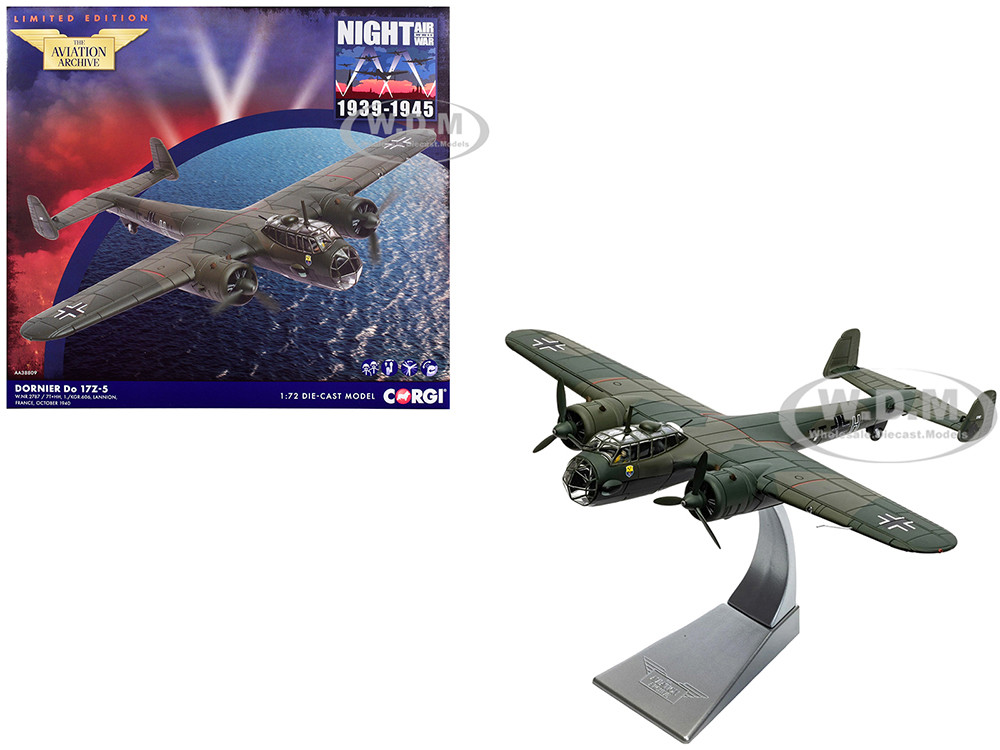


 German Luftwaffe "The Aviation Archive" Series 1/72 Diecast Model by Corgi, $139.99 (https://www.diecastmodelswholesale.com/dornier-do-17z-5-aircraft-7t-hh-w-nr-2787-kgr-606-lannion-france-1940-german-luftwaffe-the-aviation-archive-series-1-72-diecast-model-by-corgi/))
Dornier Do 17Z-5 Aircraft "7T+HH, W.Nr.2787, KGR.606, Lannion, France" (1940) German Luftwaffe "The Aviation Archive" Series 1/72 Diecast Model by Corgi
Product Description
- Brand new 1/72 scale diecast model of Dornier Do 17Z-5 Aircraft "7T+HH, W.Nr.2787, KGR.606, Lannion, France" (1940) German Luftwaffe "The Aviation Archive" Series die cast model by Corgi.
- Limited edition.
- Brand new box.
- Detailed exterior.
- True-to-scale detail.
- Has opening cockpit.
- Includes display stand.
- Officially licensed product.
- Includes pilot figure in cockpit.
- Manufacturer's original unopened packaging.
- Dimensions approximately Length- 8.66, Wingspan- 9.64 inches.
- Diecast metal and plastic construction for durability and a heavy, realistic feel.
- It is a highly detailed and accurate model, perfect for collectors and enthusiasts of military history.
- Realistic panel lines, antennas, access panels, and surface details for an authentic representation of the real-life airplane.
HISTORY ASPECTS:
The Dornier Do 17Z-5 was a specialized night-fighter and reconnaissance variant of the famous Dornier Do 17, an aircraft that earned the nickname "Flying Pencil" due to its slim fuselage design. Developed by Dornier Flugzeugwerke, the Do 17 originally entered service as a fast bomber in the 1930s and became one of the Luftwaffe's principal aircraft during the opening years of World War II. The Z-series featured more powerful Bramo radial engines, increased defensive armament, and improved operational capability. The Z-5 variant was adapted for long-range reconnaissance and night operations, enabling the Luftwaffe to conduct surveillance and interception missions under cover of darkness.
Dornier Do 17Z-5 Werknummer 2787, carrying the code 7T+HH, was operational during October 1940, at the height of the Battle of Britain. During this period, the Luftwaffe was engaged in a sustained air campaign against the United Kingdom, attempting to gain air superiority and weaken British military and industrial capabilities. Aircraft such as 7T+HH were employed in reconnaissance and night-flying roles, gathering intelligence on British defenses, shipping movements, and military installations. As daylight bomber losses mounted during the Battle of Britain, the Luftwaffe increasingly relied on night operations to continue pressure against British targets.
The Do 17 family participated in several major conflicts during World War II. It was heavily involved in the invasions of Poland and France, the Battle of Britain, and subsequent operations across Western and Eastern Europe. Reconnaissance-equipped variants such as the Do 17Z-5 provided valuable intelligence that supported Luftwaffe operations throughout the war. During the Battle of Britain, the aircraft faced determined resistance from RAF fighters and anti-aircraft defenses, leading to significant losses among bomber units. Nevertheless, the Do 17 remained an important component of German air operations during the early years of the conflict.
Although eventually replaced by more advanced aircraft such as the Junkers Ju 88 in many frontline roles, the Dornier Do 17 left a lasting mark on aviation history. Its speed, distinctive appearance, and adaptability allowed it to serve in bombing, reconnaissance, maritime patrol, and night-fighting missions. Aircraft like W.Nr. 2787 represent the evolution of Luftwaffe tactics during one of the most critical air campaigns of World War II and illustrate the increasing importance of reconnaissance and night operations in modern warfare.
This 1:72 scale model faithfully recreates Dornier Do 17Z-5 W.Nr. 2787, coded 7T+HH, as it appeared during October 1940. Featuring authentic Luftwaffe markings, detailed twin-engine construction, and the distinctive profile that earned the Do 17 its "Flying Pencil" nickname, this replica captures an important aircraft from the Battle of Britain era. Perfect for collectors of World War II aviation and Luftwaffe aircraft, it makes an outstanding display piece celebrating one of Germany's most recognizable bombers and reconnaissance aircraft.
Related Products
-
$39.99$35.99 -
$126.99$104.99 -
$94.99$84.99 -
$169.99$149.99 -
$149.99$139.99