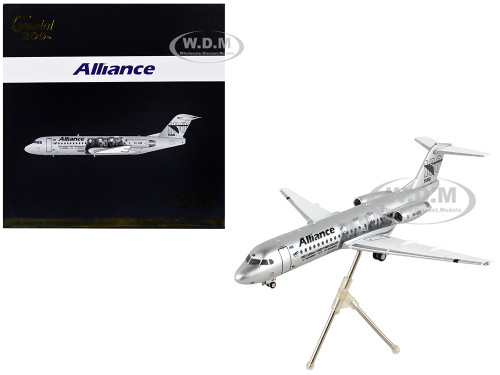
Fokker diecast aircraft models represent more than a century of Dutch aviation history, from Anthony Fokker's pioneering early aircraft to the company's famous World War I fighters and influential passenger aircraft. Fokker became one of the most recognizable names in European aviation, producing aircraft for military, commercial, and specialized roles.
For collectors, the Fokker category offers an opportunity to explore several very different periods of aviation. Depending on the model and manufacturer, shoppers may find historic Fokker biplanes and triplanes, World War I fighters, interwar airliners, reconnaissance aircraft, and later passenger aircraft. Among the best-known subjects are the Fokker Dr.I, Fokker D.VII, Fokker D.XXI, Fokker F.VII, Fokker F.VIIA, Fokker F.10, Fokker F.27 Friendship, and Fokker F28 Fellowship.
The History of Fokker Aviation
Dutch aviation pioneer Anthony Fokker established his aircraft company in the Netherlands during the early 20th century. Fokker became particularly influential during World War I, when his aircraft were used by the German air service. After the war, the company increasingly turned toward civil aviation and became an important supplier of aircraft to airlines in Europe and elsewhere.
The transition from military aircraft to commercial aviation is one of the most interesting aspects of Fokker's history. The company developed aircraft ranging from small single-engine designs to large passenger aircraft, while its engineering philosophy emphasized practical construction, relatively light airframes, and reliable operation.
Today, preserved Fokker aircraft can be found in aviation museums and private collections around the world. The Aviodrome aviation museum in the Netherlands has an especially significant collection of Fokker aircraft, including the Fokker Spin, F.VIIA, and examples and replicas of famous Fokker fighters.
Fokker Dr.I Triplane
The Fokker Dr.I is arguably the most recognizable Fokker aircraft and one of the most famous fighter aircraft of World War I.
The Dr.I was a compact three-wing fighter designed by Reinhold Platz. Its origins can be traced to the Fokker V.4 prototype, and the aircraft entered service during 1917. Its three-wing configuration gave it a distinctive appearance and contributed to its maneuverability and climb performance.
The aircraft is strongly associated with German fighter pilot Manfred von Richthofen, better known as the Red Baron. Richthofen flew several Dr.Is, including red-painted aircraft that contributed to the enduring visual association between the triplane and the famous pilot.
For collectors, the Dr.I offers several interesting subjects within a single aircraft type. Models may differ according to pilot markings, camouflage, unit markings, serial numbers, and whether they represent a historically specific aircraft.
Collecting the Fokker Dr.I
A Dr.I model works particularly well in:
- World War I aircraft collections
- Early military aviation displays
- German aviation collections
- Famous pilot collections
- Historic biplane and triplane displays
- Collections focused on the Red Baron
Its compact dimensions also make the Dr.I practical for collectors who want to display several early aircraft together.
Fokker D.VII
The Fokker D.VII is another landmark in Fokker's aviation history. Designed by Reinhold Platz, the D.VII appeared at the front during the final stages of World War I and became one of the most successful German fighters of the conflict.
The D.VII was selected following a 1918 German fighter competition and subsequently entered large-scale production. Because Fokker's facilities alone could not meet demand, production was also undertaken by other manufacturers, including Albatros and Ostdeutsche Albatros Werke.
Unlike the highly distinctive Dr.I, the D.VII was a more conventional biplane, but its structure and handling characteristics made it an important fighter. The aircraft also had a remarkably long postwar career. D.VIIs continued operating in several countries, including the Netherlands, Finland, Poland, Switzerland, Sweden, Denmark, Belgium, Italy, and the United States.
This international service history makes the D.VII especially interesting for collectors. A model representing a Dutch, German, Finnish, American, or other postwar operator can have a very different collecting significance.
Fokker D.XXI
The Fokker D.XXI was one of the company's most important later fighter designs. Designed by Erich Schatzki, the prototype first flew on March 27, 1936.
The D.XXI was a single-seat fighter with a relatively conventional configuration, featuring a steel-tube fuselage and wooden wings. It was originally developed in response to a requirement associated with the Royal Netherlands East Indies Army, but the type subsequently attracted interest from several air forces.
The Netherlands, Finland, and Denmark all operated the D.XXI, with licensed production taking place in Finland and Denmark. Finnish D.XXIs became particularly well known for their use during the Winter War against the Soviet Union. Dutch D.XXIs also saw combat during the German invasion of the Netherlands in May 1940.
For collectors, the D.XXI provides an excellent opportunity to explore Dutch and Finnish military aviation rather than focusing exclusively on German World War I aircraft.
Fokker F.VII and the Development of Commercial Aviation
Fokker's contribution to civil aviation is just as important as its military history. The Fokker F.VII became one of the company's landmark passenger and mail aircraft during the 1920s.
The F.VII first flew in 1924 and was developed as a single-engine high-wing aircraft. It could carry two pilots and six passengers and became particularly associated with KLM, the Dutch airline. One F.VII, registered H-NACC, completed the famous 1924 flight from Amsterdam to Batavia in the Dutch East Indies, demonstrating the aircraft's suitability for long-distance aviation.
The later F.VIIA incorporated aerodynamic improvements and became an important development in Fokker's growing commercial-aircraft family. The F.VII and F.VIIA are particularly attractive to collectors interested in early airline history, historic KLM aircraft, and the development of European commercial aviation.
Fokker F.VII Collecting Themes
F.VII models can complement collections focused on:
- Early commercial aviation
- KLM history
- Historic European airlines
- Air mail routes
- Dutch aviation
- 1920s and 1930s aircraft
- Early long-distance flights
Operator markings and registrations are particularly important when comparing F.VII models because the same aircraft type served different airlines and roles.
Other Historic Fokker Aircraft
Fokker produced a large number of aircraft designs, and collectors may encounter many different types beyond the Dr.I, D.VII, D.XXI, and F.VII.
The company's D-series fighters included the D.VI, D.VII, D.VIII, and other pre- and post-World War I designs. The Fokker D.VI, for example, was developed from experimental aircraft and briefly served as a fighter and trainer during 1918.
The company also developed reconnaissance and utility aircraft, passenger aircraft, and later airliners. This makes Fokker an especially versatile manufacturer category for collectors who want to represent different periods of aviation rather than concentrating on a single aircraft.
Fokker's Later Passenger Aircraft
Fokker continued its commercial-aircraft legacy well into the second half of the 20th century.
The Fokker F27 Friendship became one of the world's important turboprop regional airliners. Its high-wing configuration, twin turboprop engines, and ability to operate regional routes made it a widely used aircraft.
The later Fokker F28 Fellowship brought Fokker into the regional jet era. Its twin-engine configuration and compact size made it suitable for shorter commercial routes, while later Fokker regional jets continued the company's presence in airline fleets.
These aircraft provide an interesting contrast to the company's World War I fighters. A Fokker Dr.I and Fokker F27 may have little in common visually, but together they demonstrate the extraordinary range of aircraft developed under the Fokker name.
Fokker Diecast Aircraft for Collectors
When choosing a Fokker model aircraft, consider the specific aircraft, variant, operator, and historical period rather than simply the Fokker name.
Important details to compare include:
- Aircraft type – Dr.I, D.VII, D.XXI, F.VII, F.VIIA, F27, F28, or another Fokker design.
- Variant – Different versions may have different engines, wings, equipment, or cabin configurations.
- Operator – Military aircraft may represent Germany, the Netherlands, Finland, Denmark, or another country, while airliners may represent specific airlines.
- Markings and registration – Unit insignia, aircraft codes, airline colors, and registration numbers can make one release significantly different from another.
- Era – World War I, interwar aviation, World War II, postwar aviation, and the jet age each offer distinct collecting themes.
- Scale – Match the model to the other aircraft in your collection.
- Manufacturer – Construction, finish, cockpit detail, landing gear, propellers, and display features can vary between releases.
Fokker Diecast Aircraft Scales
Fokker aircraft models can be found in several scales depending on the aircraft and manufacturer.
1/72 scale is a popular choice for military aircraft collections and works particularly well for compact fighters such as the Dr.I, D.VII, and D.XXI.
1/48 scale provides a larger presentation with additional room for cockpit, surface, landing-gear, and engine detail. It can be an excellent choice for collectors who want a centerpiece representation of a historic Fokker fighter.
1/100 and 1/144 scales are useful for collectors who want to display multiple aircraft while conserving shelf space.
1/200 and 1/400 scales can be especially appropriate for larger Fokker passenger aircraft and airline collections, although exact availability depends on the aircraft and manufacturer.
Always check the individual product specifications for the exact scale, dimensions, materials, and included display features.
Building a Fokker Aircraft Collection
A Fokker collection can follow several themes.
A World War I collection might concentrate on the Dr.I and D.VII, with different pilots, markings, and camouflage schemes.
A Dutch military aviation collection could include the D.VII, D.XXI, and other aircraft operated by the Netherlands.
An early aviation collection could combine the Fokker Spin, F.VII, and F.VIIA to illustrate the transition from pioneering aircraft to practical passenger and mail services.
An airline collection could focus on F.VII, F27 Friendship, and F28 Fellowship aircraft in different airline liveries.
Collectors can also display Fokker aircraft alongside models from other manufacturers to illustrate how aircraft design changed from wood-and-fabric fighters to metal airliners, turboprops, and regional jets.
Shop Fokker Diecast Aircraft Models
From the unmistakable Fokker Dr.I triplane and historic D.VII to the D.XXI, F.VII, and later Fokker passenger aircraft, these models offer collectors an opportunity to explore one of aviation's most recognizable names across multiple generations.
Browse the available Fokker diecast aircraft models at DiecastModelsWholesale.com and find a model that matches your preferred aircraft, era, operator, scale, and aviation collecting interests.