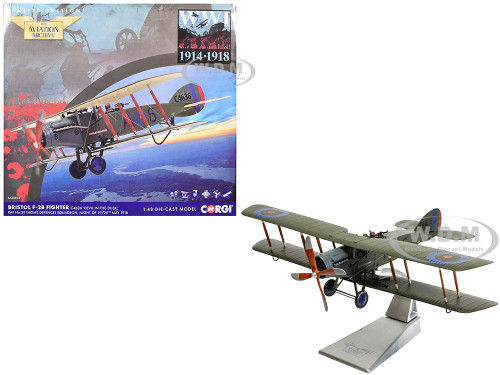
Bristol diecast aircraft models represent more than a century of British aviation design, from pioneering First World War aircraft to important World War II bombers and fighters, postwar transport aircraft, helicopters, and other specialized designs. For aviation collectors, the Bristol name is closely associated with some of Britain's most recognizable aircraft, including the Bristol F.2B Fighter, Blenheim, Beaufort, Beaufighter, Britannia, and Belvedere.
The Bristol category at DiecastModelsWholesale.com is primarily focused on Bristol aircraft models and scale aviation collectibles. Current products can include detailed diecast aircraft as well as model kits, with examples such as the Bristol F.2B Fighter, Bristol Beaufort, Bristol Blenheim, Bristol Superfreighter, and Bristol 192 Belvedere. Availability, manufacturers, and scales vary by product.
The History of Bristol Aircraft
The Bristol Aeroplane Company traces its origins to the British and Colonial Aeroplane Company, established at Filton in 1910. The company quickly became an important British aircraft manufacturer and eventually produced both aircraft and aircraft engines.
One of the company's most important early designers was Frank Barnwell, whose work resulted in several influential Bristol aircraft. His designs helped establish Bristol as a major name in British military aviation before and during the First World War.
The company's aviation legacy continued through the interwar years and into World War II. Bristol aircraft eventually served as fighters, bombers, reconnaissance aircraft, torpedo bombers, transports, trainers, and night fighters.
After World War II, Bristol became an important manufacturer of civil aircraft as well, most notably with the Bristol Freighter and Bristol Britannia. Bristol's later engineering work also contributed to the development of the British and French Concorde program through the company's eventual involvement with the British Aircraft Corporation.
For collectors, this broad history makes Bristol particularly interesting because a single category can encompass aircraft from several very different periods of aviation development.
Bristol F.2B Fighter
The Bristol F.2B Fighter, commonly called the "Brisfit," is one of the most important aircraft in the Bristol collection.
Developed during World War I, the Bristol Fighter was a two-seat biplane intended for reconnaissance and fighter duties. It combined a forward-firing synchronized machine gun with a flexible rear gun operated by the observer.
The aircraft proved to be unusually versatile. Rather than simply acting as a conventional reconnaissance aircraft, Bristol Fighters could engage enemy aircraft and conduct offensive operations. Its strength, speed, maneuverability, and ability to absorb damage helped establish its reputation with Royal Flying Corps and Royal Air Force crews.
More than 5,000 Bristol F.2B Fighters were built, and the type remained in service for years after World War I. Its long career makes the F.2B an especially appealing subject for collectors interested in early military aviation.
The DMW Bristol category includes examples such as the Bristol F-2B Fighter C4636 "Devil-in-the-Dusk" of No. 39 Squadron, represented as a 1/48 scale diecast model.
Bristol Blenheim
The Bristol Blenheim is perhaps the best-known Bristol aircraft of the World War II era.
Its origins were unusual. The Bristol Type 142 was designed as a fast civilian aircraft for newspaper proprietor Lord Rothermere. The aircraft demonstrated exceptional speed for its period, and its performance attracted the attention of the British government. A military development became the Bristol Type 142M, subsequently named the Blenheim.
The Blenheim entered RAF service before World War II and initially possessed a significant speed advantage over many contemporary aircraft. By the beginning of the war, however, fighter development had progressed rapidly, reducing that advantage.
Despite its limitations, the Blenheim performed numerous roles, including light bombing, fighter operations, reconnaissance, and coastal duties. Blenheim night fighters were also equipped with early airborne interception radar, making the aircraft part of the development of Britain's radar-directed night-fighting capability.
The Blenheim was produced in several major versions, including the Mk I, Mk IV, and Mk V, and served with British and Commonwealth forces as well as other operators.
For collectors, Blenheim models are especially relevant to collections focused on the RAF, Battle of Britain, World War II bombing, early radar-equipped fighters, and British military aviation.
Bristol Beaufort
The Bristol Beaufort was a twin-engine torpedo bomber developed from the Blenheim family.
Designed as the Type 152 Beaufort, the aircraft first flew in 1938. It served primarily with RAF Coastal Command and the Royal Navy's Fleet Air Arm, performing maritime strike, torpedo-bombing, conventional bombing, and mine-laying missions.
Beauforts saw combat in European, Mediterranean, and Pacific theaters. The aircraft was particularly important in operations against Axis shipping, while Australian-built Beauforts became an important part of Royal Australian Air Force operations in the Pacific.
The Beaufort is also significant because its design provided the foundation for the Bristol Beaufighter, one of Britain's most successful heavy fighters of World War II.
A Bristol Beaufort is currently represented in the DMW category by a Corgi 1/72 scale Bristol Beaufort Mk Ia in Royal Air Force markings. The model includes a display stand and detailed exterior features.
Bristol Beaufighter
The Bristol Beaufighter evolved from the Beaufort but became a very different aircraft in operational use.
Powered by twin Bristol Hercules radial engines, the Beaufighter was heavily armed and served in multiple roles. It became particularly famous as a night fighter, especially after being equipped with early airborne interception radar.
Beaufighters operated in Europe, the Mediterranean, the Pacific, and other theaters. Their combination of speed, firepower, endurance, and radar equipment made them effective against enemy aircraft and also useful for maritime strike and other missions.
The aircraft is an excellent choice for collectors who want a Bristol model representing the technological transition from conventional bomber and reconnaissance aircraft toward specialized radar-equipped fighters.
Bristol Britannia
Bristol's contribution to aviation did not end with military aircraft.
The Bristol Britannia was a postwar turboprop airliner developed for long-range passenger service. The prototype first flew in 1952, and the Series 300 was developed for transatlantic operations.
The Britannia became known for its combination of speed, comfort, and relatively quiet operation compared with earlier piston-engine airliners. It was operated by airlines including British Overseas Airways Corporation (BOAC) and later found extensive use with independent airlines and cargo operators.
The Royal Air Force also operated Britannias as long-range troop and freight transports.
For collectors, a Bristol Britannia model adds a distinctly different subject to a Bristol aviation collection and illustrates the company's transition from wartime aircraft manufacturing to postwar commercial aviation.
Bristol Helicopters and the Belvedere
Bristol also developed significant rotorcraft designs.
The Bristol 192 Belvedere was a twin-engine tandem-rotor helicopter developed for the Royal Air Force. Its unusual configuration, with one rotor positioned at the front and another at the rear, gives it a distinctive appearance compared with conventional helicopters.
The Belvedere was designed for transport duties and could carry personnel and equipment. It represents an important period in British helicopter development when tandem-rotor designs were being explored for heavy-lift and military transport applications.
The DMW Bristol category includes a 1/72 scale Bristol 192 Belvedere model kit by Airfix, giving collectors and model builders an opportunity to add this unusual British helicopter to their collections.
Bristol Freighter and Superfreighter
Another important Bristol design is the Bristol Type 170 Freighter, developed as a rugged postwar transport aircraft.
The Freighter was designed around practical cargo and vehicle transportation requirements. Its unusual nose-loading arrangement made it possible to load vehicles and freight directly into the aircraft, making the type particularly useful for short-haul cargo and ferry operations.
The later Superfreighter represented an enlarged development of the basic concept. These aircraft were operated by airlines and freight companies in Britain and other countries.
A Bristol Superfreighter model or kit can therefore appeal to collectors interested in commercial aviation, cargo aircraft, historic British airlines, and unusual aircraft designs, rather than exclusively military subjects.
Collecting Bristol Aircraft Models
Bristol aircraft are especially interesting because the category covers such a broad range of aircraft types and historical periods.
Collectors may choose to concentrate on one particular theme:
- World War I aviation – Bristol F.2B Fighter and Bristol M.1
- Interwar RAF aircraft – Bristol Bulldog and other early designs
- World War II – Blenheim, Beaufort, and Beaufighter
- British naval and coastal aviation – Beaufort and related aircraft
- Postwar commercial aviation – Britannia and Freighter
- British helicopter history – Belvedere
- Historic aircraft technology – early monoplanes, radar-equipped fighters, bombers, and turboprop airliners
This makes Bristol a useful category for both focused collections and broader British aviation displays.
Choosing the Right Bristol Scale Model
Scale is an important consideration when purchasing a Bristol aircraft model. Aircraft are commonly represented in scales such as 1/48, 1/72, 1/100, 1/144, 1/200, and 1/400, although the actual scales available depend on the aircraft and manufacturer.
The DMW Bristol category currently includes examples in 1/48 and 1/72, including Corgi diecast aircraft and Airfix model kits.
A 1/48 scale aircraft provides a larger display presence and is particularly suitable for detailed military aircraft subjects such as the Bristol F.2B. 1/72 scale is one of the most practical choices for collectors who want to display several aircraft together while keeping the overall collection manageable.
When comparing models, consider more than scale. The aircraft variant, historical markings, squadron, operator, manufacturer, construction type, and whether the item is a ready-made diecast model or an assembly kit can all make a significant difference.
Why Collect Bristol Diecast Aircraft Models?
Bristol offers an unusually broad historical range for aviation collectors. The F.2B represents the evolution of the fighter during World War I, the Blenheim and Beaufort illustrate the rapid development of military aircraft before and during World War II, the Beaufighter demonstrates the emergence of radar-equipped night fighters, and the Britannia represents Britain's postwar transition to turboprop commercial aviation.
That variety makes Bristol models useful for building a chronological display of British aviation technology. They can also complement collections centered on the Royal Flying Corps, Royal Air Force, British Airways and BOAC history, World War I, World War II, or postwar British aviation.
Browse the Bristol diecast aircraft collection at DiecastModelsWholesale.com to explore available Bristol aircraft models and kits, compare historical aircraft and scales, and find a distinctive addition to your aviation collection.