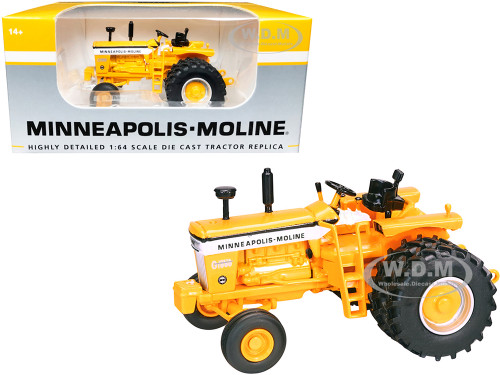
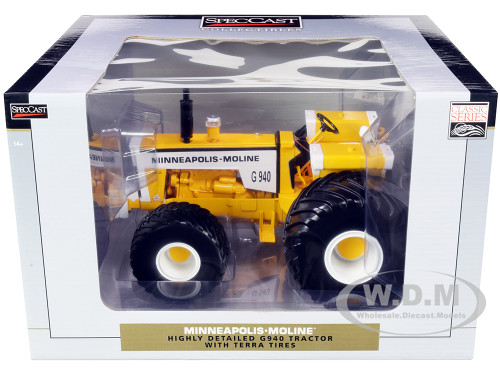
Discover Minneapolis-Moline diecast tractor models celebrating the history of one of America's notable agricultural machinery manufacturers. Recognized for its distinctive yellow and orange tractors, Minneapolis-Moline developed equipment that served American farms throughout much of the 20th century. Today, its vintage tractors remain popular subjects among farm toy collectors, agricultural history enthusiasts, and diecast model collectors.
The Minneapolis-Moline category at Diecast Models Wholesale is for collectors seeking miniature replicas of classic Minneapolis-Moline farm tractors. Depending on current product availability, models may represent familiar tractor families such as the U Series, 4 Star, Jet Star, and G Series, including larger tractors from the brand's later production years.
Available models may come in a range of scales, including 1:12, 1:16, 1:18, 1:24, 1:43, 1:50, and 1:64. These different sizes allow collectors to choose between larger display tractors with prominent detailing and compact miniatures suitable for smaller farm layouts or broader agricultural collections.
Whether you grew up around Minneapolis-Moline equipment, collect vintage farm machinery, or are building a miniature agricultural display, Minneapolis-Moline diecast tractors offer a way to preserve the legacy of classic American farming.
The History of Minneapolis-Moline
Minneapolis-Moline was formed in 1929 through the merger of three established agricultural machinery businesses: Minneapolis Steel and Machinery, the Minneapolis Threshing Machine Company, and the Moline Plow Company. The combined company brought together experience in tractor manufacturing, threshing equipment, plows, and other agricultural machinery.
Based in the American Midwest, Minneapolis-Moline became associated with agricultural equipment designed for the needs of farmers working across different regions and types of farmland. Its tractors were used for a variety of tasks, including field preparation, planting, cultivation, harvesting support, and general farm work.
Over the following decades, the manufacturer developed tractors of different sizes and configurations. Its lineup included smaller general-purpose machines, utility tractors, row-crop models, and larger tractors intended for demanding agricultural work.
One of the brand's distinctive characteristics was its recognizable paint scheme. Many Minneapolis-Moline tractors featured yellow or orange bodywork, frequently combined with contrasting light-colored panels and dark tires. This appearance has become familiar to farm toy collectors and helps distinguish the brand from other historic tractor manufacturers.
In 1963, Minneapolis-Moline was acquired by White Motor Company. The Minneapolis-Moline name continued to appear on tractors for several more years, but White eventually discontinued the brand name in 1974. Although the original marque disappeared from new tractor production, its machinery remains part of American agricultural history.
For diecast collectors, this history creates an opportunity to explore several generations of tractor design, from early utility machines to more powerful tractors developed during the industry's move toward larger farms and more mechanized operations.
Classic Minneapolis-Moline Tractor Models
Minneapolis-Moline produced numerous tractor models and series over its history. Each offers a different perspective on how agricultural machinery evolved in response to changing farm sizes, equipment requirements, and engine technology.
Minneapolis-Moline U Series
The Minneapolis-Moline U Series represents an important part of the company's tractor heritage. The U family included tractors designed for general agricultural work, with variations produced over time to meet different requirements.
The original Model U was introduced in the late 1930s and became a recognizable part of the company's lineup. Related versions, including the UTU and UB, illustrate how the range developed through different production periods.
For collectors, U Series diecast tractors offer traditional styling and a strong connection to mid-century American agriculture. Their exposed operator stations, prominent front grilles, engine detailing, and characteristic body shapes make them appealing subjects for vintage farm displays.
Some model versions may depict narrow-front configurations, while others feature a wider front axle arrangement. These differences can give collectors additional variety when comparing miniature tractors within the same family.
Minneapolis-Moline UDLX Comfortractor
The Minneapolis-Moline UDLX Comfortractor is one of the most unusual tractors associated with the brand. Introduced in the late 1930s, it featured an enclosed cab designed to provide greater operator comfort than the open-station tractors common during that period.
Its cab incorporated amenities such as a heater and radio, making it a distinctive example of early attention to tractor operator comfort. The UDLX combined agricultural capability with features that were unusual for farm machinery of its era.
The Comfortractor is particularly interesting to collectors because its enclosed body and streamlined styling differ substantially from conventional tractors of the time. If a UDLX replica is available, it can be a distinctive addition to a display of early Minneapolis-Moline machinery.
When selecting a model of this tractor, review the precise model identification and cab configuration, since enclosed-cab tractors from the period can be visually different from ordinary open-station farm tractors.
Minneapolis-Moline 4 Star
The Minneapolis-Moline 4 Star was part of the company's lineup of mid-sized agricultural tractors during the late 1950s and early 1960s. It combined practical farm utility with styling characteristic of Minneapolis-Moline equipment from that period.
The 4 Star's proportions and familiar exterior design make it an appealing subject for miniature tractor collectors. Diecast versions may feature details such as the front grille, engine housing, operator seat, steering wheel, exhaust stack, and agricultural tires.
Some replicas represent a narrow-front configuration, giving the miniature a different stance from tractors with a wider front axle. Collectors should examine the particular model description to determine which configuration is represented.
A 4 Star model can fit naturally into a collection of postwar farm machinery or serve as a representative example of Minneapolis-Moline's mid-century tractor lineup.
Minneapolis-Moline Jet Star
The Jet Star series illustrates another stage in the development of Minneapolis-Moline tractors. The Jet Star and its related versions were produced around the late 1950s and 1960s, offering agricultural functionality in a different size and design category from some of the company's larger tractors.
For collectors, Jet Star replicas offer another opportunity to explore variations within the Minneapolis-Moline lineup. Their styling, body proportions, and equipment details can help distinguish them from U Series and later G Series machines.
When comparing Jet Star models, confirm the specific version shown in the product listing. Model designations and external features are useful for identifying the particular tractor represented.
Minneapolis-Moline G Series Tractors
The Minneapolis-Moline G Series is especially interesting to collectors who appreciate larger agricultural tractors. The series included several models produced as tractor technology continued to develop during the 1960s and early 1970s.
These tractors reflected the increasing importance of engine output, capacity, and performance in larger-scale agricultural operations. Their styling often featured more substantial bodywork and prominent engine compartments, creating a different appearance from earlier utility tractors.
Minneapolis-Moline G1000
The G1000 is a notable Minneapolis-Moline tractor from the 1960s. It is associated with the company's larger six-cylinder tractor designs and represents an important period in the development of higher-powered American farm machinery.
The model's size, engine housing, and characteristic Minneapolis-Moline colors make it an attractive subject for diecast replicas. Collectors may encounter versions representing different configurations or finishes, depending on the manufacturer and release.
A G1000 miniature can serve as a centerpiece in a display focused on Minneapolis-Moline tractors or be grouped with comparable farm machinery from other manufacturers.
Minneapolis-Moline G850 and G940
The G850 and G940 belong to Minneapolis-Moline's later tractor lineup. These models are associated with the company's final years under the Minneapolis-Moline name and illustrate the changing approach to tractor production during the 1970s.
Their styling provides a contrast with the older U Series and 4 Star tractors. Depending on the version represented, replicas may feature enclosed cabs, different wheel configurations, or other details associated with later agricultural equipment.
When selecting a G850 or G940 diecast tractor, pay attention to the exact model designation, paint scheme, cab configuration, and scale. These details can help you choose a miniature that fits the era and style of your collection.
Minneapolis-Moline G1355
The G1355 represents the later development of Minneapolis-Moline's larger agricultural tractors. Introduced in the early 1970s, it was among the most powerful tractors associated with the Minneapolis-Moline name.
For collectors, the G1355 is an interesting subject because it represents the brand near the end of its identity as a separate tractor marque. A replica can complement other large tractors in a collection and show how Minneapolis-Moline's designs evolved from earlier models.
The appeal of a G1355 miniature may include its larger proportions, prominent grille, substantial tires, and recognizable paint scheme. Exact features vary by model, so collectors should review the product specifications before purchasing.
Why Collect Minneapolis-Moline Diecast Tractors?
Minneapolis-Moline models appeal to collectors for their historical significance, recognizable styling, and connection to American agriculture.
-
American farming heritage: These tractors represent decades of agricultural machinery development and the mechanization of farm work.
-
Distinctive brand colors: Yellow and orange finishes, often combined with contrasting panels, make many Minneapolis-Moline models visually recognizable.
-
Variety of tractor designs: From traditional U Series tractors to larger G Series machines, the range offers different sizes and configurations.
-
Historical interest: Models can represent different periods in the company's development, including its early history and final years under the Minneapolis-Moline name.
-
Farm display possibilities: Miniature tractors can be displayed individually, grouped by model series, or incorporated into larger agricultural layouts.
-
Collecting across manufacturers: Minneapolis-Moline tractors can complement replicas from other historic farm equipment brands, allowing collectors to compare designs and eras.
Collectors may choose to specialize in Minneapolis-Moline alone or incorporate the brand into a wider farm toy collection. Either approach offers opportunities to explore the details that distinguish one tractor manufacturer from another.
Choosing the Right Minneapolis-Moline Diecast Tractor Scale
Scale determines the size of a miniature relative to the full-size tractor. Choosing the right scale depends on available display space, the type of detail you prefer, and the other models in your collection.
1:12 and 1:16 Scale Tractor Models
Larger scales such as 1:12 and 1:16 provide a substantial display presence. These models can make excellent centerpieces for shelves, cabinets, or dedicated farm toy displays.
The 1:16 scale is especially familiar in agricultural collecting, with many farm toy tractors produced in this size. Larger models may include visible engine details, operator stations, realistic tires, and other features, although the exact features depend on the individual replica.
1:18 and 1:24 Scale Tractor Models
The 1:18 and 1:24 scales offer alternatives for collectors who want a noticeable miniature without using quite as much space as a larger model.
These scales can work well for displaying several tractors from different manufacturers. Compare the listed dimensions and features rather than assuming that all models of the same scale have identical levels of detail.
1:43 and 1:50 Scale Tractor Models
The 1:43 and 1:50 scales suit collectors who prefer a more compact display. Their smaller footprints make it easier to group multiple tractors or incorporate agricultural equipment into a wider miniature scene.
These scales can also be useful when organizing models by manufacturer, model series, or historical period.
1:64 Scale Tractor Models
The 1:64 scale is popular for compact farm toy collections and miniature agricultural layouts. Small Minneapolis-Moline tractors can fit neatly into farm scenes, alongside barns, implements, trailers, trucks, and other agricultural vehicles.
For collectors building a larger miniature farm, the smaller scale provides an efficient way to represent different machines without requiring extensive display space.
Collector tip: Scale does not determine quality by itself. Check the model's dimensions, materials, wheel configuration, paint finish, and included features to determine whether it suits your collection.
What to Look for When Buying Minneapolis-Moline Models
Before purchasing a Minneapolis-Moline diecast tractor, consider the details that matter most to your collecting preferences.
-
Tractor model: Confirm whether the replica represents a U Series, 4 Star, Jet Star, G Series, or another model.
-
Front axle configuration: Narrow-front and wide-front versions can look significantly different.
-
Cab or open station: Determine whether the miniature represents an open operator station or an enclosed cab.
-
Paint and markings: Review the colors, lettering, grille details, and model identification.
-
Scale and dimensions: Make sure the tractor fits your display space and matches the other models in your collection.
-
Construction and features: Materials, steering components, moving parts, and attached implements vary by product.
-
Packaging: Collectors who retain original packaging should check the product information for relevant details.
Not every tractor series, scale, or configuration will necessarily be available at all times. Reviewing individual product descriptions helps confirm the specific model and features offered.
Minneapolis-Moline Models for Collectors and Gifts
Minneapolis-Moline diecast tractors can appeal to farm toy collectors, agricultural history enthusiasts, model builders, and people with personal connections to farming. They can also make thoughtful gifts for someone who remembers using Minneapolis-Moline machinery or has an interest in vintage tractors.
For established collectors, a model from a less-represented series can add variety to an existing display. For new collectors, a recognizable U Series or G Series tractor can be a starting point for exploring the company's history.
A collection organized around Minneapolis-Moline can showcase the development of tractor design over several decades. Alternatively, adding a Minneapolis-Moline model to a broader farm toy collection can help represent the variety of machinery used in American agriculture.
Explore Minneapolis-Moline Diecast Tractor Models
From classic U Series tractors and the unusual UDLX Comfortractor to the 4 Star, Jet Star, and larger G Series models, Minneapolis-Moline represents an important chapter in American farm machinery history.
Browse the Minneapolis-Moline category at Diecast Models Wholesale to compare available tractor replicas, explore different scales and configurations, and find a distinctive miniature to add to your farm toy or diecast collection.



 $29.99