Fairchild Republic represents an important chapter in American military aviation history, particularly through the development of the A-10 Thunderbolt II, one of the most recognizable U.S. Air Force attack aircraft ever produced. Fairchild Republic was the name associated with the Republic Aviation operation after Republic Aviation Corporation became part of Fairchild Hiller in 1965. The company continued Republic's aircraft-development heritage while operating as part of the larger Fairchild organization.
For diecast aircraft collectors, the Fairchild Republic category is especially significant because of the A-10A/C Thunderbolt II, commonly known as the Warthog. The category may also include the Fairchild Republic T-46A, an unsuccessful 1980s U.S. Air Force trainer program that produced a small number of prototype aircraft. These subjects offer collectors an opportunity to explore both a highly successful combat aircraft and a lesser-known experimental military aircraft.
Fairchild Republic and Republic Aviation
The history of Fairchild Republic is closely connected to Republic Aviation, the Long Island, New York aircraft manufacturer known for aircraft such as the P-47 Thunderbolt. Republic became part of Fairchild Hiller in 1965, when Republic Aviation Corporation was reorganized as the Republic Aviation Division, also known as Fairchild Republic. Fairchild Industries later continued the aircraft business before closing its Republic operations in 1987.
This corporate history is useful when shopping for Fairchild Republic models because the name can appear alongside aircraft that have a much longer Republic Aviation lineage. For collectors, Fairchild Republic is therefore best understood as a historical manufacturer and corporate designation rather than simply a modern aircraft brand.
The company's most important aircraft by far was the A-10 Thunderbolt II, but the T-46A also provides an interesting glimpse into a different period of U.S. military aircraft development.
A-10 Thunderbolt II
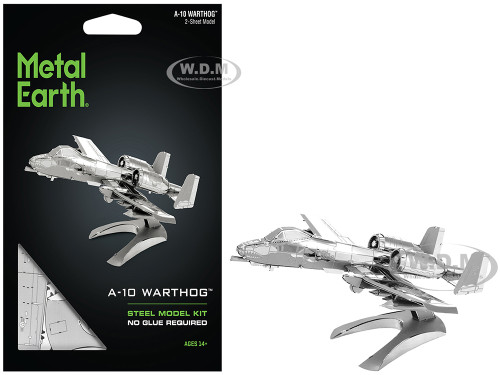
The Fairchild Republic A-10 Thunderbolt II was designed specifically for close air support of ground forces. The U.S. Air Force developed the aircraft to operate at relatively low altitude and low speed while providing accurate weapons delivery, substantial endurance, and a high degree of survivability.
The A-10's unusual appearance reflects its mission. It features straight wings, two engines mounted high and toward the rear of the fuselage, widely separated vertical stabilizers, and a heavily protected cockpit. The aircraft was also designed around the GAU-8/A Avenger 30mm seven-barrel Gatling gun, giving the A-10 one of the most distinctive weapon and airframe combinations in military aviation.
The A-10's official name, Thunderbolt II, connects it to Republic Aviation's famous P-47 Thunderbolt of World War II. The earlier P-47 became particularly well known for ground-attack missions, making the name appropriate for the newer close-air-support aircraft.
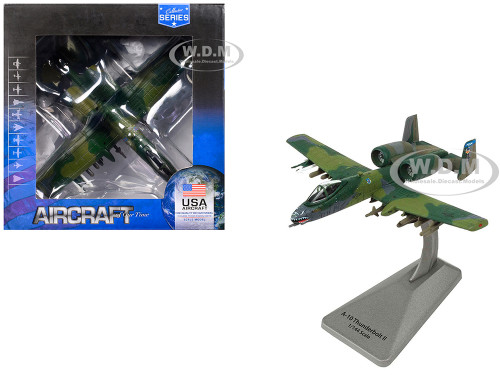
A-10A Thunderbolt II
The A-10A was the original operational version of the Thunderbolt II. The first production aircraft was delivered in 1975, and the A-10 entered operational service in the following year. The aircraft was built around the requirements of close air support, with armor, redundant systems, large weapons capacity, and the ability to operate from relatively austere airfields.
Fairchild Republic ultimately produced 713 A-10 aircraft, with the final production aircraft delivered in 1984.
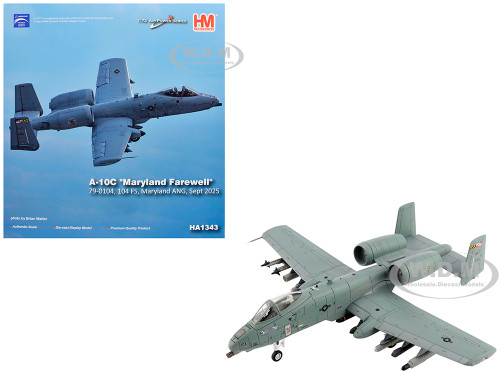
A-10C Thunderbolt II
The later A-10C incorporated significant avionics and weapons-system improvements, transforming the aircraft into a more capable precision-attack platform while retaining the fundamental airframe and mission characteristics of the A-10.
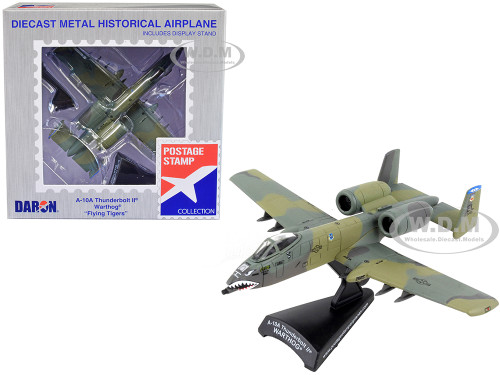
For collectors, A-10A and A-10C models can represent different periods of the aircraft's service history. Details such as cockpit configuration, sensors, weapons, markings, and camouflage can help distinguish different representations.
A-10 Combat History
Although developed during the Cold War to counter armored ground forces, the A-10 did not enter combat until Operation Desert Storm in 1991. It subsequently participated in numerous U.S. and coalition operations, including missions in Iraq, Afghanistan, the Balkans, and elsewhere.
The A-10's Desert Storm service is particularly significant to collectors. Models depicting aircraft from specific units or with Gulf War-era markings can connect a display to an important chapter in modern military aviation.
The aircraft's reputation for durability also became an important part of its identity. Its protected cockpit, redundant systems, and structural design were intended to help it survive the demanding low-altitude environment associated with close air support.
Fairchild Republic T-46A
The T-46A represents a very different side of Fairchild Republic history. During the 1980s, the U.S. Air Force sought a replacement for the Cessna T-37 Tweet primary trainer. Fairchild Republic was selected to develop the T-46A, a twin-engine jet trainer featuring side-by-side seating, a twin-tail configuration, pressurization, and ejection seats.
The T-46A first flew on October 15, 1985, but the program encountered technical, manufacturing, scheduling, and affordability problems. The program was eventually cancelled, making the aircraft an unusual and relatively obscure subject compared with the A-10.
For aviation-history collectors, the T-46A is particularly interesting because only a very small number of aircraft were produced. Its short-lived development makes it a useful subject for collections focused on experimental aircraft, canceled U.S. military programs, or the evolution of American pilot training.
Collecting Fairchild Republic Aircraft Models
A Fairchild Republic diecast aircraft model can appeal to several different types of collectors. The A-10 is an obvious choice for military aviation enthusiasts, Cold War collectors, Gulf War collections, and anyone interested in close-air-support aircraft.
Collectors can organize Fairchild Republic models around several themes:
- A-10A and A-10C variants
- Cold War military aviation
- Desert Storm aircraft
- Modern U.S. Air Force aircraft
- Close air support aircraft
- Aircraft with distinctive squadron markings
- Fairchild Republic experimental aircraft
- T-46A trainer development
- Republic Aviation and Fairchild aircraft history
A particularly interesting display can place the A-10 alongside other U.S. attack aircraft such as the A-1 Skyraider, A-7 Corsair II, and later multirole aircraft. This provides a visual history of how American close-air-support and ground-attack aircraft evolved.
Choosing an A-10 Diecast Model
Because many A-10 models can look similar at first glance, collectors should examine the details of each release before purchasing. Important differences can include:
Aircraft Variant
Check whether the model represents an A-10A, A-10C, prototype, or another configuration. Later aircraft can have different avionics, sensors, and external details.
Unit and Markings
Squadron insignia, tail markings, aircraft numbers, and camouflage can make one A-10 significantly different from another. Collectors interested in a particular conflict or unit should pay close attention to these details.
Weapons Configuration
A-10 models may be represented with different combinations of external stores. The weapons load can help identify the period and mission represented by the model.
Scale
Scale is especially important when building an aircraft collection. 1/72 scale is a common choice for military aircraft displays because it provides a good balance between detail and display size. 1/48 scale produces a substantially larger model for collectors who want more visual presence.
Other scales, including 1/100, 1/144, and 1/200, can be useful for compact displays depending on manufacturer and product availability.
Always check the individual product listing for the exact scale, dimensions, materials, features, and included accessories.
Why Fairchild Republic Is Important to Collectors
Fairchild Republic occupies a relatively short but memorable period in American aircraft manufacturing history. Its legacy is dominated by the A-10 Thunderbolt II, an aircraft whose unusual design was driven by a very specific battlefield mission.
At the same time, the T-46A demonstrates that Fairchild Republic's history was not limited to successful production aircraft. The trainer program illustrates the challenges involved in developing and procuring a new military aircraft, making it an interesting subject for collectors who appreciate less-common aviation designs.
For collectors, these aircraft provide two very different perspectives: the A-10 Thunderbolt II as a successful operational combat aircraft and the T-46A as an experimental trainer that never entered full production.
Whether you are building a collection of U.S. Air Force aircraft, Cold War aviation, combat aircraft, or historically significant American designs, Fairchild Republic models offer distinctive subjects with strong connections to military aviation history.
Browse the Fairchild Republic diecast aircraft models at DiecastModelsWholesale.com to explore available A-10 Thunderbolt II and other Fairchild Republic aircraft models and find the right addition to your aviation collection.

 $59.99


 $54.99


 $44.99
 $49.99