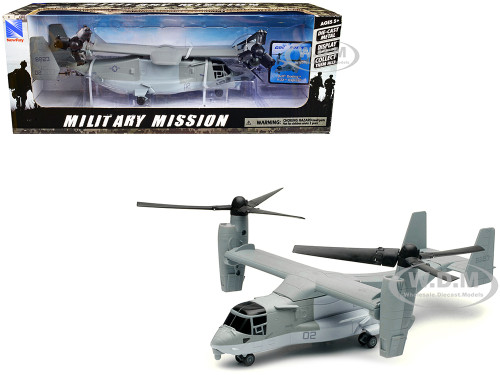
Bell Boeing is best known to aviation collectors for the Bell Boeing V-22 Osprey, one of the most distinctive military aircraft ever developed. Combining the vertical takeoff and landing capability of a helicopter with the speed and range of a turboprop airplane, the V-22 introduced a new category of military aircraft: the tiltrotor. Bell Boeing diecast aircraft models are especially appealing to collectors interested in modern military aviation, U.S. Marine Corps aircraft, special operations aviation, naval aviation, and innovative aircraft design.
The Bell Boeing V-22 Osprey
The V-22 Osprey was developed through a partnership between Bell and Boeing to create an aircraft capable of performing missions that traditionally required either helicopters or fixed-wing transports. Its defining feature is its pair of large engine nacelles mounted at the ends of the wings. The nacelles rotate, allowing the Osprey to take off and land vertically like a helicopter. Once airborne, the nacelles rotate forward so the aircraft can cruise more like a conventional turboprop airplane.
This configuration gives the Osprey a distinctive appearance that is immediately recognizable in a collection of military aircraft models. The aircraft has a relatively compact fuselage compared with traditional transport aircraft, long wings, large rotors, and prominent tilting engine nacelles. These features also make the V-22 particularly interesting as a display model because the aircraft represents a major departure from conventional helicopter and airplane designs.
The first V-22 prototype flew on March 19, 1989. Development continued through an extensive test program before the aircraft entered operational service. Full-rate production was authorized in 2005, followed by the Marine Corps MV-22B reaching initial operating capability in 2007.
From Tiltrotor Experiment to Operational Aircraft
The V-22 was not created in isolation. Bell had spent decades developing and testing vertical-lift and tiltrotor technology. Earlier Bell aircraft such as the XV-3 and XV-15 helped demonstrate the potential of an aircraft that could transition between helicopter-style vertical flight and airplane-style forward flight. The XV-15 in particular became an important technological predecessor to the V-22.
The Bell Boeing program brought this concept into a much larger military aircraft. Boeing's responsibilities included major portions of the fuselage, subsystems, avionics, and fly-by-wire flight-control systems, while Bell's experience with vertical-lift technology played a central role in the aircraft's tiltrotor configuration.
For collectors, this background helps explain why Bell Boeing occupies a unique position in aviation history. The V-22 is not simply another military transport aircraft; it represents the transition of tiltrotor technology from experimental aircraft into operational military aviation.
Major V-22 Variants
Bell Boeing models may represent different versions of the Osprey, and identifying the variant can add another level of interest to collecting.
MV-22B Osprey
The MV-22B is the Marine Corps version and is the variant most closely associated with expeditionary assault support. It was developed to transport personnel, equipment, and supplies while providing considerably greater speed and range than a conventional helicopter.
The MV-22 has become an important part of U.S. Marine Corps aviation and has been used for assault support, resupply, casualty evacuation, humanitarian assistance, and other missions where a combination of vertical access and longer-range transportation is valuable.
CV-22 Osprey
The CV-22 was developed for the U.S. Air Force Special Operations Command. It is optimized for long-range special operations missions, including infiltration, exfiltration, transportation, and resupply.
Its ability to operate from locations without conventional runways makes the CV-22 particularly relevant to special operations aviation. For military aircraft collectors, CV-22 models provide an opportunity to represent a different branch of service and mission profile within an Osprey collection.
CMV-22B Osprey
The CMV-22B is the U.S. Navy variant developed for carrier onboard delivery and logistics missions. It provides a way to move personnel, equipment, and high-priority cargo between shore facilities and aircraft carriers and within carrier strike groups.
The Navy received its first CMV-22B in 2020, giving the Osprey another important role beyond Marine Corps assault support and Air Force special operations.
Japanese V-22
Japan became the first international customer for the V-22. The Japan Ground Self-Defense Force operates the aircraft for missions including transport, amphibious operations, and humanitarian and disaster-relief support. Japanese V-22 models can therefore be especially interesting to collectors who focus on international military aviation or Japanese defense aircraft.
What Makes the Osprey Different?
The most important feature to look for when collecting a Bell Boeing V-22 model is the tiltrotor system. Unlike a conventional helicopter, the V-22 does not rely on a fixed vertical rotor system for all phases of flight. Its two engine nacelles rotate between vertical and forward-facing positions.
The aircraft can therefore:
- Take off and land vertically
- Hover like a helicopter
- Transition into forward airplane flight
- Carry troops, equipment, and cargo
- Operate from ships and expeditionary locations
- Fold its rotors and wings for shipboard storage
The folding arrangement is another particularly recognizable characteristic. The wings and rotors can be configured for compact storage aboard amphibious assault ships and aircraft carriers, making the V-22 an important part of naval and expeditionary aviation.
Bell Boeing Models for Aviation Collectors
A Bell Boeing diecast aircraft model can be an excellent addition to several different types of collections. Some collectors focus specifically on helicopters and rotorcraft, while others collect U.S. military aircraft by service branch, aircraft manufacturer, or historical era. The Osprey fits naturally into all of these themes.
A V-22 model can also complement collections featuring aircraft such as the Bell UH-1 Huey, AH-1 Cobra, CH-47 Chinook, C-130 Hercules, or other military transports and support aircraft. Its unusual configuration makes it visually different from both conventional helicopters and fixed-wing military aircraft.
When comparing models, collectors may want to consider the represented variant, operator markings, squadron or unit markings, color scheme, configuration of the rotors and nacelles, landing gear, antennas, weapons or external equipment, and overall level of molded and painted detail.
Choosing the Right Scale
Scale is particularly important with military aircraft because the full-size V-22 is a relatively large aircraft. A larger scale can provide more room for features such as the rotating nacelles, rotor assemblies, cockpit, landing gear, panel lines, antennas, and service markings.
Common aviation model scales include:
- 1/32 and 1/48 – larger display models with more room for fine details.
- 1/72 – a popular aircraft scale that offers a useful balance between size and detail.
- 1/100 – compact enough for collections containing multiple aircraft while retaining recognizable features.
- 1/144 – well suited to collectors with limited display space or larger fleets of aircraft.
- 1/200 – a popular scale for detailed military and commercial aviation displays.
- 1/400 and 1/500 – particularly useful for compact aviation collections and large multi-aircraft displays.
Availability varies by manufacturer and release, so collectors should check the specific scale and configuration of each Bell Boeing model before purchasing.
Building a Bell Boeing Osprey Collection
Because the V-22 has served multiple military branches and operators, collectors can build a more specialized collection by focusing on different variants. For example, an Osprey display might include an MV-22B representing Marine Corps aviation, a CV-22 representing Air Force special operations, and a CMV-22B representing Navy carrier logistics.
Another approach is to place the V-22 within a broader history of vertical-lift development. A display featuring earlier Bell experimental aircraft or helicopters alongside the Osprey can illustrate how tiltrotor technology evolved from experimental concepts into an operational military capability.
For modern military aviation collectors, the Osprey also provides a useful connection between traditional helicopter collections and contemporary fixed-wing military aircraft. Its unusual design makes it one of the easiest aircraft in a collection to identify.
Shop Bell Boeing Diecast Aircraft Models
Whether you collect modern military aircraft, Bell aircraft, Boeing aircraft, tiltrotors, U.S. Marine Corps aviation, special operations aircraft, or distinctive aviation designs, Bell Boeing models offer a unique subject for your display. Explore the available Bell Boeing diecast aircraft models at DiecastModelsWholesale.com and find the V-22 Osprey scale model that best fits your collection.