Discover Northrop diecast aircraft models inspired by one of America's most innovative aerospace manufacturers. From the distinctive P-61 Black Widow night fighter and F-5 Freedom Fighter to the F-89 Scorpion interceptor, T-38 Talon trainer, and B-2 Spirit stealth bomber, Northrop's aircraft represent important milestones in military aviation and aerospace engineering.
The Northrop category at Diecast Models Wholesale is intended for aircraft enthusiasts, military aviation collectors, and hobbyists looking for miniature replicas of aircraft developed by Northrop and its successor organization, Northrop Grumman. Depending on current product availability, models may include World War II fighters, early Cold War interceptors, supersonic trainers, lightweight combat aircraft, experimental flying wings, and modern stealth aircraft.
Northrop became particularly well known for exploring unconventional aircraft configurations. Its experimental flying-wing designs helped establish a technological legacy that eventually led to the B-2 Spirit. Other Northrop aircraft, including the P-61 Black Widow and F-5 Tiger, became recognizable examples of specialized military aircraft design.
Whether you collect World War II aircraft, Cold War military jets, experimental aviation models, or modern stealth bombers, Northrop diecast aircraft offer a way to explore several generations of American aerospace innovation.
The History of Northrop Aviation
Northrop's history is closely associated with aircraft designer and engineer John Knudsen "Jack" Northrop. Throughout his career, he pursued new approaches to aircraft construction, aerodynamic efficiency, and flying-wing design.
Northrop established an aircraft company in the early 1930s and later founded Northrop Corporation in 1939. The company developed aircraft for military and other aviation applications, earning a reputation for distinctive designs and specialized engineering.
During World War II, Northrop manufactured aircraft including the A-17 attack aircraft and the P-61 Black Widow night fighter. The company also worked on ambitious experimental designs, exploring ways to improve aerodynamic efficiency and aircraft performance.
Following the war, Northrop continued developing military aircraft as jet propulsion transformed aviation. Its products included the F-89 Scorpion interceptor, F-5 Freedom Fighter, and T-38 Talon trainer. These aircraft addressed different requirements, ranging from all-weather interception to international fighter sales and advanced pilot training.
Northrop also continued researching flying-wing aircraft. Experimental projects such as the XB-35 and YB-49 investigated the potential benefits and challenges of aircraft without conventional fuselage-and-tail arrangements. Although these early designs did not enter operational service, their concepts helped establish an important engineering foundation for later flying-wing aircraft.
In 1994, Northrop merged with Grumman, creating Northrop Grumman. The combined company continued developing advanced military aircraft, including the B-2 Spirit stealth bomber.
For collectors, Northrop's history offers a broad selection of aircraft from different periods. A collection can focus on a single aircraft family or showcase the evolution from piston-engine military aircraft to advanced jets and low-observable flying-wing designs.
Northrop P-61 Black Widow Diecast Models
The Northrop P-61 Black Widow was developed during World War II as a dedicated night fighter for the United States Army Air Forces. It was designed to locate and engage enemy aircraft in darkness and poor visibility, using onboard radar and specialized equipment.
The P-61 first flew in 1942 and entered operational service during World War II. Its unusual appearance distinguished it from most contemporary fighters. The aircraft featured twin engines, twin tail booms, a central fuselage, and a large wing, creating a distinctive silhouette.
The Black Widow's mission required more than speed and maneuverability. It also needed to detect targets at night, operate with specialized onboard equipment, and provide its crew with the information required to intercept other aircraft.
P-61A, P-61B, and P-61C
The P-61 family included several production versions. The P-61A was the initial production model, while the P-61B incorporated numerous refinements. The later P-61C featured more powerful engines and performance improvements.
For diecast collectors, these variants offer opportunities to compare aircraft with different external equipment, markings, and operational histories. Their twin-boom configuration makes them especially recognizable when displayed alongside conventional single-engine fighters.
Why Collect the Black Widow?
A Northrop P-61 Black Widow diecast model can be an appealing addition to a World War II aviation collection. Its unusual structure and specialized night-fighting role distinguish it from familiar fighters such as the P-51 Mustang and P-47 Thunderbolt.
Collectors may encounter replicas representing particular squadrons, operational theaters, or aircraft markings. When choosing a model, check the variant, unit identification, camouflage, and other details to understand which aircraft the miniature represents.
The Black Widow is also a useful starting point for a collection focused on specialized military aircraft, including night fighters, reconnaissance aircraft, and early radar-equipped combat platforms.
Northrop F-89 Scorpion Diecast Models
The Northrop F-89 Scorpion was an all-weather jet interceptor developed after World War II. It was designed to defend North American airspace against potential aerial threats, including aircraft approaching in poor weather or at night.
The F-89 first flew in 1948 and entered United States Air Force service in 1950. Its twin-engine configuration, straight wings, and twin vertical stabilizers gave it a distinctive appearance among early Cold War jets.
Unlike fighter aircraft primarily optimized for close-range maneuvering, the Scorpion was designed around the specialized requirements of interception. Radar, onboard weapons systems, and the ability to operate in challenging weather conditions were important aspects of its mission.
F-89D and F-89J
The F-89 family included several variants with different avionics and armament arrangements. The F-89D became a major production version and used rocket armament instead of the earlier cannon-focused configuration.
The F-89J introduced further changes and could carry the AIR-2 Genie unguided air-to-air rocket. This unusual weapon system reflected the interceptor's specialized Cold War role.
For collectors, F-89 replicas provide an interesting way to explore the evolution of air defense aircraft. The Scorpion's large wingtip installations on certain versions and its twin-tail arrangement make it visually different from later swept-wing jets.
When comparing F-89 models, examine the variant designation, wingtip equipment, markings, and represented operational period. These details can significantly change the appearance of the miniature.
Northrop F-5 Freedom Fighter and Tiger II Models
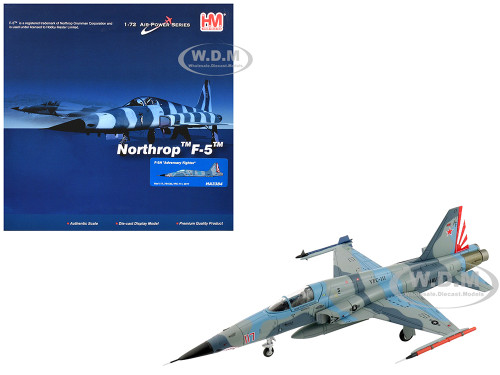
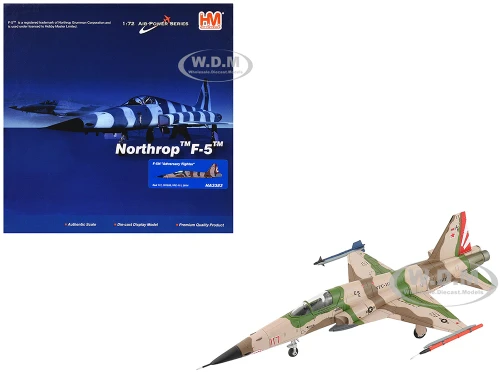
The Northrop F-5 is one of the manufacturer's best-known fighter aircraft families. Developed as a lightweight, comparatively economical supersonic combat aircraft, the F-5 was intended to provide capable performance without the complexity and cost associated with some larger fighters.
The F-5 first flew in 1959, and the subsequent F-5A and F-5B entered service with the designation Freedom Fighter. The later F-5E and F-5F became known as the Tiger II family, incorporating changes to performance, avionics, and other systems.
These aircraft were widely exported and operated by numerous air forces, making the F-5 an important subject for international military aviation collecting.
Northrop F-5A and F-5B Freedom Fighter
The F-5A was a single-seat fighter, while the F-5B was a two-seat version used for training and other duties. Both represented Northrop's approach to creating a relatively compact, agile supersonic aircraft.
F-5A models may feature different national insignia, squadron markings, and camouflage schemes depending on the operator represented. This variety can make the aircraft appealing to collectors interested in international aviation rather than only United States military aircraft.
Northrop F-5E and F-5F Tiger II
The F-5E Tiger II introduced a more capable configuration, including improved engines and other refinements. The two-seat F-5F retained the Tiger II family identity while providing a training configuration.
These later aircraft are recognizable for their compact fuselage, twin-engine layout, small nose intake area, and swept wings. Their appearance makes them useful additions to collections focused on Cold War fighters and export military aircraft.
For collectors, F-5E and F-5F replicas can represent different air forces and periods of service. Confirm the exact variant and operator when choosing a miniature, particularly if historical markings are important to your collection.
F-20 Tigershark
The Northrop F-20 Tigershark was developed as an advanced lightweight fighter based on the F-5 concept. It incorporated a more powerful engine and updated avionics, with the aim of offering improved performance and operational capability.
The F-20 first flew in 1982, but the program did not lead to production orders, and only a small number of prototypes were built. This makes the aircraft an interesting subject for collectors who appreciate experimental and less common designs.
An F-20 Tigershark model can complement F-5 replicas by illustrating a proposed next stage in Northrop's lightweight fighter development.
Northrop T-38 Talon Trainer Models
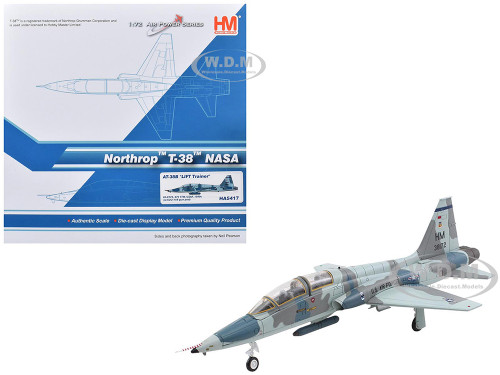
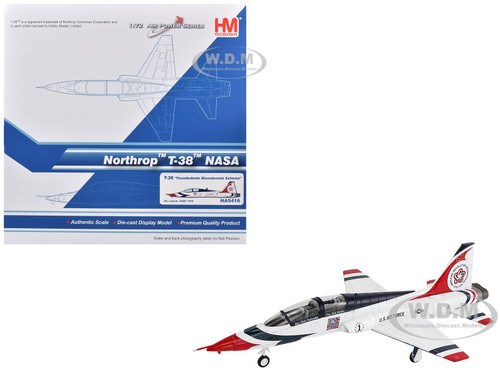
The Northrop T-38 Talon is a twin-engine supersonic jet trainer developed to prepare pilots for high-performance military aircraft. It first flew in 1959 and entered United States Air Force service in 1961.
The T-38's compact design, narrow fuselage, swept wings, and tandem cockpit make it instantly recognizable. It became an important part of advanced military flight training, supporting generations of pilots preparing for more demanding aircraft.
The T-38 also became associated with specialized applications outside conventional military training. NASA has used Talons in support roles involving astronaut training and research aviation.
Collecting T-38 Talon Models
A T-38 diecast model appeals to collectors interested in training aircraft and Cold War jet design. Its relatively slender shape provides a contrast to larger fighters and bombers.
Depending on the specific replica, models may represent United States Air Force training aircraft, specialized units, or NASA-operated aircraft. Different markings and color schemes allow collectors to explore the range of roles performed by the Talon.
Check the aircraft version, operator, paint scheme, and scale when comparing models. These details can help distinguish a standard trainer from an aircraft used in a specialized role.
Northrop Flying-Wing Aircraft: XB-35 and YB-49
Northrop's flying-wing research became one of the most distinctive parts of its engineering legacy. Rather than relying on a conventional fuselage, tail, and separate wing, these designs incorporated much of the aircraft into a broad wing-shaped structure.
The XB-35 was an experimental piston-engine flying-wing bomber developed during World War II. It was designed to investigate the potential of the configuration for long-range missions.
The later YB-49 explored jet propulsion by converting flying-wing airframes to turbojet engines. The YB-49 first flew in 1947, but the program did not progress to operational production.
Why Collect Flying-Wing Models?
The XB-35 and YB-49 are notable because they represent engineering ideas that were unconventional for their era. Their broad, integrated wing structures look very different from traditional aircraft and make them recognizable display subjects.
For collectors, these aircraft offer a glimpse into the experimentation that shaped later aerospace development. They can be displayed alongside conventional bombers to illustrate the different approaches engineers explored during the transition to jet-powered flight.
The experimental nature of these aircraft is important when identifying replicas. Neither the XB-35 nor the YB-49 entered regular operational service, so models generally represent prototypes or experimental aircraft rather than production combat versions.
Northrop B-2 Spirit Stealth Bomber Models
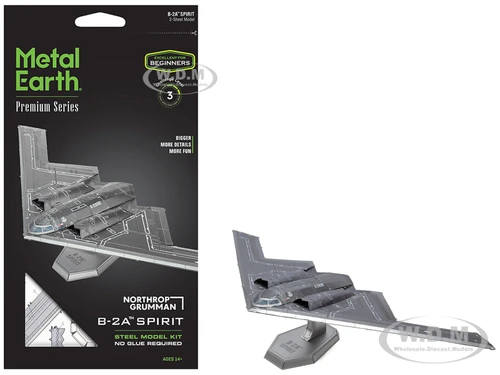
The Northrop Grumman B-2 Spirit represents the modern development of the flying-wing concept. Developed during the Cold War, the B-2 uses a broad flying-wing configuration and low-observable design features to reduce its detectability.
The aircraft first flew in 1989 and entered United States Air Force service in 1997. It was designed for long-range missions and the delivery of conventional or nuclear weapons.
Its distinctive shape, lack of a conventional tail, and carefully integrated surfaces distinguish it from other strategic bombers. The B-2's development also reflects major advances in materials, computer-aided design, aerodynamic analysis, and aircraft systems integration.
B-2 Spirit Diecast Aircraft Models
A Northrop Grumman B-2 Spirit diecast model can serve as a centerpiece in a collection of modern military aircraft. Its broad wing planform creates a display profile quite unlike conventional fighters and bombers.
When choosing a B-2 miniature, check the scale and overall wingspan, since the aircraft is very wide relative to its length. Also consider the finish, landing gear, display stand, and whether the model represents a particular aircraft or unit.
The B-2 is particularly relevant for collectors who want to connect Northrop's early experimental flying-wing projects with the later operational stealth bomber. The relationship between the YB-49 and B-2 illustrates how a long-standing design concept eventually became part of modern military aviation.
Other Notable Northrop Aircraft
Northrop's history includes additional aircraft that offer variety for collectors.
Northrop A-17 Attack Aircraft
The A-17 was a light attack and bomber aircraft developed during the 1930s. It served with the United States Army Air Corps and was also exported to several countries.
Its low-wing configuration and conventional tail make it visually different from Northrop's later night fighters and jets. A model of the A-17 can appeal to collectors interested in prewar military aviation.
Northrop F-5-Derived Aircraft and International Operators
The F-5 family served numerous countries, leading to a wide range of national markings and color schemes. Some operators used the aircraft for training, combat, or specialized roles.
Collectors interested in international aviation may appreciate comparing replicas from different air forces. Even when the underlying aircraft is similar, national insignia and paint schemes can create very different collectible models.
Northrop Grumman B-21 Raider
The B-21 Raider is a newer stealth bomber developed by Northrop Grumman. It continues the company's long involvement in advanced military aircraft and flying-wing design.
As a modern program, the B-21 represents the latest chapter in Northrop's strategic bomber history. Specific model availability depends on manufacturers and licensed product releases, so collectors should verify individual listings rather than assume a particular replica is available.
Why Collect Northrop Diecast Aircraft?
Northrop models offer several distinct collecting opportunities:
-
World War II aviation: The P-61 Black Widow and A-17 represent different specialized aircraft roles.
-
Cold War aircraft: The F-89 Scorpion and F-5 Tiger illustrate advances in interception and lightweight fighter design.
-
Pilot training: The T-38 Talon represents an important stage in military aviation training.
-
Experimental engineering: The XB-35, YB-49, and F-20 Tigershark represent designs that explored alternatives to conventional aircraft.
-
Stealth technology: The B-2 Spirit connects Northrop's flying-wing heritage with modern strategic aviation.
-
International operators: Aircraft such as the F-5 allow collectors to explore different national markings and service histories.
A collection can focus on one type or bring together aircraft from several generations, showing how Northrop's design priorities changed with advances in propulsion, aerodynamics, avionics, and military requirements.
Choosing the Right Northrop Diecast Model
Identify the Aircraft and Variant
Begin by deciding which aircraft interests you most. The P-61 suits World War II collectors, the F-89 and F-5 fit Cold War aviation displays, and the T-38 appeals to fans of military training aircraft. The XB-35, YB-49, and B-2 offer a focused way to explore flying-wing development.
Confirm the full designation and historical configuration in the product description. This is especially important for aircraft with multiple variants or experimental status.
Consider Scale and Display Space
Northrop diecast aircraft may be available in scales such as 1:72, 1:48, and 1:32, depending on the aircraft and manufacturer.
-
1:72 scale: Suitable for compact collections and displays with many aircraft.
-
1:48 scale: Provides a larger display presence while remaining manageable for many shelves.
-
1:32 scale: A larger format that can make an individual aircraft a centerpiece where available.
The right scale depends on the model's dimensions and your display space. Wide aircraft such as the B-2, XB-35, and YB-49 may require considerably more room than a compact fighter or trainer.
Review Finish, Markings, and Features
Check the aircraft variant, unit markings, national insignia, paint scheme, landing gear, and display accessories. Construction materials and included features vary by product.
If historical accuracy matters to your collection, confirm whether the miniature depicts a prototype, production aircraft, training version, or operational combat aircraft.
Explore Northrop Diecast Aircraft Models
From the P-61 Black Widow and F-5 Tiger to the T-38 Talon and B-2 Spirit, Northrop's aircraft history spans experimental designs, military fighters, trainers, and advanced stealth technology.
Browse the Northrop category at Diecast Models Wholesale to explore available aircraft replicas, compare generations and scales, and find a distinctive addition to your aviation collection.






 $34.99