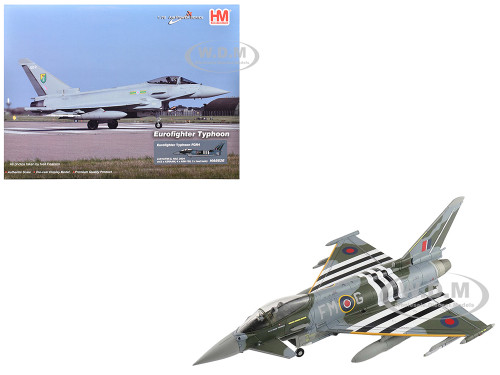
The Eurofighter category features scale models of the Eurofighter Typhoon, a European multirole combat aircraft developed through one of Europe's most significant multinational aerospace programs. Known for its distinctive canard-delta configuration, twin-engine layout, high agility, and multirole capabilities, the Eurofighter Typhoon has become a prominent fighter aircraft in the air forces of Germany, the United Kingdom, Italy, Spain, and several international operators.
For collectors, Eurofighter diecast models provide an opportunity to display a modern European fighter alongside other military aircraft from the Cold War and post-Cold War eras. Depending on the product, models may represent different national air forces, squadron markings, camouflage schemes, registrations, configurations, and stages of the Typhoon's development.
Eurofighter Typhoon History
The origins of the Eurofighter program date to the late 1970s and early 1980s, when several European nations were investigating a new generation of fighter aircraft. Germany, the United Kingdom, Italy, and Spain eventually established the European Fighter Aircraft program, while France pursued a separate design that ultimately became the Dassault Rafale. The four participating nations developed a common aircraft while dividing major production and industrial responsibilities among their aerospace industries.
Development aircraft began flying in the 1990s. The first Eurofighter development aircraft, DA1, made its maiden flight at Manching, Germany, on March 27, 1994. The aircraft subsequently underwent extensive testing as the program progressed toward production-standard aircraft.
The aircraft was eventually named Eurofighter Typhoon, although the name appears as Typhoon in the United Kingdom, Tifone in Italy, and Tifón in Spain. The first operational aircraft entered service in the early 2000s, beginning a long service career with the four partner nations.
A European Multirole Fighter
The Eurofighter Typhoon was originally developed with a strong emphasis on air-to-air combat and agility. Its aerodynamic design incorporates a delta wing and forward canards, while its two engines provide the performance expected from a modern frontline fighter.
As the aircraft matured, its capabilities expanded beyond air-to-air missions. Modern Typhoon versions perform air defense, air policing, reconnaissance, precision strike, and other multirole missions. The Royal Air Force, for example, describes the Typhoon FGR4 as a multirole combat aircraft used for air policing, peacekeeping, Quick Reaction Alert, and high-intensity operations.
This evolution is particularly interesting for collectors because Eurofighter models can represent different configurations and periods of the aircraft's service life. Some models emphasize the fighter's original air-defense role, while others depict later aircraft equipped for expanded strike and multirole operations.
Eurofighter Models from Four Partner Nations
One of the most appealing aspects of collecting Eurofighter Typhoon models is the opportunity to compare aircraft from the four original partner nations.
Royal Air Force Eurofighter Typhoon
British Typhoons are commonly identified by RAF squadron markings and aircraft registrations. The RAF operates the Typhoon FGR4 and uses the aircraft for air defense, Quick Reaction Alert, international exercises, NATO missions, and combat operations. RAF Typhoons first saw combat during Operation Ellamy over Libya in 2011.
German Air Force Eurofighter
German Eurofighters represent an important part of the aircraft's European heritage. Germany was one of the four founding partner nations and continues to operate Typhoon fighters for air defense and other missions.
Italian Air Force Eurofighter
Italian Typhoons are another popular subject for military aircraft collections. Italy was a founding partner in the Eurofighter program and continues to operate the aircraft for national air defense, NATO activities, training, and international air policing.
Spanish Air Force Eurofighter
Spain's Eurofighters provide another distinctive collecting theme, with Spanish markings and national squadron configurations creating a clear contrast with RAF, Luftwaffe, and Italian examples.
Collecting several national versions allows enthusiasts to build a display around the international history of the Eurofighter program rather than focusing on only one air force.
Eurofighter Variants and Configurations
Eurofighter production has progressed through different development and production standards, commonly described in terms of Tranche aircraft. Later aircraft and upgrades introduced improvements in avionics, weapons integration, radar, mission systems, and multirole capabilities.
The exact designation shown on a diecast model can vary according to the aircraft represented. Collectors may encounter descriptions such as Eurofighter Typhoon, EF2000, Typhoon FGR4, or national service designations.
When comparing models, pay attention to the aircraft's:
- Variant or configuration
- National air force
- Squadron markings
- Aircraft registration
- Camouflage or special paint scheme
- Weapons configuration
- Landing gear position
- Included display stand
- Scale and dimensions
These details can make two models of the same basic aircraft significantly different additions to a collection.
Eurofighter Typhoon in Modern Operations
The Typhoon has become an important component of European and NATO air power. Its missions include air policing, air defense, international exercises, and expeditionary operations.
The RAF's Typhoon fleet has participated in operations including Libya, Iraq, and Syria, as well as NATO air-policing missions. The aircraft also regularly operates alongside other allied air forces during multinational exercises.
The aircraft continues to evolve through upgrades to radar, weapons, electronic systems, and other capabilities. Modernization programs include work on advanced radar technology intended to maintain the Typhoon's effectiveness as the aircraft remains in service.
For collectors, this continuing development means the Eurofighter is not simply a historical aircraft. It represents an active chapter in modern military aviation.
Eurofighter Diecast Models and Collecting
Eurofighter diecast models can fit naturally into several different types of aviation collections. Military aircraft enthusiasts may display a Typhoon with other modern fighters such as the F-15, F-16, F/A-18, Rafale, Gripen, or F-35. European aviation collectors may instead focus on aircraft operated by Germany, Italy, Spain, and the United Kingdom.
Another approach is to collect different Eurofighter markings. A British RAF Typhoon, German Luftwaffe Typhoon, Italian Air Force Typhoon, and Spanish Air Force Typhoon can form a compact collection illustrating the multinational nature of the aircraft.
Special markings can also be attractive to collectors. Depending on availability, models may feature squadron insignia, anniversary schemes, display aircraft markings, exercise markings, or other distinctive liveries.
Choosing the Right Scale
1/72 scale is one of the most common scales for detailed Eurofighter models and offers a good balance between aircraft size, detail, and display space. It works particularly well for collectors who want to build a larger modern military aircraft collection.
1/48 scale produces a substantially larger Eurofighter and can be a good choice for collectors who want greater visual presence.
1/144 and 1/200 scales are useful for smaller displays, comparisons with other aircraft, or collectors working with limited shelf space. Availability varies by manufacturer and release.
When shopping for a Eurofighter model, always check the individual product listing for the exact scale, dimensions, construction, included accessories, and configuration.
Building a Modern Fighter Aircraft Collection
A Eurofighter Typhoon can serve as a centerpiece for a collection focused on contemporary military aviation. Collectors can compare its canard-delta design with aircraft from different design philosophies and countries.
The Eurofighter is especially interesting when displayed with other European fighters. A collection featuring Eurofighter Typhoon, Dassault Rafale, Saab Gripen, and earlier European aircraft can illustrate the development of European fighter design from the Cold War period into the modern era.
For a broader military aviation display, the Typhoon can also be paired with American, Russian, and Asian fighter aircraft to compare different approaches to aircraft design, mission requirements, and national aviation history.
What to Look for When Buying a Eurofighter Model
Before purchasing a Eurofighter diecast model, consider the details that matter most to your collection:
- Scale: Make sure the model fits the rest of your aircraft collection.
- Operator: Choose the Royal Air Force, German Air Force, Italian Air Force, Spanish Air Force, or another operator according to your collecting interests.
- Aircraft markings: Registration numbers and squadron markings can distinguish otherwise similar models.
- Configuration: Check whether the aircraft represents an earlier air-defense configuration or a later multirole aircraft.
- Display features: Some models include stands, removable landing gear, or other display options.
- Manufacturer: Different manufacturers can emphasize different levels of detail, materials, and presentation.
- Display space: Larger scales provide greater presence but require considerably more room.
Whether you are collecting modern military aircraft, European aviation history, or specific national air forces, the Eurofighter Typhoon offers a distinctive subject with a strong connection to the development of European aerospace cooperation.
Browse the Eurofighter diecast models available at DiecastModelsWholesale.com to find Typhoon aircraft in different scales, markings, and configurations, and choose a model that fits your aviation collection.