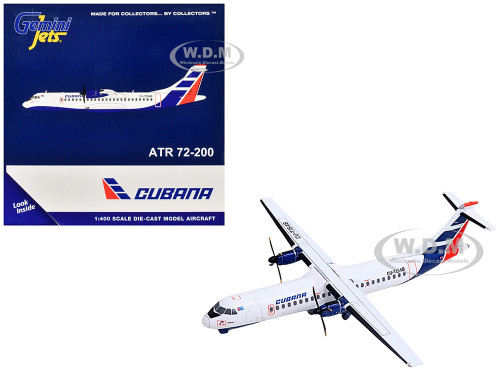
ATR diecast models and scale aircraft bring one of the most recognizable families of modern regional turboprop airliners into collectible form. The ATR name is closely associated with efficient short-haul aviation and the distinctive twin-engine, high-wing aircraft that connect smaller cities, regional airports, islands, and communities around the world.
This category is designed for collectors looking for ATR model aircraft, including the ATR 42 and ATR 72 families, as well as models representing different generations, airlines, operators, and liveries. ATR aircraft are particularly interesting to aviation collectors because the same basic family has been developed over several decades while appearing in the fleets of airlines across many different countries.
The History of ATR
ATR was established in 1981 through a partnership between France's Aérospatiale and Italy's Aeritalia. The name ATR comes from Avions de Transport Régional in French and Aerei da Trasporto Regionale in Italian, reflecting the company's international origins and its focus on regional transportation. The two companies had independently been developing ideas for a modern turboprop regional aircraft before combining their efforts into a single program.
The result was the ATR 42, a twin-engine turboprop designed specifically for regional routes. Its first flight took place in 1984, and the first ATR 42 was delivered to Air Littoral in December 1985. The aircraft was designed around the requirements of short-haul regional aviation, where operating efficiency, access to smaller airports, and appropriate passenger capacity were particularly important.
ATR subsequently developed the larger ATR 72, which was launched in 1986 and first flew in 1988. The first ATR 72 was delivered in 1989. The larger aircraft retained the fundamental design philosophy of the ATR 42 while offering greater passenger and cargo capacity.
For collectors, this makes ATR an interesting manufacturer category because the aircraft can be viewed both individually and as part of a long-running aircraft family.
ATR 42 Diecast Models
The ATR 42 is the smaller member of the modern ATR family and was designed as a regional airliner with seating for roughly 40 passengers depending on configuration.
Its high-mounted wings, twin turboprop engines, T-tail, and compact fuselage give the ATR 42 a distinctive appearance that is easy to recognize in a collection of commercial aircraft.
Several generations of ATR 42 have been produced. The original ATR 42-300 established the family, followed by later improvements including the ATR 42-320, ATR 42-500, and ATR 42-600. The ATR 42-600 represents the current-generation passenger aircraft and incorporates modern avionics and other improvements over earlier versions. ATR identifies the ATR 42-600 as its local-commuter model within the current family.
An ATR 42 model can therefore be collected as an individual aircraft or used to represent the development of regional aviation from the 1980s to today's modern turboprop fleet.
ATR 72 Diecast Models
The ATR 72 is the larger and perhaps more widely recognized member of the family. It was developed from the ATR 42 concept with a longer fuselage and greater passenger capacity.
The aircraft has been produced in several generations, including the ATR 72-200, ATR 72-210, ATR 72-500, and current ATR 72-600. The ATR 72-500 entered the next stage of the aircraft's development in the 1990s, while the ATR 72-600 brought another major modernization with an updated cockpit and other improvements.
The ATR 72 has also appeared in an exceptionally wide variety of airline liveries. That makes it especially attractive to collectors who enjoy collecting aircraft by airline, country, registration, livery, or airport rather than simply by aircraft type.
An ATR 72 model wearing the colors of one airline can look dramatically different from the same aircraft in another operator's livery, even when the underlying aircraft is essentially the same.
ATR 72-600 and Modern Regional Aviation
The ATR 72-600 is the current passenger version of the larger ATR family. It combines the traditional ATR turboprop configuration with modern avionics and updated systems.
ATR currently identifies three members of its aircraft family: the ATR 42-600, ATR 72-600, and ATR 72-600F freighter. The company lists the ATR 42-600 at 22.67 meters in length and the ATR 72-600 at 27.17 meters, illustrating the noticeable difference in size between the two aircraft.
The two passenger aircraft also share many components and systems. Their common design philosophy is part of what makes the ATR family so recognizable and explains why collectors can build a particularly cohesive display using both ATR 42 and ATR 72 models.
ATR Freighter Models
ATR aircraft are not limited to passenger service. The ATR 72-600F is a dedicated regional freighter developed from the ATR 72 platform.
The freighter version is designed specifically for cargo operations, giving collectors another way to explore the ATR family. An ATR 72 freighter model can add an interesting commercial aviation or cargo-aircraft subject to a collection dominated by passenger airliners.
Cargo versions can also be especially appealing when displayed alongside passenger ATR aircraft in different airline liveries, demonstrating how the same basic airframe can serve different roles.
ATR Airline Liveries and Collecting
One of the greatest attractions of ATR diecast models is the variety of operators that have used the aircraft.
ATR aircraft have served airlines in many parts of the world, including regional carriers operating in Europe, North America, Asia, Africa, the Pacific, the Caribbean, and other markets. ATR states that its aircraft have been delivered to operators in more than 100 countries.
This creates several collecting strategies:
Collect by Aircraft Type
A straightforward approach is to collect ATR 42 and ATR 72 models. You can then add different generations to show how the aircraft evolved over time.
Collect by Airline
Another popular approach is to collect the same ATR aircraft in different airline liveries. This works particularly well with the ATR 72 because of its widespread use by regional carriers.
Collect by Country or Region
Collectors interested in aviation around a particular country can use ATR models to represent regional airline operations in that market.
Collect by Era
An ATR collection can begin with early ATR 42 and ATR 72 liveries from the 1980s and 1990s and continue through the ATR 500 and 600 generations.
Collect by Mission
Passenger aircraft, regional cargo aircraft, and specialized configurations can be combined to create a broader collection illustrating the many roles performed by ATR aircraft.
What Makes ATR Aircraft Distinctive?
ATR aircraft are turboprops rather than regional jets. Their high-mounted wings, propeller engines, compact fuselage, and T-tail give them a distinctive silhouette.
The aircraft were specifically designed around the needs of regional aviation. Their high wing allows the engines and propellers to sit well above the ground, while the design is suited to airports and routes where larger aircraft may not be practical. ATR also incorporated composite materials into its aircraft from an early stage, including composite propellers and later carbon-fiber structures.
For aviation enthusiasts, these characteristics make ATR models particularly useful for illustrating the differences between regional turboprops and regional jets in a scale aircraft collection.
Choosing an ATR Scale Model
When buying an ATR diecast model, scale is one of the most important details to check. Aircraft scales can vary considerably, and the physical size of an ATR model depends on both the aircraft type and the scale.
Common aviation scales that collectors may encounter include:
- 1/72: A larger display scale that can provide substantial detail and presence.
- 1/100: A useful middle ground for aircraft collections.
- 1/144: A popular compact aircraft scale, especially useful for displaying multiple airline models.
- 1/200: A compact but detailed scale that works well for commercial-aircraft collections.
- 1/400: Particularly useful for collectors building large airline fleets in limited display space.
- 1/500: Another compact scale suitable for airline and regional-aircraft collections.
The availability of a particular ATR aircraft, generation, airline, and scale varies by model manufacturer and production run, so collectors should check the exact aircraft variant and scale when comparing models.
Building an ATR Aviation Collection
ATR models can work well as the foundation of a dedicated regional-aircraft collection or as part of a much broader airline display.
A collector might pair an ATR 42 with an ATR 72 to show the difference in aircraft size, then add several airline liveries to demonstrate the international reach of the aircraft family. Another approach is to place ATR aircraft alongside regional jets and larger narrow-body airliners, creating a chronological or operational display of commercial aviation.
ATR models are also well suited to airport and regional-airline dioramas. Their relatively compact size makes them practical for scenes representing regional terminals, island airports, short-haul routes, and smaller aviation facilities.
For airline collectors, the livery can be just as important as the aircraft itself. Details such as the airline logo, tail design, registration, engine markings, and color scheme can turn two otherwise similar ATR models into distinctly different collectibles.
Whether your interest is regional aviation, airline history, turboprop aircraft, airport displays, or collecting specific airline liveries, ATR offers a distinctive subject with a history spanning more than four decades.
Browse the ATR diecast models and scale aircraft available at DiecastModelsWholesale.com to find ATR 42, ATR 72, and other regional aviation collectibles for your collection or display.