Gloster diecast aircraft models are ideal for collectors interested in British aviation history, Royal Air Force aircraft, early jet fighters, and the development of military aviation from the First World War through the Cold War. The Gloster Aircraft Company produced some of Britain's most recognizable fighters, including the Gladiator, Meteor, and Javelin, making Gloster an especially interesting subject for aviation model collections.
Depending on the product, the Gloster category may include detailed scale models representing classic propeller-driven fighters, pioneering jet aircraft, and later Cold War interceptors. These models can be displayed individually or combined with other British aircraft, RAF squadron models, and historically significant aviation subjects.
The History of Gloster Aircraft
The company that became Gloster Aircraft Company was established in 1917 as the Gloucestershire Aircraft Company. Based in Gloucestershire, England, it initially manufactured aircraft and components for other companies during the First World War. The company later developed its own aircraft designs and became an important British aircraft manufacturer.
In 1926, the company adopted the shorter name Gloster Aircraft Company, partly because the original "Gloucestershire" name was difficult for international customers to pronounce. Gloster subsequently became associated with a series of successful British fighter designs and was acquired by Hawker Aircraft in 1934 while continuing to operate under the Gloster name.
Gloster's importance grew substantially during the transition from piston-powered aircraft to jet propulsion. The company became closely associated with the pioneering work of Sir Frank Whittle and the development of Britain's first operational jet fighter, the Gloster Meteor.
Gloster eventually merged with Armstrong Whitworth in 1961, becoming Whitworth Gloster Aircraft. In 1963, the business became part of Hawker Siddeley's Avro Whitworth Division, bringing the independent Gloster name to an end.
Gloster Gladiator
The Gloster Gladiator is one of the most recognizable aircraft in the Gloster lineup and an important subject for World War II aviation collectors.
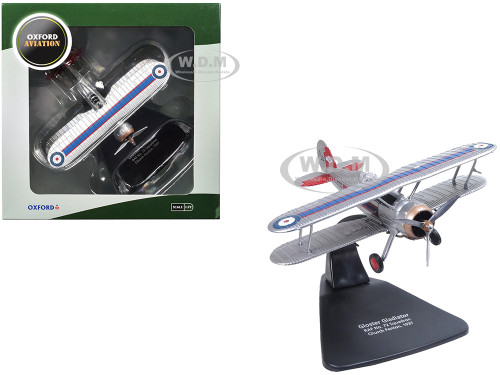
Introduced into RAF service in the late 1930s, the Gladiator was the RAF's last biplane fighter and featured an enclosed cockpit. By the time World War II began, newer monoplane fighters such as the Hurricane and Spitfire were already changing aerial combat, but the Gladiator nevertheless saw extensive service during the early years of the war.
Gladiators operated in several important theaters, including Norway, France, Greece, North Africa, and the defense of Malta. Its service history makes it particularly appealing to collectors interested in early-war RAF aviation and Fleet Air Arm operations.
Gladiator Models for Collectors
When selecting a Gloster Gladiator model, collectors may want to compare:
- Gladiator Mk I and Mk II variants
- RAF squadron markings
- Fleet Air Arm aircraft
- Aircraft associated with the defense of Malta
- Norwegian, Greek, and North African operations
- Different camouflage and national markings
- 1/72, 1/48, 1/100, and other available scales
The Gladiator also makes an excellent companion to other early-war British aircraft models, including Hurricanes, Spitfires, Blenheims, and other RAF subjects.
Gloster E.28/39 and the Beginning of British Jet Aviation
The Gloster E.28/39 occupies a special place in aviation history. Developed around Frank Whittle's turbojet engine, the experimental aircraft made its first flight on May 15, 1941, marking a major step forward in British jet aviation.
Although the E.28/39 was an experimental aircraft rather than a production fighter, its development helped demonstrate the potential of jet propulsion and led toward the Gloster Meteor.
For aviation collectors, an E.28/39 model represents an important technological milestone and provides historical context for the jet aircraft that followed.
Gloster Meteor
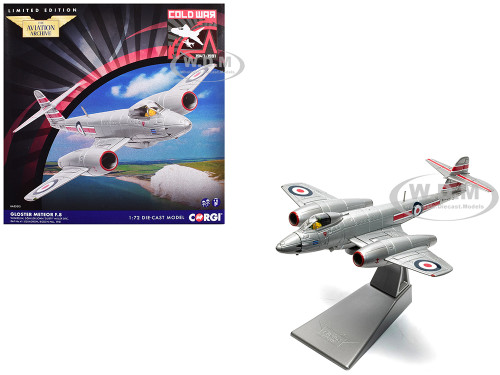
The Gloster Meteor is arguably the most historically significant Gloster aircraft. It became the first Allied jet fighter to enter operational service during World War II, with the RAF receiving its first operational Meteors in July 1944.
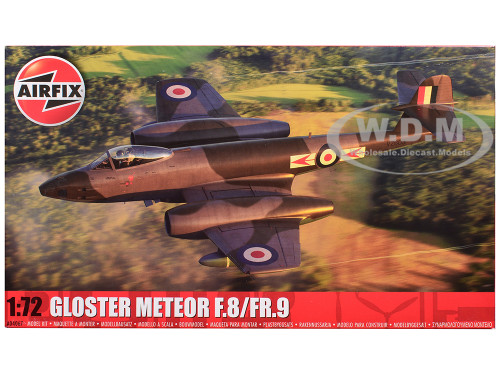
The Meteor evolved considerably after the war. Different variants served in fighter, night-fighter, reconnaissance, training, and other roles. The Meteor F.8 became one of the most important postwar versions and formed a major part of Britain's fighter defense during the early 1950s.
The aircraft also gained international significance. Meteor variants served with air forces outside Britain, including Australia, where Meteor F.8 aircraft saw combat during the Korean War.
Collecting Gloster Meteor Models
The Meteor provides numerous possibilities for collectors because of its long service history and variety of versions. Depending on the model available, collectors may encounter:
- Meteor F.3
- Meteor F.4
- Meteor F.8
- Meteor F.9
- Meteor night-fighter variants
- Trainer and two-seat versions
- RAF squadron aircraft
- Royal Australian Air Force aircraft
- Different postwar camouflage schemes
A Meteor model can be especially effective as part of a display showing the transition from World War II piston fighters to the first generation of operational jet aircraft.
Gloster Javelin
The Gloster Javelin represents the next major stage in the company's development. Designed as an all-weather interceptor, the Javelin featured a distinctive delta-wing configuration and twin-engine layout.
The first prototype flew in 1951, while the first production version, the FAW Mk 1, followed in the mid-1950s. The Javelin was designed to intercept high-altitude targets and incorporated radar and other equipment for all-weather operations.
Later versions received improved engines, radar systems, and other modifications. Javelins served with RAF squadrons in Britain and overseas, remaining in RAF service until 1968.
Gloster Javelin Models
The Javelin is particularly attractive to collectors who specialize in Cold War military aviation. Its unusual delta-wing shape makes it visually distinct from earlier Gloster aircraft and from more conventional swept-wing fighters of the same period.
Collectors may wish to compare models by:
- FAW variant
- RAF squadron
- Aircraft markings
- Camouflage scheme
- Cold War period
- Scale and display size
A Javelin model pairs naturally with other early British jet and Cold War aircraft, creating a chronological display of RAF fighter development.
Other Gloster Aircraft
Although the Gladiator, Meteor, and Javelin are the best-known Gloster aircraft for collectors, the company produced and worked on a broader range of aircraft.
Earlier Gloster designs included aircraft such as the Gamecock, Gauntlet, and Grebe, reflecting the company's important role in British interwar fighter development. Gloster also produced aircraft for other manufacturers during World War II, including Hawker Hurricanes and Typhoons.
This production history is important because Gloster was not simply a manufacturer of a few famous aircraft. It was deeply involved in Britain's aviation industry during periods of rapid technological change.
Building a Gloster Aircraft Collection
A Gloster collection can be organized in several ways. Some collectors concentrate on a single aircraft, such as the Meteor, while others prefer to show the progression of Gloster aircraft over several decades.
A chronological collection could include:
- Interwar Gloster fighters such as the Gamecock or Gauntlet
- Gloster Gladiator representing the final generation of RAF biplane fighters
- Gloster E.28/39 representing early British jet experimentation
- Gloster Meteor representing the first generation of operational British jets
- Gloster Javelin representing the Cold War all-weather interceptor era
This approach creates a compact visual history of how fighter aircraft developed from biplanes to advanced jet-powered interceptors.
Another option is to collect by operator or historical event. RAF squadron markings, aircraft based in specific locations, and aircraft associated with major conflicts can add another layer of interest to an aviation collection.
Choosing the Right Scale
Aircraft models are available in a variety of scales, and the appropriate choice depends on the aircraft type, available display space, and the rest of your collection.
1/72 scale is a popular choice for military aircraft collections because it offers a practical balance between detail and display space.
1/48 scale provides larger models with more room for surface detail and markings, making it attractive for collectors who want a more substantial aircraft display.
1/100 and 1/144 scales are useful for compact collections, while other scales may be available depending on the specific Gloster model.
Because aircraft dimensions vary considerably, always check the individual product specifications for the confirmed scale, dimensions, materials, and features.
Gloster Models for British Aviation Collectors
Gloster aircraft provide an excellent way to explore several important periods of aviation history. The Gladiator represents the final era of British biplane fighters, the E.28/39 marks the beginning of British jet experimentation, the Meteor represents the arrival of operational jet fighters, and the Javelin demonstrates the development of specialized Cold War interceptors.
Whether you collect RAF aircraft, World War II fighters, early jets, Cold War aircraft, or British aviation manufacturers, Gloster diecast aircraft models can add historically significant subjects to your display.
Browse the Gloster diecast aircraft models available at DiecastModelsWholesale.com to find aircraft that match your preferred era, scale, markings, and collecting interests.