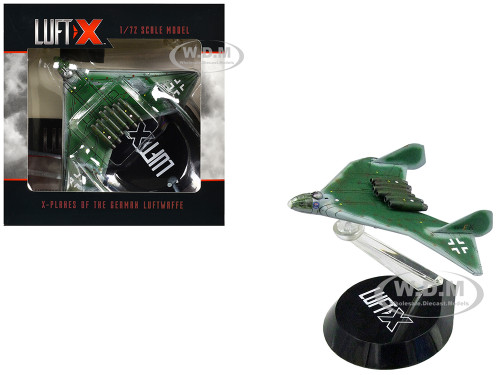
Arado diecast models represent an important chapter in German aviation history, particularly the development of military and training aircraft during the interwar period and World War II. Arado Flugzeugwerke was a German aircraft manufacturer based in Warnemünde that became known for a diverse range of aircraft, from trainers and reconnaissance aircraft to floatplanes, bombers, and one of the world's earliest operational jet-powered reconnaissance bombers.
For aviation collectors, an Arado scale model provides an opportunity to explore aircraft that played very different roles. Depending on current availability, this category may include models of the Arado Ar 66, Ar 68, Ar 196, Ar 234, and other Arado aircraft, with models representing different variants, camouflage schemes, military units, and historical periods.
The History of Arado Flugzeugwerke
Arado Flugzeugwerke developed from the German aircraft manufacturing industry established at Warnemünde during the early 20th century. The company became known as Arado Flugzeugwerke in the 1920s and subsequently developed a broad portfolio of military and civil aircraft.
During the interwar period, Arado designers worked on aircraft ranging from trainers to fighters and reconnaissance aircraft. As German military aviation expanded during the 1930s, Arado became an important supplier of aircraft to the Luftwaffe.
The company's aircraft were characterized by a wide variety of configurations rather than a single recognizable design philosophy. This makes Arado particularly interesting for collectors because its aircraft range includes conventional biplanes, monoplane fighters, floatplanes, and advanced jet aircraft.
Arado Ar 66
The Arado Ar 66 was one of the company's most important training aircraft. Designed as a two-seat biplane, it first flew in the early 1930s and was subsequently used extensively for pilot, observer, and gunner training.
The Ar 66 used a mixed construction that included a welded steel-tube fuselage framework with wooden components and fabric covering. Its relatively straightforward construction suited the training role, and the aircraft remained in service into World War II. The Deutsches Museum preserves an Ar 66D recovered from Lake Starnberg as an example of this important training aircraft.
An Arado Ar 66 model is particularly interesting for collectors who focus on Luftwaffe trainers, early German military aviation, or aircraft from the transition between the 1920s and 1930s design era.
Arado Ar 68
The Arado Ar 68 represented another important stage in the development of German military aviation. Introduced during the 1930s, it was a single-seat biplane fighter and reconnaissance aircraft used during the period when the Luftwaffe was being re-established.
The Ar 68 is an interesting subject for collectors because it illustrates the rapid technological transition taking place during the 1930s. Traditional biplane configurations were increasingly being replaced by faster monoplane fighters, making aircraft such as the Ar 68 part of an important transitional period in aviation design.
Collectors interested in early Luftwaffe aircraft can pair an Ar 68 model with other 1930s fighters and trainers to illustrate this technological progression.
Arado Ar 196
One of the most recognizable Arado aircraft was the Arado Ar 196, a single-engine floatplane designed primarily for maritime reconnaissance and observation.
The Ar 196 was developed for operation from German naval vessels and shore bases. Its floats allowed it to operate from water, while its compact size made it suitable for reconnaissance missions supporting naval operations.
The aircraft became particularly associated with the German Kriegsmarine and was used aboard major German warships. Its distinctive twin-float configuration makes the Ar 196 immediately recognizable in a collection of military aircraft.
For collectors, the Ar 196 is an especially interesting subject because it adds a maritime dimension to an aviation display. A model can be displayed alongside naval aircraft, German warships, or other World War II floatplanes.
Arado Ar 234 Blitz
The most technologically distinctive Arado aircraft was the Arado Ar 234 Blitz.
Developed during World War II, the Ar 234 was designed as a high-speed reconnaissance aircraft and later adapted for bombing missions. It was powered by two jet engines and became one of the first operational jet aircraft used for reconnaissance and bombing.
The aircraft represented a significant departure from conventional piston-engine military aircraft. Its streamlined fuselage, swept wings, engine pods, and tricycle landing arrangement gave it a distinctly modern appearance.
The Ar 234 saw limited operational use late in World War II. The Deutsches Museum's historical documentation identifies the Ar 234 among the German jet aircraft that reached operational service during the final period of the war.
An Arado Ar 234 diecast model is therefore an important subject for collectors interested in the development of early jet aviation. It can also provide a useful contrast with piston-powered Arado aircraft from earlier in the company's history.
Arado Aircraft and World War II Aviation
Many Arado aircraft models appeal specifically to collectors of World War II aviation. The company's aircraft covered several different operational roles, including:
- Fighter and interceptor aircraft
- Pilot and crew trainers
- Maritime reconnaissance aircraft
- Floatplanes
- Bombers
- High-speed reconnaissance aircraft
- Early jet aircraft
This variety allows collectors to build a focused Arado collection rather than simply collecting one type of aircraft.
Historical markings can also be an important part of collecting. Different aircraft may be represented with Luftwaffe unit markings, camouflage patterns, tactical markings, national insignia, or other period-specific details.
When comparing models, collectors should pay attention to the exact aircraft variant and historical configuration rather than treating all models of the same aircraft as identical.
Collecting Arado Scale Models
There are several ways to approach an Arado collection.
Collect by Aircraft Type
A chronological collection can include the Ar 66, Ar 68, Ar 196, and Ar 234. These aircraft demonstrate how rapidly aviation technology changed between the early 1930s and the end of World War II.
The contrast between a fabric-covered training biplane such as the Ar 66 and the streamlined jet-powered Ar 234 makes for an especially interesting display.
Collect German Military Aircraft
Arado models can also form part of a broader German military aviation collection. They can be displayed alongside aircraft from other German manufacturers to compare different approaches to fighter, reconnaissance, bomber, and training aircraft design.
Collect by Mission
Another approach is to focus on a particular aviation role. A maritime collector might concentrate on the Ar 196, while a collector interested in aviation technology could focus on the Ar 234 and other early jet aircraft.
This approach can be particularly effective when space is limited because a small group of carefully selected models can tell a specific historical story.
Arado Diecast Models in Different Scales
The scale of an Arado model can have a significant effect on both its physical size and its suitability for your display.
1/48 scale offers a relatively large presentation and is well suited to collectors who want to appreciate details such as landing gear, cockpit features, propellers, floats, and aircraft markings.
1/72 scale is a popular aircraft scale that provides a good balance between detail and display space. It is particularly useful when collecting several aircraft from the same historical period.
1/100 scale offers a more compact alternative for collectors who want to display multiple aircraft.
1/144 scale makes it possible to build a larger historical collection while using relatively little display space.
1/200 scale is even more compact and can work well for collectors building a broad aviation fleet.
Availability varies by aircraft, manufacturer, and production run, so always check the listed scale and product specifications when comparing Arado models.
Building an Arado Aviation Display
An Arado collection can be organized chronologically, by aircraft role, or by historical period.
A chronological display beginning with the Ar 66 and Ar 68 and continuing through the Ar 196 and Ar 234 illustrates the dramatic transition from conventional biplanes to specialized floatplanes and early jet aircraft.
A World War II display can also combine Arado models with aircraft from other German manufacturers. Alternatively, an Arado-only collection emphasizes the variety of aircraft developed by the company itself.
The Arado Ar 196 is particularly effective in a naval aviation display because of its floatplane configuration, while the Arado Ar 234 makes an excellent centerpiece for a collection focused on early jet technology.
Whether you are searching for an Arado Ar 66, Ar 68, Ar 196, Ar 234, or another historic Arado aircraft model, browse the available Arado diecast models at DiecastModelsWholesale.com and find a scale aircraft that adds an important piece of German aviation history to your collection.