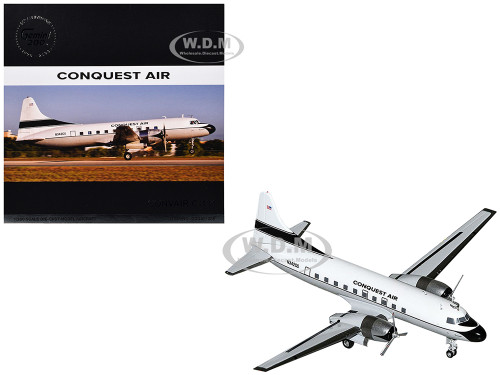
Convair Diecast Aircraft Models
Convair was one of the most important American aerospace companies of the 20th century, with a history spanning piston-engine aircraft, commercial airliners, supersonic interceptors, strategic bombers, missiles, and space-launch vehicles. For diecast aircraft collectors, the Convair name represents an especially interesting period in aviation history, from the postwar transition to jet aircraft through the early Space Age.
The Convair name is associated with a remarkably diverse range of aircraft. Depending on available releases, collectors may find scale models representing the Convair 240, 340, and 440 airliners, Convair 880 and 990 jetliners, F-102 Delta Dagger, F-106 Delta Dart, B-36 Peacemaker, B-58 Hustler, XF2Y-1 Sea Dart, and other significant aircraft and experimental designs.
From Consolidated Vultee to Convair
The story of Convair begins with Consolidated Aircraft Corporation, founded by Reuben H. Fleet in 1923. Consolidated became particularly well known for military aircraft and flying boats, including the PBY Catalina and B-24 Liberator. The company moved its operations to San Diego in the 1930s, establishing an aerospace manufacturing presence that would remain important to the region for decades.
In March 1943, Consolidated merged with Vultee Aircraft Corporation to form Consolidated Vultee Aircraft Corporation. The company was commonly known as Convair, a name that eventually became its formal identity after General Dynamics acquired a majority interest in 1954. Convair continued developing aircraft and aerospace systems under General Dynamics for many years.
This history is important when collecting Convair diecast models because some aircraft associated with the company were developed during the Consolidated Vultee period, while others were designed and produced after the Convair name became established.
Convair and the Rise of the Commercial Airliner
One of Convair's most successful postwar programs was its family of piston-engine commercial airliners. The Convair 240 was developed as a modern replacement for the Douglas DC-3 and became the foundation for a larger family of aircraft.
The Convair 240 was followed by the Convair 340 and Convair 440, which incorporated improvements in performance, passenger capacity, and operational capability. These aircraft were operated by airlines around the world and became familiar sights at airports during the postwar expansion of commercial aviation.
For collectors, Convair's piston airliners are particularly attractive because they represent the transition between the classic propeller-airliner era and the coming jet age.
Convair 240
The Convair 240 was a twin-engine airliner developed to offer airlines a more modern alternative to older piston-engine transports. Its streamlined fuselage, low-mounted wings, and twin-engine configuration give it a distinctive appearance in a diecast aircraft collection.
Convair 340 and 440
The Convair 340 and Convair 440 developed the basic design further and became important aircraft for scheduled passenger service. Their period airline liveries can be just as important to collectors as the aircraft itself.
A Convair 240, 340, or 440 model can therefore be an excellent addition to collections focused on classic airliners, historic airlines, or the development of commercial aviation after World War II.
Convair 880 and 990 Jetliners
Convair entered the jet age with the Convair 880, followed by the larger and faster Convair 990 Coronado.
The Convair 880 was designed as a high-speed commercial jetliner and featured a swept-wing configuration with four engines mounted under the wings. The aircraft was intended to compete in the rapidly developing jet transport market.
The Convair 990 pushed the concept further, with a larger fuselage and distinctive engine nacelles mounted beneath the wings. Its design included the characteristic external "Speed Pods" on the wings, intended to reduce drag and improve high-speed performance.
Neither aircraft achieved the commercial success of competing Boeing and Douglas jetliners, but that relative rarity is part of their appeal to aviation collectors. Convair 880 and 990 models represent an important alternative branch of early American jetliner development. The San Diego Air & Space Museum identifies the 880 and 990 among the major aircraft programs associated with Convair.
Airline Liveries
Commercial Convair models are especially interesting when collected by airline. A single aircraft type can look dramatically different depending on its operator, era, paint scheme, and markings.
Collectors may therefore choose to build a display around:
- Historic U.S. airlines
- International airlines
- Classic jet-era liveries
- Regional and charter operators
- Early postwar commercial aviation
- Specific airports or airline fleets
Convair F-102 Delta Dagger
The F-102 Delta Dagger was one of Convair's most important military aircraft. Developed for the U.S. Air Force as a supersonic interceptor, the F-102 represented the rapid development of American fighter technology during the Cold War.
Its name came from its distinctive delta-wing configuration. The aircraft was designed primarily for air defense and interception rather than conventional fighter missions.
The F-102 is particularly interesting to collectors because its appearance clearly reflects the transition from the straight-wing aircraft of the early postwar era to the high-speed delta-wing designs that became prominent during the 1950s.
The San Diego Air & Space Museum identifies the F-102 among the major aircraft developed by the Consolidated/Convair organization.
Convair F-106 Delta Dart
The F-106 Delta Dart was developed as an improved successor to the F-102. It became one of the most advanced U.S. Air Force interceptors of its era.
The F-106's streamlined fuselage, delta wing, powerful engine, and integrated weapons system gave it a distinctly futuristic appearance. It was designed around the concept of intercepting high-speed threats during the Cold War and remained in U.S. service for many years.
For collectors, the F-106 is an excellent example of Convair's contribution to high-performance military aviation. It also makes an interesting companion to an F-102 model because the two aircraft demonstrate the evolution of Convair's delta-wing interceptor family.
Convair B-36 Peacemaker
The B-36 Peacemaker was another major aircraft program connected with the Consolidated Vultee/Convair lineage. Developed during the transition from World War II into the early Cold War, the B-36 was a massive long-range strategic bomber.
Its enormous size and unusual propulsion arrangement made it one of the most distinctive aircraft ever operated by the United States. Early B-36 versions used six piston engines, while later versions added four jet engines to improve performance.
The aircraft's extraordinary wingspan and long-range capability made it particularly important during the early years of the Strategic Air Command. Convair's historical aircraft portfolio included the B-36 alongside the B-24, B-58, F-102, and F-106.
A B-36 scale model is therefore an especially compelling centerpiece for a Cold War or strategic bomber collection.
Convair B-58 Hustler
The B-58 Hustler represented another dramatic step forward in bomber technology. Designed during the Cold War, the B-58 was a supersonic strategic bomber with a distinctive delta-wing configuration.
Its sleek fuselage, four underwing engines, and sharply swept delta wing made it visually unlike conventional bombers. The aircraft was built around speed rather than the massive size and endurance associated with earlier strategic bombers.
For collectors, the B-58 is a particularly attractive model for displays covering:
- Cold War aviation
- Strategic bombers
- Supersonic aircraft
- Delta-wing aircraft
- U.S. Air Force history
- 1950s and 1960s aerospace technology
Convair XF2Y-1 Sea Dart
One of the most unusual Convair aircraft was the XF2Y-1 Sea Dart, a supersonic seaplane fighter developed for the U.S. Navy.
The Sea Dart was designed to take off and land on water using retractable hydro-skis. It combined a delta-wing configuration with a boat-like fuselage, making it unlike almost any other fighter aircraft of its era.
The prototype first flew in 1953, and a Sea Dart exceeded Mach 1 during testing in 1954. Only five aircraft were built, and the Navy eventually abandoned the operational seaplane-fighter concept as tactical requirements changed.
A Convair Sea Dart model is particularly appealing to collectors of experimental aircraft, naval aviation, seaplanes, and unusual aerospace designs.
Convair and the Space Age
Convair's importance extended beyond conventional aircraft. The company became heavily involved in missile and space programs, most notably the Atlas program.
The Atlas began as an intercontinental ballistic missile program and later became an important space-launch vehicle. Atlas vehicles played a major role in early American spaceflight, including the launch of John Glenn aboard Friendship 7 during Project Mercury.
Convair's aerospace work therefore connects traditional aircraft collecting with the beginning of the Space Age. The San Diego Air & Space Museum's Convair collection documents extensive work associated with Atlas missiles and space-launch vehicles.
Depending on the products available, collectors interested in Convair may therefore encounter subjects that extend beyond conventional airplanes into missiles and space hardware.
Other Experimental Convair Aircraft
Convair's engineering work produced numerous unusual aircraft that can be especially interesting to specialist collectors.
The XF2Y-1 Sea Dart is one example, but the company also experimented with vertical-takeoff aircraft such as the XFY-1 Pogo. The Pogo used a tail-sitting configuration and was designed as a vertical-takeoff-and-landing escort fighter for the U.S. Navy. Only a small number were built.
Convair also experimented with a flying car after World War II. The Model 116 and Model 118 combined a roadable automobile with detachable aircraft components. The project ultimately failed to enter production, but the prototypes demonstrate how unconventional Convair's postwar engineering projects could be.
These experimental subjects can make especially unusual additions to collections of aviation prototypes and rare aircraft designs.
Collecting Convair Diecast Aircraft Models
A Convair collection can be organized in several different ways depending on your interests.
By Aircraft Type
Collectors may focus on a specific family, such as:
- Convair 240/340/440
- Convair 880
- Convair 990
- F-102 Delta Dagger
- F-106 Delta Dart
- B-36 Peacemaker
- B-58 Hustler
- XF2Y-1 Sea Dart
- XFY-1 Pogo
By Historical Era
Another approach is to collect Convair aircraft chronologically, showing the progression from piston-engine airliners to early jetliners, supersonic interceptors, strategic bombers, and Space Age aerospace systems.
By Scale
Aircraft models are produced in several scales. Common scales include 1:72, 1:100, 1:144, 1:200, 1:400, and 1:500, although the available scale depends on the specific aircraft and manufacturer.
Large scales can provide more room for surface and cockpit details, while smaller scales make it easier to display multiple aircraft together. Always check the individual product specifications when comparing models.
By Airline or Military Operator
Convair commercial aircraft offer another collecting opportunity through their airline liveries. Military aircraft can similarly be collected according to service branch, squadron, base, historical period, or camouflage scheme.
Why Collect Convair Aircraft?
Convair models appeal to collectors because the company was involved in so many important transitions in aviation history. A single manufacturer connects the piston-engine airliner era, the rise of commercial jets, Cold War interception, strategic bombing, experimental aircraft, and the beginning of America's space program.
The variety also makes Convair an excellent category for collectors who prefer historically significant aircraft rather than focusing exclusively on today's aircraft.
From the graceful Convair 440 to the unusual Sea Dart, the imposing B-36, the supersonic B-58, and the iconic F-102 and F-106, Convair produced aircraft with some of the most distinctive designs of the 20th century.
Shop Convair Diecast Aircraft Models
Convair's legacy covers some of the most fascinating aircraft in American aviation history. Whether your interest is classic airline travel, Cold War fighters, strategic bombers, experimental aircraft, or the Space Age, a Convair scale model can add an important piece of aviation history to your display.
Browse the Convair category at DiecastModelsWholesale.com to explore available Convair diecast aircraft models, compare aircraft types, scales, liveries, and markings, and find the right addition to your aviation collection.