
Lavochkin
Explore Lavochkin diecast aircraft models inspired by one of the most important Soviet aircraft design bureaus of World War II and the early jet age. Founded by aviation designer Semyon Lavochkin and his associates, the Lavochkin design organization became known for rugged fighter aircraft that played a significant role in Soviet military aviation.
From the La-5 and La-7 piston-engine fighters of World War II to the La-15 jet fighter and the experimental La-176, Lavochkin aircraft reflect a period of rapid technological change. These aircraft are particularly interesting to collectors of Soviet military aviation, historic fighter planes, World War II aircraft, and early jet prototypes.
The Lavochkin category at Diecast Models Wholesale is intended for enthusiasts looking for miniature representations of aircraft associated with this historic design bureau. Depending on available products, collectors may find models of wartime fighters, postwar jet aircraft, and experimental designs. Specific aircraft, scales, finishes, and markings vary by release, so individual product listings are the best place to confirm each model's details.
Whether you collect World War II fighters, compare Soviet and Allied aircraft designs, or focus on the transition from propeller-driven planes to jet-powered combat aircraft, Lavochkin diecast aircraft models can add an important chapter of aviation history to your collection.
The History of Lavochkin Aircraft
The Lavochkin Design Bureau
Semyon Alekseyevich Lavochkin was a Soviet aircraft designer whose work became especially influential during World War II. In the late 1930s and early 1940s, Soviet aircraft designers faced the challenge of developing fighters capable of competing with increasingly capable German aircraft.
Lavochkin worked with engineers Vladimir Gorbunov and Mikhail Gudkov on early fighter designs. Their organization became associated with the LaGG-1 and LaGG-3 fighters, which used a wooden structure and represented an important stage in Soviet fighter development.
Although the early LaGG aircraft had limitations, continued redesign and improvements helped establish the foundation for the more capable La-5 and La-7. These later aircraft became some of the best-known Lavochkin fighters and were used extensively by Soviet forces during the latter part of World War II.
After the war, the design bureau turned toward jet propulsion, exploring new aerodynamic configurations and higher-performance aircraft. Its work included operational jet fighters as well as experimental aircraft that investigated the limits of contemporary aviation technology.
For model collectors, this history creates several distinct collecting themes: early Soviet fighters, wartime piston-engine aircraft, postwar jet fighters, and experimental high-speed designs.
Iconic Lavochkin Aircraft for Collectors
LaGG-3: An Early Soviet Fighter
The LaGG-3 emerged from the joint work of Lavochkin, Gorbunov, and Gudkov. It entered service in the early years of the German-Soviet war and was produced in numerous variants as designers worked to improve its performance.
The aircraft used a largely wooden structure, reflecting both material choices and industrial constraints of the period. While early versions were not without shortcomings, the LaGG-3 served as an important development step toward the more successful La-5.
A LaGG-3 diecast model is relevant to collectors who want to trace the evolution of Soviet fighter aircraft rather than focus only on the most famous wartime types.
La-5: A Major World War II Fighter
The La-5 was developed by adapting the LaGG-3 design to use a more powerful radial engine. This change significantly improved performance and helped create a fighter better suited to the demands of combat on the Eastern Front.
Introduced in 1942, the La-5 became an important Soviet frontline fighter. Later versions improved performance and handling, and the aircraft served alongside other Soviet types as the Red Air Force expanded its ability to challenge German fighters.
The La-5FN variant was especially notable for its improved engine performance. It became associated with several successful Soviet fighter pilots and contributed to the aircraft family's reputation.
For collectors, the La-5 offers a recognizable subject from a decisive period in World War II aviation. Product variants may represent different production versions, camouflage schemes, unit markings, or historical aircraft. Check individual listings to determine which version is depicted.
La-7: A Refined Late-War Fighter
The La-7 was a further development of the La-5 family and entered service in 1944. Improvements to the aircraft's aerodynamics, structure, and systems helped make it one of the most capable Soviet piston-engine fighters of the war.
The La-7 combined a powerful radial engine with a streamlined airframe and strong performance at combat altitudes. It served during the final stages of the European war and remained part of the Soviet Union's broader fighter-development story.
Its connection to celebrated wartime pilots and late-war air combat makes the La-7 a natural choice for collections focused on World War II fighters.
Collectors comparing the La-5 and La-7 can look for differences in engine cowling, air intakes, exhaust arrangements, wing details, and other features represented by a particular model. The precise configuration depends on the variant being reproduced.
La-9 and La-11: The Final Generation of Piston Fighters
Following World War II, Lavochkin continued developing piston-engine fighters even as jet propulsion became increasingly important. The La-9 and La-11 represented advanced stages of the Soviet radial-engine fighter concept.
The La-9 featured an all-metal structure and four 23 mm cannons. The longer-range La-11 was developed with escort and long-distance operations in mind. Both aircraft illustrate how piston-engine fighter design continued to evolve during the transition to the jet age.
For collectors, these aircraft provide a useful comparison with the wartime La-5 and La-7. They also show how designers attempted to extend the usefulness of conventional fighter configurations while jet aircraft were entering service.
La-15: Lavochkin's Early Jet Fighter
The La-15 was among the early Soviet jet fighters developed after World War II. It featured swept wings and a relatively compact airframe, reflecting the growing influence of aerodynamic research into high-speed flight.
The La-15 entered limited service with the Soviet Air Force in the late 1940s. Although it was not produced in the same numbers as the MiG-15, it remains an important example of the Soviet Union's early experimentation with jet-powered fighter design.
A La-15 model can add variety to a collection of early Cold War aircraft, especially when displayed alongside other first-generation jet fighters. Its swept-wing configuration provides a clear visual contrast with the straight-wing jets and piston-engine aircraft that preceded it.
La-176: Experimental High-Speed Aviation
The La-176 was an experimental jet aircraft developed to explore the high-speed performance of swept-wing designs. It became historically significant during the Soviet Union's efforts to approach and exceed the speed of sound in level flight.
The aircraft is associated with early Soviet supersonic research and the work required to understand compressibility effects, aerodynamic stability, and the challenges of operating aircraft at very high speeds.
Experimental aircraft such as the La-176 appeal to collectors who are interested in engineering milestones as well as operational military aircraft. If a model of the La-176 is available, its specific version and historical markings should be confirmed through the product description.
Lavochkin's Experimental Aircraft and Research Legacy
Lavochkin's work extended beyond frontline fighters. The design bureau participated in research involving high-speed aerodynamics, advanced propulsion, and experimental aircraft configurations during the early Cold War.
One particularly unusual project was the La-250, nicknamed Anakonda. Developed as an interceptor intended to counter high-speed threats, it featured a long fuselage and was designed around a powerful radar and guided-missile system. Its development encountered technical difficulties, and it never entered operational service, but it remains an interesting example of the ambitious interceptor concepts pursued during the period.
Lavochkin also worked on experimental aircraft and advanced research projects as aviation moved toward higher speeds and more sophisticated weapons systems. These projects are of interest to collectors who appreciate prototypes and designs that reveal the direction engineers hoped to take aviation, even when a particular aircraft never became a standard production type.
Why Collect Lavochkin Diecast Aircraft Models?
Lavochkin models offer several ways to explore Soviet aviation history through miniature aircraft.
-
World War II aviation: The La-5 and La-7 represent important Soviet fighter designs from the later war years.
-
Aircraft development: The LaGG-3, La-5, and La-7 illustrate how a basic fighter design evolved through successive improvements.
-
The early jet age: The La-9, La-11, and La-15 demonstrate the transition from piston engines to jet propulsion.
-
Experimental aviation: Aircraft such as the La-176 and La-250 represent research into high-speed flight and interception.
-
Military aviation displays: Lavochkin models can be displayed alongside other Soviet, German, British, and American aircraft to compare designs from the same historical periods.
For collectors, the appeal is not limited to an aircraft's combat record. Airframe design, engine configuration, historical role, camouflage, unit insignia, and prototype status can all make a model distinctive.
Choosing a Lavochkin Aircraft Model
Before purchasing a Lavochkin diecast aircraft model, review the product listing for the following details:
Aircraft designation: Confirm whether the model represents a LaGG-3, La-5, La-7, La-9, La-11, La-15, La-176, La-250, or another design. Similar designations can refer to substantially different aircraft.
Scale and dimensions: Scale determines the approximate relationship between the miniature and the full-size aircraft. Compare the listed scale and dimensions with other models in your collection.
Historical version: Some aircraft were produced in multiple variants. Engine arrangements, armament, air intakes, and other details may differ, so verify the specific version being represented.
Markings and finish: Camouflage patterns, national insignia, tactical numbers, and pilot-associated markings can distinguish one release from another. Historical accuracy varies by manufacturer and product.
Construction and display features: Although the category focuses on diecast models, materials and features can vary. Check whether the product includes a display stand, landing gear, removable components, or other accessories rather than assuming these are standard.
Product availability, scale, and finish may vary. Use the individual listing to confirm the specifications of the model you are considering.
Displaying Lavochkin Models in an Aviation Collection
Lavochkin aircraft work well in collections organized by aircraft generation, historical period, or national origin. A display featuring the La-5 and La-7 can illustrate the development of Soviet wartime fighters, while the La-9 and La-15 show the transition into the postwar era.
You can also arrange aircraft by their intended role. Operational fighters, long-range interceptors, and experimental research aircraft each tell a different part of the story. Combining them in a chronological display can highlight changes in engine technology, wing design, speed, and mission requirements.
If you collect multiple scales, consider using separate shelves or display areas for different sizes. This helps maintain visual balance and makes it easier to appreciate the details of each model.
Shop Lavochkin Diecast Aircraft Models at Diecast Models Wholesale
From the wartime La-5 and La-7 to the early jet-powered La-15 and experimental La-176, Lavochkin aircraft represent important stages in Soviet aviation development. Their history makes them compelling subjects for collectors of military aircraft, World War II aviation, and early Cold War technology.
Browse the available Lavochkin diecast aircraft models at Diecast Models Wholesale to find aircraft that match your interests. Compare the designations, scales, markings, and product specifications to select a collectible that complements your aviation display.
Filter
-
Oxford Diecast
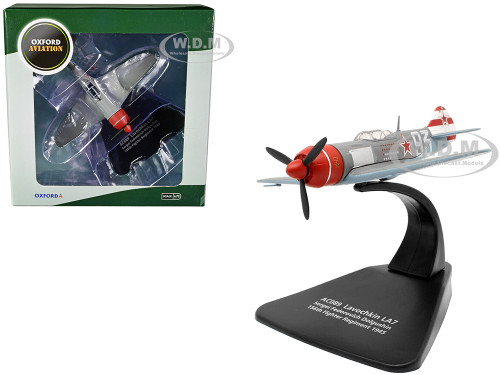
Lavochkin LA7 Fighter Plane Sergei Federovich Dolgushin 156th Fighter Regiment (1945) "Oxford Aviation" Series 1/72 Diecast Model Airplane by Oxford Diecast
$35.99WasAdd to Cart The item has been added$35.99WasAdd to Cart The item has been added