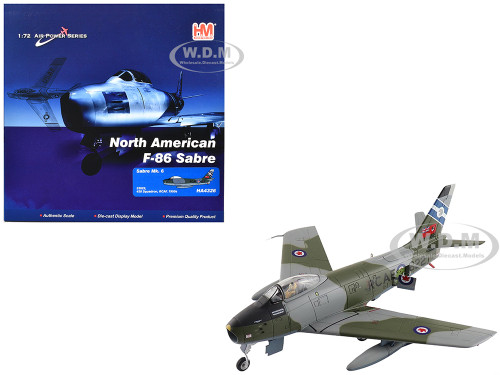
Discover North American and Canadair diecast aircraft models inspired by two important names in North American aviation history. From the legendary P-51 Mustang and F-86 Sabre to Canada's distinctive CT-114 Tutor and specialized Canadair aircraft, these manufacturers and their associated designs represent significant developments in military aviation, pilot training, and aerospace engineering.
The North American Canadair category at Diecast Models Wholesale is intended for aircraft enthusiasts, military aviation collectors, and hobbyists interested in miniature replicas of historically significant aircraft. Depending on current product availability, models may represent World War II fighters and bombers, Cold War jet aircraft, military trainers, and other aircraft associated with North American Aviation and Canadair.
Although North American Aviation and Canadair were separate manufacturers, their histories intersected through aircraft production and engineering. Canadair manufactured Canadian-built versions of North American designs, including the F-86 Sabre, known in Canadian service as the CL-13 Sabre. Canadair also developed its own aircraft, including the CT-114 Tutor trainer and the CL-215 amphibious firefighting aircraft.
This combination makes the category interesting for collectors who want to explore both American aircraft designs and Canada's contribution to aerospace manufacturing. Whether you collect historic fighters, classic jet aircraft, Canadian military aviation, or specialized aircraft, these diecast replicas offer a way to appreciate the engineering and history behind notable aircraft.
North American Aviation and Canadair: An Overview
North American Aviation
North American Aviation was established in 1928 and became one of the most important American aircraft manufacturers of the 20th century. Under the leadership of James H. "Dutch" Kindelberger, the company developed a reputation for producing aircraft for military training, combat, and experimental research.
During World War II, North American Aviation became well known for aircraft such as the P-51 Mustang fighter, B-25 Mitchell medium bomber, and T-6 Texan trainer. These aircraft served different operational roles, from escorting bomber formations to conducting tactical bombing missions and preparing military pilots for advanced flight.
After the war, North American Aviation moved into the rapidly developing jet age. Its F-86 Sabre became one of the best-known early jet fighters, while the F-100 Super Sabre represented a major step toward supersonic combat aircraft. The company also developed advanced experimental aircraft, including the X-15 and XB-70 Valkyrie.
For collectors, North American aircraft offer a broad range of subjects spanning propeller-driven combat aircraft, early jets, and experimental aerospace designs.
Canadair
Canadair was established in Montreal in 1944 and became a major Canadian aircraft manufacturer. Its early work included the production and modification of military aircraft, followed by the development of aircraft for military, civilian, transport, and specialized applications.
Canadair's history includes Canadian-built aircraft based on foreign designs as well as aircraft developed specifically for Canadian requirements. The CL-13 Sabre, for example, was derived from the North American F-86, while the CT-114 Tutor was an original Canadian jet trainer.
The company also developed aircraft for specialized operations, including the CL-44 transport and the CL-215 amphibious aircraft. These designs illustrate Canada's contributions to both military aviation and civilian aerospace engineering.
Canadair later became part of Bombardier, continuing its influence through programs that included the Challenger business jet and regional aircraft. Its legacy remains important to Canadian aviation history.
North American P-51 Mustang Diecast Models
The North American P-51 Mustang is one of the most recognizable American fighter aircraft of World War II. Developed in response to a British requirement, the aircraft first flew in 1940 and entered operational service during the early years of the war.
Early Mustangs used Allison engines, while later versions equipped with Packard-built Rolls-Royce Merlin engines offered substantially improved high-altitude performance. The combination of speed, range, and combat capability made the Mustang an important long-range escort fighter.
P-51D Mustang
The P-51D is one of the best-known Mustang variants. Its bubble canopy improved visibility, while its six .50-caliber machine guns provided substantial firepower.
For diecast collectors, the P-51D offers a recognizable silhouette and a wide range of historical markings. Replicas may depict aircraft associated with particular pilots, squadrons, and wartime operations.
When choosing a Mustang model, consider the specific variant, nose art, paint scheme, squadron markings, and aircraft identification. These details can distinguish replicas of the same basic aircraft type.
A P-51 Mustang model can serve as a centerpiece in a collection of World War II fighters or complement other North American aircraft such as the B-25 Mitchell.
North American B-25 Mitchell Bomber Models
The North American B-25 Mitchell was a twin-engine medium bomber that entered service during World War II. It was designed for a range of missions, including conventional bombing, low-level attacks, and specialized operations.
The B-25 became especially famous for the Doolittle Raid of April 1942, when modified aircraft launched from the aircraft carrier USS Hornet to attack targets in Japan. This operation became a notable event in the early American Pacific air campaign.
Different B-25 variants featured different nose arrangements, armament, and equipment. Some had glazed noses for bombing duties, while other versions incorporated concentrated forward-firing armament for low-level attack missions.
A B-25 Mitchell diecast model appeals to collectors interested in World War II bombers and historic American military aviation. When comparing models, review the variant, unit markings, camouflage, and represented aircraft configuration.
North American F-86 Sabre and Canadair CL-13 Sabre Models
The F-86 Sabre is an important aircraft for understanding the connection between North American Aviation and Canadair. Designed by North American Aviation, the Sabre became one of the defining jet fighters of the early Cold War.
Its swept wings improved high-speed performance, and the aircraft became especially well known for its combat record during the Korean War. The F-86 faced the Soviet-designed MiG-15 in some of the era's most significant jet-versus-jet engagements.
Canadair manufactured the Sabre under license in Montreal for the Royal Canadian Air Force and other customers. These Canadian-built aircraft were designated CL-13, with several marks produced.
Canadair Sabre Mk 2, Mk 5, and Mk 6
Canadair developed several versions of the CL-13 Sabre. Early models were closely related to their North American counterparts, while later versions incorporated important improvements.
The Sabre Mk 5 introduced an improved engine, and the Sabre Mk 6 featured the Canadian-built Orenda engine along with other refinements. These changes gave the later Canadian Sabres a distinctive place in the history of the aircraft.
For collectors, Canadair Sabre replicas offer an opportunity to compare Canadian-built aircraft with American F-86 versions. Differences in engine installation, airframe details, markings, and paint schemes may be relevant when identifying specific variants.
Canadair Sabres served with the Royal Canadian Air Force and other international operators. Models may represent operational fighter squadrons, aerobatic teams, or aircraft in different national markings, depending on the product.
The Canadair Sabre can be an especially useful addition to a Cold War aviation collection because it represents both the original North American design and Canada's role in manufacturing and refining the aircraft.
North American F-100 Super Sabre Models
The F-100 Super Sabre was developed as a successor to the F-86 and became the first production fighter capable of exceeding the speed of sound in level flight under suitable conditions.
First flown in 1953, the F-100 featured swept wings, a powerful turbojet engine, and a more advanced airframe than earlier subsonic fighters. Different versions served in fighter, fighter-bomber, and other operational roles.
The aircraft later became associated with American operations during the Vietnam War, where it performed ground-attack and close-support missions.
For collectors, the F-100 illustrates the rapid evolution of jet fighter technology during the Cold War. Its pointed nose, prominent air intake, and swept-wing design distinguish it from the earlier F-86.
When selecting an F-100 diecast model, check the exact version, aircraft markings, camouflage, and external equipment. Different variants such as the F-100D and F-100F have distinct configurations.
Canadair CT-114 Tutor Trainer Models
The Canadair CT-114 Tutor was a Canadian-designed jet trainer that first flew in 1960. It entered service with the Royal Canadian Air Force in 1963 and remained an important training aircraft for decades.
Unlike the Canadair Sabre, which was based on an American design, the Tutor was developed specifically as a Canadian aircraft. Its compact airframe, side-by-side seating, and straightforward handling characteristics made it suitable for preparing military pilots for more advanced jet aircraft.
The Tutor is perhaps best known today as the aircraft flown by the Canadian Forces Snowbirds aerobatic team. Its association with the Snowbirds has made the aircraft particularly recognizable among Canadian aviation enthusiasts.
Snowbirds Tutor Diecast Models
Snowbirds aircraft are distinctive because of their red-and-white paint scheme and team markings. A Canadair Tutor model in Snowbirds livery can be an appealing display piece for collectors of Canadian military aviation and aerobatic aircraft.
The Tutor also offers a useful contrast with larger combat aircraft. Its smaller proportions and training role illustrate the supporting aircraft needed to prepare pilots for front-line service.
When choosing a CT-114 model, confirm whether it represents a standard training aircraft or a Snowbirds demonstration aircraft. The represented markings and configuration can make a significant difference to the collectible's appeal.
Other Notable Canadair Aircraft
Canadair developed aircraft for a wide range of roles beyond the Sabre and Tutor. Depending on current model availability, collectors may encounter other designs connected with the company's history.
Canadair CL-215 and CL-415
The Canadair CL-215 is an amphibious aircraft developed for firefighting and other specialized duties. Its design allows it to operate from suitable water surfaces as well as conventional airfields, making it particularly recognizable among emergency-response aircraft.
The CL-415 developed the amphibious firefighting concept further with updated systems and improved performance. These aircraft have been used to combat wildfires by collecting and dropping water over affected areas.
For collectors, Canadair firefighting aircraft provide a different subject from military fighters and trainers. Their distinctive hull-shaped fuselage, high-mounted wings, and specialized role make them unique additions to aviation displays.
Canadair CL-44
The Canadair CL-44 was a transport aircraft developed from the Bristol Britannia design, with substantial modifications to the fuselage and other systems. It was used for cargo operations and by military operators.
The CL-44 is notable for its large turboprop configuration and, on certain variants, a swing-tail arrangement that allowed easier loading of bulky freight. This specialized feature makes the aircraft particularly interesting to enthusiasts of cargo aviation.
A CL-44 model can complement collections focused on transport aircraft, freighters, and the history of Canadian aerospace manufacturing.
Canadair Regional and Business Aircraft
Canadair's later aerospace history included regional and corporate aircraft programs. The CL-600 Challenger business jet, first flown in 1978, became an important product in the company's development of business aviation.
The Challenger's wide-body cabin and twin-engine design distinguished it from many smaller business jets. The program later developed through successive versions and became part of Bombardier's business aircraft family.
These later aircraft illustrate how Canadair's legacy extended from military aircraft production to corporate and regional aviation.
Why Collect North American and Canadair Diecast Aircraft?
North American and Canadair models offer collectors a varied perspective on aviation development in the United States and Canada.
-
World War II aviation: The P-51 Mustang and B-25 Mitchell represent important American fighter and bomber designs.
-
Cold War jet development: The F-86 Sabre and F-100 Super Sabre illustrate the shift toward swept-wing and supersonic aircraft.
-
Canadian aviation history: The CL-13 Sabre and CT-114 Tutor highlight Canada's role in military aircraft production and original design.
-
Specialized aircraft: Canadair's CL-215 and CL-415 firefighting aircraft and CL-44 transport provide alternatives to conventional military models.
-
International aircraft service: Different operators, national markings, and paint schemes create variety within the same aircraft family.
A collection can focus on one aircraft type, such as the Sabre, or represent multiple decades of aviation history through fighters, trainers, bombers, and specialized aircraft.
Choosing the Right North American Canadair Model
Identify the Aircraft and Manufacturer
Start by confirming the exact aircraft designation. The North American F-86 and Canadair CL-13 are closely related, but the Canadian-built version has its own production history and variants.
Similarly, distinguish aircraft designed by North American Aviation from those developed by Canadair. This is especially useful for collectors who want to build a historically accurate display.
Consider Scale and Display Space
Aircraft replicas are commonly available in scales such as 1:72, 1:48, and 1:32, although the available scales vary by manufacturer and aircraft.
-
1:72 scale: A compact choice for collectors displaying many aircraft together.
-
1:48 scale: Offers a larger display presence and can help the aircraft's overall design stand out.
-
1:32 scale: A substantially larger format, suitable for a centerpiece where available.
Check the individual model's dimensions before purchasing, especially for twin-engine aircraft and larger bombers.
Review Markings and Product Details
Aircraft markings, squadron insignia, paint schemes, landing gear, propeller details, and display stands vary by product. Collectors who prioritize accuracy should confirm the represented variant, operator, and historical period.
Materials, packaging, and other model features also differ by manufacturer. Review the product listing to verify the details of the specific replica.
Explore North American Canadair Diecast Aircraft Models
From the P-51 Mustang and B-25 Mitchell to the Canadair-built CL-13 Sabre, CT-114 Tutor, and specialized Canadair aircraft, this category represents an important range of American and Canadian aviation history.
Browse the North American Canadair category at Diecast Models Wholesale to explore available aircraft replicas, compare models and markings, and find a distinctive addition to your aviation collection.