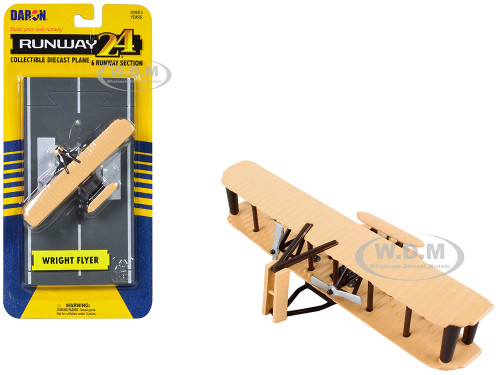
Wright occupies a special place in aviation history through the pioneering work of the Wright brothers, Orville and Wilbur Wright. Their experiments with powered flight helped usher in the age of aviation and laid the foundation for the aircraft industry that followed. For aviation enthusiasts and model collectors, Wright-related aircraft represent the earliest chapter of powered, controlled flight and the remarkable engineering advances that transformed transportation.
The Wright category at DiecastModelsWholesale.com is intended for shoppers interested in collectible models associated with Wright aviation history. Depending on the products available, this subject may appeal to collectors of pioneering aircraft, early aviation replicas, and historically significant flying machines.
Wright aircraft look very different from the streamlined fighters, airliners, and modern military aircraft that dominate many aviation collections. Early designs featured exposed structural members, fabric-covered wings, wire bracing, and propulsion systems that reflected the experimental nature of the period. These features give pioneering aircraft a distinctive appearance and make them especially interesting to collectors who want to represent the origins of flight.
Because historical aircraft can be reproduced in different forms and scales, review each product listing for the specific aircraft represented, the scale, construction, and included display features.
The Wright Brothers and the Birth of Powered Flight
Orville and Wilbur Wright were American inventors and aviation pioneers whose systematic experiments helped solve some of the most difficult problems facing early flight. Working first with gliders, they investigated lift, balance, and control before progressing to powered aircraft.
Their achievement was not simply building a machine that could leave the ground. They worked toward controlled, sustained flight, developing methods for managing an aircraft in the air. Their experiments with wing warping and other control techniques contributed to the development of practical aircraft design.
The 1903 Wright Flyer
The Wright Flyer is the aircraft most closely associated with the brothers' first successful powered flight. On December 17, 1903, near Kitty Hawk, North Carolina, Orville Wright piloted the first of four flights made that day. The longest flight covered approximately 852 feet and lasted 59 seconds, piloted by Wilbur Wright.
The Flyer used a lightweight structure, fabric-covered wings, a small gasoline engine, and propellers designed through the brothers' own experiments. Its configuration differed substantially from later aircraft, with the pilot positioned prone on the lower wing and the aircraft controlled through a combination of aerodynamic surfaces and wing-warping mechanisms.
For collectors, the Wright Flyer is a historically significant subject because it represents a turning point in human transportation. A model can serve as a centerpiece in an aviation-history collection, particularly one devoted to early flight, pioneering inventors, or the development of aircraft technology.
The Flyer is also visually distinctive. Its multiple wings, exposed framework, forward elevator, and rear-mounted rudder assembly make it immediately recognizable compared with later conventional aircraft.
The Wright Flyer III
The Wright Flyer III marked an important advance in the brothers' experiments. Tested in 1905, it incorporated design changes that helped make it a much more practical flying machine than their earlier prototypes. With improvements to control and stability, the aircraft demonstrated the potential for sustained, repeatable flight.
The Flyer III is significant to aviation enthusiasts because it illustrates how the Wright brothers progressed from an initial breakthrough to a more capable aircraft. Collectors interested in engineering development may find the distinction between early Flyer designs especially meaningful.
When choosing a model of an early Wright aircraft, identifying the exact version is important. Similar-looking pioneering aircraft can represent different stages of experimentation, and their structural arrangements may vary.
The Wright Military Flyer and Early Military Aviation
The Wright brothers' work soon attracted interest from the U.S. military, which recognized the potential of airplanes for observation and reconnaissance. The 1909 Wright Military Flyer became the first airplane purchased by the U.S. Army, marking an important milestone in military aviation.
The aircraft was a two-seat biplane with a wooden structure, fabric-covered wings, and a gasoline engine driving two propellers. Its unusual configuration reflected the engineering priorities of the era, when aircraft designers were still developing the basic principles of powered flight.
For collectors, the Wright Military Flyer connects the earliest days of aviation with the emergence of military aircraft. It can complement displays featuring pre-World War I aviation, early reconnaissance planes, and the aircraft that preceded modern military aviation.
The Wright Model B followed as a more practical aircraft offered for sale to customers. It was used for demonstrations and flying exhibitions and contributed to the development of early aviation training. Its design illustrates how the Wright brothers moved beyond experimental flight toward aircraft that could be manufactured, sold, and operated by other pilots.
These pioneering aircraft are particularly meaningful to collectors interested in the origins of military aviation. They show how aircraft initially developed for experimentation began to find practical roles in observation, training, and public demonstrations.
Distinctive Features of Early Wright Aircraft
Wright aircraft from the pioneering period have several characteristics that distinguish them from later airplanes. These details can also help collectors appreciate the engineering represented by a scale model.
-
Biplane wings: Multiple wing surfaces provided lift using the materials and aerodynamic knowledge available at the time.
-
Exposed framework: Wooden structural members and wire bracing were visible rather than enclosed within a streamlined fuselage.
-
Fabric-covered surfaces: Lightweight fabric covered much of the wing and control structure.
-
Pusher propellers: On notable early Wright designs, the propellers were positioned behind the wings, pushing the aircraft forward.
-
Forward control surfaces: Several early designs used a canard arrangement, with an elevator mounted ahead of the wings.
-
Skid landing gear: Early aircraft often rested on skids rather than the wheeled landing gear that later became standard.
Not every Wright aircraft shared exactly the same configuration. The brothers continually refined their designs, and later models incorporated changes to control surfaces, landing gear, seating, and other components. When choosing a historical replica, the specific aircraft designation is therefore an important detail.
Collecting Wright Aviation Models
Wright aviation collectibles appeal to a different audience from modern fighter jets and commercial airliners. Their value as display pieces comes largely from their historical significance, unusual construction, and connection to the earliest years of powered flight.
For Aviation History Enthusiasts
Collectors interested in the development of flight can use Wright models to represent the beginning of the powered-aircraft era. A model of the 1903 Flyer provides a natural starting point, while later Wright aircraft can illustrate the progress from experimental prototypes to more practical flying machines.
A collection organized chronologically can tell a compelling story about the evolution of aviation. Early Wright designs can be displayed alongside later biplanes and subsequent generations of aircraft to show how quickly aircraft engineering advanced during the first decades of the 20th century.
For Military Aviation Collectors
The Wright Military Flyer is especially relevant to collections focused on the history of military aviation. It represents a period when armed forces were first exploring the potential of airplanes for observation and reconnaissance.
Displayed alongside later military aircraft, a Wright model helps show how dramatically aircraft design and military roles changed over time. The contrast between a wire-braced early biplane and a modern jet can make the progression of aviation technology particularly clear.
For Museum-Style and Educational Displays
Wright models can also suit educational displays, offices, libraries, and aviation-themed rooms. Because their historical importance is widely recognized, they can be interesting conversation pieces even for people who do not actively collect aircraft.
When building a display, consider the aircraft's historical role, the amount of detail included, and how the model will be presented. A replica of the 1903 Flyer may be best suited to a display about the invention of powered flight, while a military model may fit a broader exhibit about the development of military aviation.
Choosing a Wright Scale Model
Scale is an important consideration when buying any aircraft collectible. It indicates the model's size relative to the real aircraft. The finished dimensions of an early Wright biplane depend on the original aircraft's wingspan and length, so even a relatively small scale can produce a model with a wide footprint.
Before purchasing, review the scale and dimensions specified in the product listing. Also consider the following:
-
Display footprint: Wide wings and exposed structural details may require more shelf space than expected.
-
Historical accuracy: Look for the specific aircraft designation and compare its general configuration with the period you want to represent.
-
Construction and finish: Materials, surface treatments, and levels of detail vary by manufacturer and release.
-
Display support: Check whether a stand or other display component is included if you intend to exhibit the model in a particular position.
-
Collection compatibility: If you display aircraft from different periods together, decide whether consistent scale or historical variety matters more to your collection.
Product details should always be checked individually. A model's scale, materials, stand, finish, and included accessories depend on the specific release, and current availability may change.
Wright Models as Gifts
A Wright aircraft model can make a thoughtful gift for aviation enthusiasts, history buffs, educators, or collectors interested in the origins of flight. It may be especially suitable for someone who appreciates the Wright brothers' achievements or enjoys learning about the engineering milestones that shaped modern aviation.
For a gift, consider whether the recipient is more interested in the first powered flight, early military aviation, or the development of aircraft design. A model representing a specific historical milestone can be more meaningful than a generic aircraft collectible.
Wright models can also complement collections of aviation books, historical memorabilia, and models representing later aircraft generations. Their distinctive appearance and historical significance make them a fitting addition to a collection devoted to the story of flight.
Explore the Wright category at DiecastModelsWholesale.com to browse the available aviation collectibles and find a model that celebrates the pioneering achievements that helped change the history of transportation.