
Boulton Paul
Boulton Paul diecast aircraft models represent an important chapter in British aviation history, particularly the development of innovative military aircraft during the interwar period and World War II. Boulton Paul became especially well known for aircraft designed around powered gun turrets and unusual approaches to fighter and bomber defense, culminating in the famous Boulton Paul Defiant.
For aviation collectors, Boulton Paul aircraft offer something different from the more familiar British fighters of World War II. The Defiant's two-seat configuration, distinctive dorsal turret, and unconventional armament arrangement make it immediately recognizable as a scale model. The company's earlier and lesser-known aircraft also provide opportunities for collectors interested in the development of British aviation technology.
The Boulton Paul category at DiecastModelsWholesale.com is intended for collectors of historic British aircraft, Royal Air Force enthusiasts, World War II aviation historians, and anyone interested in unusual or historically significant aircraft designs.
The History of Boulton Paul
Boulton Paul has roots extending back to the early years of British aviation. The company became associated with aircraft manufacturing in Norwich before moving its main aircraft production activities to Wolverhampton. Its aviation history included military aircraft, trainers, bombers, and fighter designs.
The company became particularly associated with defensive turret technology. Boulton Paul developed powered aircraft turrets that were used on several British aircraft types, and this engineering experience influenced the design of the company's own fighters.
The company was eventually incorporated into the wider British aircraft industry, with its Wolverhampton factory continuing to have an important aviation manufacturing history. The Boulton Paul name remains strongly associated with the Defiant, one of the most unusual RAF fighters of the Battle of Britain era.
Boulton Paul Defiant
The Boulton Paul Defiant is by far the most famous aircraft associated with the company and is the central subject for many Boulton Paul aviation collections.
The Defiant was designed as a two-seat fighter with its primary armament concentrated in a powered turret positioned behind the pilot. Rather than mounting its main guns in the wings or nose, the aircraft carried four .303-inch Browning machine guns in the turret, operated by a dedicated gunner.
This arrangement reflected a specific tactical concept. The Defiant was intended to attack enemy bombers from positions where the turret-mounted guns could be brought to bear without requiring the aircraft itself to point directly at the target.
The concept was innovative, but combat experience revealed significant limitations when the Defiant encountered highly maneuverable single-seat fighters. During the Battle of Britain, Defiants suffered heavily when confronted by German fighters such as the Messerschmitt Bf 109. The type was subsequently withdrawn from daylight fighter operations and found a more suitable role as a night fighter.
For collectors, this history makes the Defiant particularly interesting. It was neither a conventional fighter nor a conventional bomber, but an aircraft built around a specific tactical idea that ultimately proved more useful in a different role.
The Defiant During the Battle of Britain
The Defiant entered operational service shortly before World War II and became involved in the Battle of Britain in 1940. No. 264 Squadron was the first RAF squadron to receive the aircraft, and other squadrons subsequently operated it.
The aircraft initially performed daylight fighter and convoy-escort duties. Combat experience quickly demonstrated that its limitations were serious when operating against enemy fighters. RAF Museum records describe the aircraft's withdrawal from daylight operations and its subsequent development as a night fighter.
The Defiant nevertheless had an important wartime career. From 1940 into 1942, it was increasingly used in the night-fighter role. Later examples were also employed for air-sea rescue, target towing, anti-aircraft cooperation, training, and radar countermeasure duties.
This varied operational history makes the Defiant an especially useful subject for collectors who enjoy aircraft with a story that goes beyond their original intended role.
Boulton Paul Defiant Mk I
The Defiant Mk I was the principal production version and is one of the most recognizable Boulton Paul aircraft subjects.
It was powered by a Rolls-Royce Merlin engine and featured the characteristic four-gun powered turret behind the cockpit. The aircraft's two-seat arrangement, relatively compact fuselage, and large turret make it visually distinctive among British fighters of the period.
One of the most historically important surviving Defiants is N1671, preserved by the RAF Museum. The aircraft was taken on RAF charge in August 1940 and served with No. 307 Squadron, a Polish night-fighter unit, before later service with an anti-aircraft cooperation squadron. It is now the sole surviving intact example of the type.
For collectors, the Defiant Mk I provides an opportunity to represent a specific aircraft from the early years of World War II and the Battle of Britain period.
The Boulton Paul Turret
The powered turret is the defining feature of the Defiant and an important detail to look for when selecting a scale model.
Boulton Paul's turret technology was significant enough to be used on other British aircraft. The company's turret designs appeared on aircraft including the Defiant and Blackburn Roc, as well as other aircraft that incorporated Boulton Paul turret equipment.
On a diecast Defiant, the turret is immediately visible and gives the model a character that separates it from aircraft such as the Supermarine Spitfire and Hawker Hurricane.
Collectors interested in aviation engineering may find the Defiant especially appealing because its appearance directly reflects the tactical philosophy behind its design.
Boulton Paul Aircraft Beyond the Defiant
Although the Defiant is the aircraft most strongly associated with Boulton Paul, the company's history was broader than a single fighter.
Boulton Paul developed and produced several aircraft during the interwar and World War II periods, including bomber, reconnaissance, trainer, and experimental designs. The company's experience with powered turrets and defensive armament was particularly important to British military aviation during the period when aircraft designers were exploring new approaches to aerial combat.
Some of these aircraft are considerably less common as scale-model subjects than the Defiant. That rarity can make them particularly interesting to aviation historians and specialist collectors when models are available.
For a collector, a Boulton Paul category therefore provides more than an opportunity to own a famous Battle of Britain aircraft. It represents a company whose engineering work reflected the rapid changes taking place in military aviation between the First and Second World Wars.
Why the Defiant Is Important to Aviation Collectors
The Defiant occupies a unique position in World War II aircraft history. Its design was based on a tactical concept that differed substantially from the conventional single-seat fighter.
Rather than treating the Defiant simply as an unsuccessful fighter, collectors can view it as an example of how aircraft designers and military planners attempted to solve the problem of bomber interception before and during the early years of World War II.
Its subsequent career also demonstrates how an aircraft could be adapted when its original tactical role proved unsuitable. The move to night fighting allowed the Defiant to contribute more effectively to Britain's air defense. Its later roles further extended its useful service life.
This combination of unusual design, combat history, technological experimentation, and adaptation makes the Defiant a compelling historical aircraft model.
Boulton Paul Diecast Models for Collectors
When shopping for a Boulton Paul model, the Defiant Mk I is likely to be the most recognizable subject. Collectors should pay attention to the aircraft's exact markings, squadron identity, camouflage, and operational role.
Important details can include:
- Aircraft variant – Confirm whether the model represents a Defiant Mk I or another configuration.
- Squadron markings – RAF squadron codes and individual aircraft markings can represent a particular historical period.
- Camouflage – Battle of Britain and later night-fighter aircraft could have different appearances.
- Turret configuration – The powered four-gun turret is a defining feature of the Defiant.
- Cockpit arrangement – The two-seat configuration distinguishes the Defiant from most contemporary single-seat RAF fighters.
- Scale – Choose a size that works with the rest of your aviation collection.
Collectors who focus specifically on the Battle of Britain can display a Boulton Paul Defiant alongside Spitfire, Hurricane, and other aircraft from the same period. Such a display helps illustrate the variety of fighter concepts employed by the RAF during the early years of the war.
Boulton Paul Aircraft Model Scales
The most appropriate scale depends on the individual aircraft and manufacturer. Historic military aircraft are commonly represented in several popular aviation scales.
- 1/32 scale – Large display models with room for cockpit, turret, landing gear, and surface details to stand out.
- 1/48 scale – A popular scale for military-aircraft collections and detailed displays.
- 1/72 scale – Compact and versatile, particularly useful for collectors building collections of many World War II aircraft.
- 1/100 scale – A smaller display option for collectors who want to conserve space.
- 1/144 scale – Suitable for compact aviation displays, although availability for historically specialized aircraft can vary.
Because the Defiant is relatively compact compared with a four-engine bomber, a larger-scale model can still be practical for a home display.
Building a British World War II Aircraft Collection
A Boulton Paul Defiant can add considerable variety to a British World War II collection. Its unusual turret arrangement makes it immediately different from the more familiar Spitfire and Hurricane.
Collectors can also use the aircraft to represent the changing nature of the Battle of Britain and Britain's night-defense strategy. A display might include a Defiant in its early fighter configuration alongside later aircraft representing Britain's increasingly specialized night-fighter force.
For collectors interested in aircraft technology rather than simply famous aircraft names, the Defiant can be particularly rewarding. Its design illustrates how aerodynamic configuration, armament placement, crew arrangement, and tactical doctrine were closely connected.
Choosing a Boulton Paul Model
When choosing a Boulton Paul diecast aircraft, consider whether your primary interest is the Battle of Britain, RAF night fighters, World War II technology, British aviation manufacturing, or unusual aircraft designs.
A model with historically specific markings can be particularly appealing to collectors who research individual aircraft and squadrons. Other collectors may prioritize the physical quality of the model, including the accuracy of the turret, propeller, landing gear, cockpit, camouflage, and surface markings.
Whether you are adding a single unusual aircraft to an established collection or building a broader display of British military aviation, Boulton Paul provides a distinctive subject with an important place in aviation history.
Browse the Boulton Paul diecast aircraft collection at DiecastModelsWholesale.com to discover scale models of the Defiant and other aircraft associated with this innovative British manufacturer.
Filter
-
DeAgostini
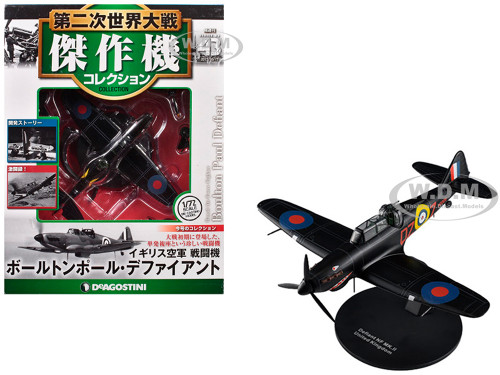
Boulton Paul Defiant Aircraft "No. 151 Squadron" British Royal Air Force 1/72 Diecast Model by DeAgostini
$26.95WasAdd to Cart The item has been added$26.95WasAdd to Cart The item has been added