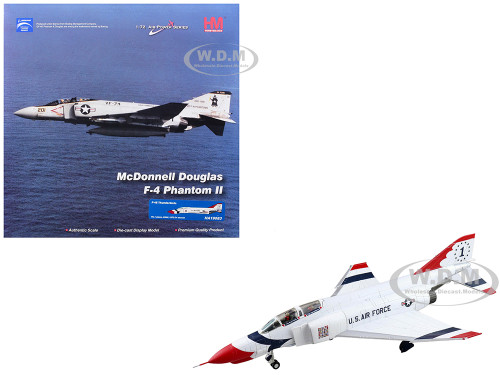


- Brand new 1/72 scale diecast model of McDonnell Douglas F-4C Phantom II Fighter-Bomber Aircraft "63-7666, William Tell, 57th FIS, Keflavik Airport, Iceland" (1977) United States Air Force "Air Power Series" die cast model by Hobby Master.
- Brand new box.
- Detailed exterior.
- True-to-scale detail.
- Includes pilot figure.
- Has opening canopy.
- Includes display stand.
- Officially licensed product.
- Detachable ordnance loads.
- Has detachable landing gear.
- Manufacturer's original unopened packaging.
- Dimensions approximately Length- 9.75, Wingspan- 6.25 inches.
- Diecast metal and plastic construction for durability and a heavy, realistic feel.
- It is a highly detailed and accurate model, perfect for collectors and enthusiasts of military history.
- Realistic panel lines, antennas, access panels, and surface details for an authentic representation of the real-life airplane.
HISTORY ASPECTS:
The McDonnell Douglas F-4C Phantom II “William Tell,” serial 63-7666, served with the 57th Fighter Interceptor Squadron of the United States Air Force during a critical period of Cold War air defense operations. Operated by the United States Air Force, the McDonnell Douglas F-4 Phantom II was originally developed as a high-speed interceptor and multi-role combat aircraft. The F-4C variant was among the earliest USAF versions, equipped for both air defense and strike missions, and became a backbone of American air power during the 1960s and 1970s.
By 1977, aircraft 63-7666 was stationed at Keflavik Air Base, where the 57th FIS played a vital role in NATO’s air defense network. From this strategically important location in the North Atlantic, the squadron conducted Quick Reaction Alert (QRA) missions, intercepting and identifying Soviet reconnaissance and bomber aircraft operating near NATO airspace during the height of Cold War tensions. The F-4C’s speed, radar capability, and long-range performance made it ideal for the demanding conditions of Arctic interception missions.
Although not engaged in conventional “hot” combat, the aircraft participated in what is often referred to as the Cold War’s continuous operational conflict—deterring and responding to potential incursions that formed part of the broader East-West confrontation. The “William Tell” name also reflects the legacy of air combat proficiency competitions and interceptor excellence, symbolizing precision and readiness. Aircraft like 63-7666 helped maintain NATO air sovereignty over the North Atlantic, ensuring rapid response capability in one of the world’s most strategically sensitive regions.
This 1:72 scale model is a powerful tribute to Cold War air defense aviation. Featuring authentic markings and detailed Phantom interceptor configuration, it captures the intensity and vigilance of NATO’s Arctic air patrol missions. Perfect for collectors of military aviation history, this replica honors the silent but critical service of Cold War defenders, add it to your collection today for a bold and historically significant centerpiece.
Shipping Policy
- Processing Time: All orders are processed and shipped within 1–2 business days.
- Standard Shipping: Delivered within 2–5 business days.
- Order Tracking: A tracking number will be sent via email as soon as your package ships.
Returns & Exchanges
- Hassle-Free Returns: We accept returns within 30 days of delivery.