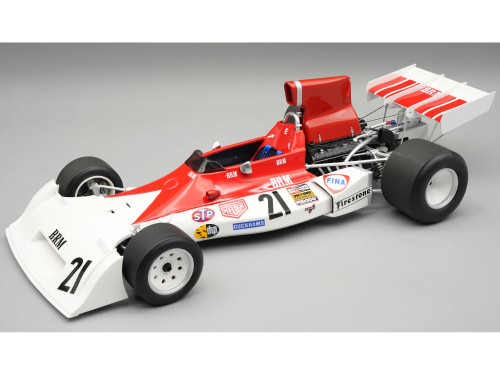
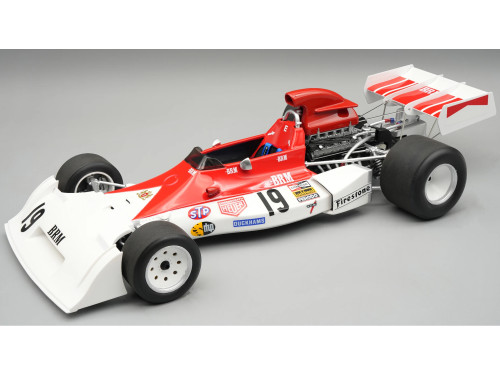
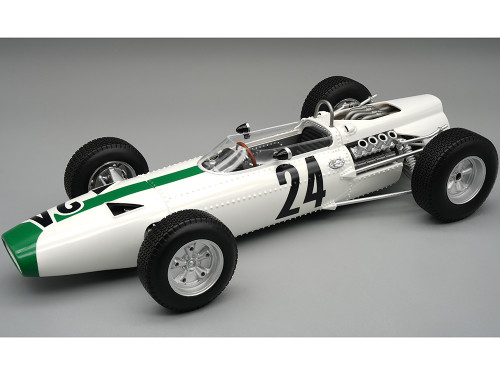
BRM diecast models celebrate one of the most distinctive names in British Formula 1 history: British Racing Motors. Founded in the years following World War II, BRM was created with an ambitious goal of producing an all-British Grand Prix car capable of competing at the highest level of international motor racing. Over more than two decades, the team produced a remarkable succession of racing cars, from the technically ambitious V16-powered P15 to the championship-winning P578, the striking V12-powered P153 and P160, and the final factory-built P201.
For collectors, BRM diecast models offer an opportunity to own miniature representations of some of the most historically significant British Formula 1 cars. The marque is especially appealing to enthusiasts interested in classic Formula 1, British racing history, Grand Prix cars, legendary drivers, and technically distinctive racing machines.
The History of British Racing Motors
British Racing Motors, commonly known as BRM, was founded shortly after World War II by Raymond Mays and engineer Peter Berthon. Mays had already established a reputation in British motor racing through ERA, while the new BRM project was intended to showcase British engineering at the international Grand Prix level.
The project was ambitious from the beginning. BRM sought to build an entire Grand Prix car in Britain, including its own engine, rather than simply purchasing a proven power unit from another manufacturer. Financial and organizational difficulties slowed the program, but the result was one of the most unusual Formula 1 cars ever constructed: the BRM Type 15 P15 V16.
Sir Alfred Owen and the Rubery Owen industrial group took control of BRM in 1952, providing the foundation for a more organized racing operation. BRM subsequently moved toward simpler and more practical designs, eventually achieving its first World Championship Grand Prix victory with the P25 in 1959.
The team's greatest achievement came in 1962, when Graham Hill won the Formula 1 World Drivers' Championship and BRM secured the Constructors' Championship with the P578. BRM continued competing through the 1960s and 1970s, producing memorable cars and working with drivers including Juan Manuel Fangio, Stirling Moss, Graham Hill, Jackie Stewart, Jo Siffert, Pedro Rodríguez, and Niki Lauda.
BRM P15 V16
The BRM P15 V16 is arguably the most recognizable early BRM racing car and one of the most technically ambitious Grand Prix cars of its era.
The Type 15 used a highly unusual 1.5-liter supercharged V16 engine. The engine's complexity and enormous performance potential were central to BRM's postwar identity. The first BRM V16 made its public racing debut at Silverstone in 1950, in front of a huge crowd that included King George VI and Queen Elizabeth. Its debut ended prematurely with a mechanical failure, illustrating the reliability problems that initially affected the program.
The V16's career was complicated by changes in Formula 1 regulations and the enormous engineering challenge of keeping such a sophisticated powerplant reliable. Nevertheless, when operating properly, the BRM could deliver extraordinary performance for its time.
The P15 is particularly attractive as a diecast model because its long, narrow body, exposed wheels, cockpit, and distinctive engineering make it immediately different from later Formula 1 cars.
Collectors interested in early Grand Prix racing will often consider the P15 an essential BRM subject.
BRM P25 and the First Grand Prix Victory
After the difficulties surrounding the V16, BRM moved toward a much simpler design with the P25.
The P25 used a 2.5-liter four-cylinder engine and a conventional front-engine layout. Although the car initially suffered reliability problems, development eventually transformed it into a competitive Grand Prix machine.
The breakthrough came at the 1959 Dutch Grand Prix at Zandvoort, where Joakim Bonnier drove a BRM P25 to victory. This was BRM's first World Championship Formula 1 Grand Prix win and an important turning point in the team's history.
The timing was significant because Formula 1 was rapidly moving toward rear-engine designs. BRM responded with the P48, beginning another important phase in the company's development.
BRM P48 and the Rear-Engine Revolution
The BRM P48 was BRM's first rear-engine Formula 1 car. Rather than being an entirely clean-sheet design, it was developed from the P25 as BRM responded to the rapidly changing competitive environment.
The rear-engine revolution had been accelerated by the success of Cooper's compact Grand Prix cars. With more teams adopting the layout, BRM needed to adapt if it wanted to remain competitive.
The P48 competed during the 1960 season and represented an important technical transition for BRM. Although it did not achieve the success of the later P57/P578, it is historically significant because it shows the team moving away from its earlier front-engine philosophy.
For collectors building a chronological BRM display, a P48 model can provide an interesting link between the front-engine P25 and the championship-winning cars of the early 1960s.
BRM P578 "Old Faithful"
The BRM P578, often simply associated with the P57, is one of the most important cars in BRM history.
Powered by BRM's 1.5-liter V8 engine, the car was driven by Graham Hill during BRM's greatest season. In 1962, Hill won the Drivers' Championship while BRM captured the Constructors' Championship.
One particular car became famous as "Old Faithful." The car accumulated an unusually long racing career and became closely associated with Hill's championship season. BRM describes it as arguably the most famous car in the marque's history.
A BRM P578 model therefore represents much more than a generic 1960s Formula 1 car. It connects directly to one of the defining championship seasons in British motorsport.
BRM P261
The BRM P261 was another major success of the 1960s and is frequently regarded as one of the most elegant BRM designs.
The car competed during the 1.5-liter Formula 1 era and achieved victories with drivers including Graham Hill. Its compact proportions and distinctive green BRM appearance make it particularly attractive as a display model.
BRM itself identifies the P261 as its most successful car in terms of races won and total championship points before the arrival of the later H16 and V12-powered designs.
For collectors, the P261 is an excellent representation of BRM's transition into the modern rear-engine Formula 1 era.
BRM H16
One of BRM's most unusual engineering experiments was the H16 engine.
The concept combined two horizontally opposed eight-cylinder engine banks into an H configuration. The result was technically fascinating but heavy and complicated. BRM's H16-powered cars illustrate the experimental character that had been part of the team's identity since the V16 program.
The H16 is particularly interesting for collectors who appreciate engineering history. Unlike a conventional V8 or V12, the H16 demonstrates BRM's willingness to explore unconventional solutions during a period when Formula 1 regulations and technology were changing rapidly.
BRM P153 and P160
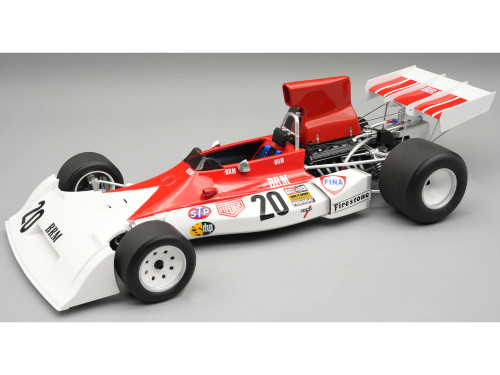
The early 1970s brought another distinctive chapter in BRM's history with the P153 and P160, both powered by 3.0-liter BRM V12 engines.
The P153 was designed by Tony Southgate and raced during the 1970, 1971, and 1972 seasons. Pedro Rodríguez drove the P153 to victory at the 1970 Belgian Grand Prix, giving BRM another important Formula 1 win.
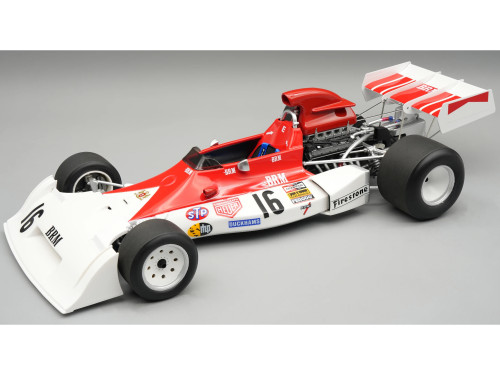
The P160 followed with an even longer competitive career. It was also designed by Tony Southgate and raced from 1971 through 1974. The car achieved three Grand Prix victories, including wins for Jo Siffert and Jean-Pierre Beltoise.
The P160 is especially interesting to collectors because of its changing liveries. Depending on the race and season, BRM models can represent cars in different sponsor colors, including the distinctive Marlboro BRM appearance associated with Beltoise.
The P160 period also has a direct connection to Niki Lauda, who joined BRM in 1973. His time with the team helped establish his reputation before his move to Ferrari and eventual World Championship success.
BRM P201 and the Final Factory Cars
The BRM P201 represents the final chapter of BRM's factory-produced Formula 1 cars.
Powered by a 3.0-liter V12, the P201 competed during the 1974 season. Jean-Pierre Beltoise scored a second-place finish at the South African Grand Prix, which remains the last World Championship podium and final points-scoring achievement associated with a BRM factory car.
The P201 provides an important endpoint for collectors tracing BRM's evolution from the spectacular V16 of the early 1950s through the championship-winning P578 and the V12-powered cars of the 1970s.
BRM and Legendary Formula 1 Drivers
One of the strongest reasons to collect BRM models is the team's connection with some of the greatest names in Grand Prix racing.
Depending on the car and period, BRM competed with drivers including:
- Juan Manuel Fangio
- Stirling Moss
- Graham Hill
- Dan Gurney
- Joakim Bonnier
- Jackie Stewart
- Pedro Rodríguez
- Jo Siffert
- Jean-Pierre Beltoise
- Niki Lauda
This creates many opportunities for collectors to build a driver-focused display. A Graham Hill P578, for example, represents BRM's championship-winning 1962 season, while a P153 or P160 can represent the team's V12 era and drivers such as Rodríguez, Siffert, Beltoise, and Lauda.
Collecting BRM Diecast Models
BRM models appeal particularly to collectors of classic Formula 1 diecast cars, historic Grand Prix cars, British racing cars, and motorsport memorabilia.
When selecting a BRM model, consider several details beyond the car's basic appearance:
- Race car: Identify the specific BRM chassis or model designation.
- Driver: Determine which driver is represented.
- Season: BRM cars could change configuration and livery during their racing careers.
- Race: Some models represent a particular Grand Prix or race-winning configuration.
- Livery: Sponsor colors can distinguish otherwise similar cars.
- Scale: Choose a size that works with the rest of your Formula 1 collection.
- Manufacturer: Different manufacturers may emphasize different levels of exterior detail and presentation.
The distinction between a P15 V16, P25, P48, P578, P261, P153, and P160 is particularly important because each represents a different stage of BRM's technical and competitive development.
BRM Models for Formula 1 Collections
BRM diecast models can work particularly well in a chronological Formula 1 display.
A collection might begin with the dramatic P15 V16, followed by the front-engine P25, rear-engine P48, championship-winning P578, P261, and later V12-powered P153 and P160. Together, these cars show how Formula 1 changed from the early postwar period into the sophisticated Grand Prix racing environment of the 1970s.
The models can also be displayed alongside other historically important British Formula 1 marques, allowing collectors to compare BRM with the racing cars of Lotus, Cooper, Brabham, Vanwall, and other constructors.
Why Collect BRM Diecast Racing Cars?
BRM is especially appealing because its history combines ambition, engineering experimentation, championship success, and distinctive racing design. Few Formula 1 constructors produced such a diverse succession of technically unusual cars.
The P15 V16 represents the ambitious beginnings of the postwar project. The P25 delivered BRM's first World Championship Grand Prix victory. The P578 brought Graham Hill and BRM their 1962 World Championships. The P261 became one of the team's most successful designs, while the P153 and P160 carried BRM into the V12 era.
Whether your interest is Graham Hill, Niki Lauda, classic British racing, Formula 1 engineering, or historically significant Grand Prix cars, a BRM diecast model can add an important piece of motorsport history to your collection.
Browse the BRM diecast model collection at DiecastModelsWholesale.com to explore available British Racing Motors race cars and find a BRM model that fits your Formula 1 collection.

 $299.99