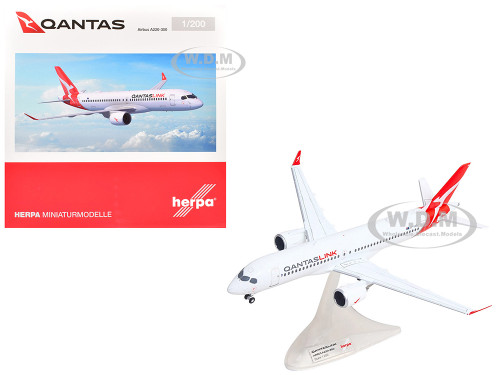
Qantas Airways is one of the most recognizable names in international aviation. Founded in Australia in 1920, the airline developed from a small regional air service into a major carrier connecting Australia with destinations across the world. Its distinctive red tail and flying kangaroo emblem have become enduring symbols of Australian aviation, making Qantas Airways diecast airplane models appealing to collectors of commercial aircraft, airline memorabilia, and historically significant passenger planes.
This category focuses on collectible airplane models featuring Qantas Airways liveries. Depending on available inventory, collectors may find models representing different generations of the airline's fleet, from classic propeller-driven airliners and pioneering Boeing jets to modern Airbus and Boeing widebody aircraft.
Whether you are building an international airline collection, recreating a favorite aircraft, or looking for a gift for an aviation enthusiast, Qantas models offer a way to celebrate the history, design, and global reach of Australia's best-known airline.
The History of Qantas Airways
From the Australian outback to international aviation
Qantas was registered as Queensland and Northern Territory Aerial Services Limited on November 16, 1920. Its founders envisioned an air service that could connect remote communities across Queensland and the Northern Territory, where vast distances made transportation challenging. The company began with small aircraft and developed its early operations around regional transportation, charter flights, and mail services.
Scheduled mail and passenger services began in 1922. In its early years, Qantas helped connect isolated settlements with larger communities, demonstrating how aviation could improve communication and transportation across Australia's interior.
The airline's ambitions soon extended beyond domestic routes. In 1934, Qantas joined with Britain's Imperial Airways to establish Qantas Empire Airways. International services began in 1935, connecting Brisbane with Singapore as part of the longer air route between Australia and the United Kingdom.
During the late 1930s, flying boats became an important part of long-distance travel. These aircraft could operate from suitable waterways and helped Qantas serve international destinations before modern long-range land-based airliners became commonplace.
Wartime aviation and the postwar expansion
World War II significantly affected Qantas operations. Aircraft and personnel supported wartime transportation requirements, while the airline maintained important connections under difficult conditions. One of its most notable wartime services involved Catalina flying boats operating long-distance flights across the Indian Ocean between Australia and Ceylon, now Sri Lanka.
After the war, Qantas expanded its international network with larger, more capable aircraft. The Lockheed Constellation family helped the airline develop long-distance services to Europe, Asia, and Africa. In 1947, Qantas introduced the celebrated Kangaroo Route between Sydney and London, although the journey required multiple stops and took considerably longer than modern long-haul flights.
These early international services are especially relevant to aviation collectors because they represent the period when Qantas developed the global identity it retains today. Models of classic piston-powered airliners can help illustrate the technology and distinctive aircraft designs that made long-distance passenger travel possible.
Entering the jet age
The arrival of the Boeing 707 in 1959 marked a major turning point. Qantas became the first airline outside the United States to operate the Boeing 707, introducing jet-powered passenger service on routes that had previously required much longer travel times.
The Boeing 707's swept wings, four jet engines, and streamlined fuselage made it visually distinct from earlier propeller airliners. Its introduction helped establish the modern jet age at Qantas and expanded the possibilities for international passenger travel.
The Boeing 747 followed in 1971. Commonly known as the Jumbo Jet, it offered substantially greater passenger capacity and became one of the most recognizable aircraft in the airline's history. Qantas operated several generations of the 747, including the long-range 747-400, which became closely associated with intercontinental travel.
For collectors, the 707 and 747 represent two important stages in the development of commercial aviation. Their different proportions, engine arrangements, and historical roles make them particularly interesting subjects for a collection of Qantas aircraft.
Modernization and the 21st century
Qantas continued to modernize its fleet as aircraft technology evolved. The Airbus A330 became an important part of domestic and international operations, while the Airbus A380 introduced a new era of very large passenger aircraft. The Boeing 787 Dreamliner later brought advanced aerodynamics, composite construction, and improved fuel efficiency to long-distance routes.
The airline also operated aircraft such as the Boeing 737 on domestic and regional services, demonstrating the variety of aircraft needed to serve Australia's extensive domestic network alongside its international routes.
In 2020, Qantas celebrated its centenary. Its long history, distinctive visual identity, and succession of important aircraft types make it a compelling subject for collectors interested in the evolution of commercial aviation.
Notable Qantas Aircraft for Diecast Collectors
Qantas has operated many aircraft types over its history. The following examples are useful reference points when exploring the airline's aircraft heritage. Their inclusion here does not indicate that every type is currently available as a model.
Boeing 707
The Boeing 707 symbolizes Qantas's transition into the jet age. With four engines mounted beneath swept wings, it helped establish faster and more practical international passenger services during the late 1950s and 1960s.
A Qantas Boeing 707 model can be a valuable addition to a vintage airline collection, particularly for collectors interested in early jetliners and the development of long-haul travel. Its classic silhouette also contrasts nicely with later widebody aircraft.
Boeing 747
Few aircraft are as closely associated with Qantas as the Boeing 747. The airline introduced the Jumbo Jet in 1971 and operated different variants over several decades. The aircraft's distinctive upper-deck hump, broad fuselage, and four-engine configuration make it instantly recognizable.
The Boeing 747-400 became particularly important to long-distance operations, including flights between Australia and Europe. Qantas aircraft also appeared in different liveries over the years, giving collectors opportunities to explore changes in airline branding and aircraft presentation.
For many aviation enthusiasts, a Qantas 747 is a centerpiece for an international airline display. Its size and recognizable profile make it especially appealing when displayed alongside other classic widebody airliners.
Airbus A380
The Airbus A380 represents a more recent chapter in Qantas history. As a double-deck, four-engine passenger aircraft, it was designed for high-capacity long-distance routes. Qantas introduced the A380 to its fleet in the late 2000s.
A Qantas A380 model offers a striking contrast to smaller narrowbody aircraft and early jetliners. Its full-length double-deck fuselage and large wings make it easy to recognize, even in a collection containing aircraft from several airlines.
Collectors interested in contemporary long-haul aviation may appreciate the A380 as a representation of the scale and engineering of modern passenger aircraft.
Boeing 787 Dreamliner
The Boeing 787 Dreamliner illustrates the shift toward modern long-range aircraft designed with an emphasis on efficiency and passenger comfort. Qantas introduced the 787-9 on international routes, including services connecting Australia with destinations farther afield.
Its distinctive curved wingtip design, swept wings, and twin-engine configuration set it apart from the four-engine 747 and A380. A Qantas 787 model can represent the airline's more recent international operations and the evolution of long-haul aircraft design.
Airbus A330 and Boeing 737
The Airbus A330 and Boeing 737 highlight the variety of aircraft used across Qantas's network. The twin-engine A330 has served domestic and international routes, while the Boeing 737 has played a major role in domestic passenger transportation.
These aircraft may be particularly interesting to collectors who want to represent more than Qantas's famous long-haul fleet. Including different aircraft sizes and roles can create a more complete picture of the airline's operations, from domestic travel to intercontinental flights.
What Makes Qantas Airline Models Collectible?
Qantas aircraft appeal to collectors for several reasons beyond the airline's name recognition.
-
The flying kangaroo emblem: The kangaroo is one of the most recognizable symbols in aviation and provides a distinctive visual feature across many Qantas liveries.
-
A century of airline history: Qantas offers a broad timeline of aircraft development, from early propeller planes to modern widebody jets.
-
Classic and contemporary aircraft: Collectors can explore different eras of aviation through aircraft such as the Boeing 707, 747, Airbus A380, and Boeing 787.
-
Australian aviation heritage: Qantas models represent an airline closely connected to Australia's geography, transportation history, and international identity.
-
International airline displays: Qantas aircraft can complement models from European, Asian, North American, and other international carriers.
Some collectors focus on a single airline, while others organize their collections by aircraft manufacturer, aircraft family, historical period, or scale. Qantas models can fit naturally into any of these approaches.
Choosing the Right Qantas Diecast Airplane Model
Select an aircraft that fits your collection
Consider whether you prefer historic airliners, early jet aircraft, classic Jumbo Jets, or modern passenger planes. If your collection emphasizes aviation history, a model representing an earlier generation may be especially appropriate. If you are assembling a display of contemporary international aircraft, a model of the A380 or 787 may be a better fit.
You may also want to compare aircraft sizes and shapes. A Boeing 707, for example, has a narrower fuselage and four engines, while a Boeing 747 features the distinctive upper deck. These visual differences help create variety when several models are displayed together.
Understand scale and display space
Scale describes the relationship between the model's dimensions and those of the real aircraft. The right scale depends on the space you have available and whether you want to display individual aircraft or build a larger airline fleet.
-
1:200 scale: Often suitable for collectors who want a more prominent aircraft model with room for visible exterior details.
-
1:400 scale: A popular format for displaying multiple commercial aircraft together in a compact space.
-
1:500 scale: Can suit collectors looking for a smaller footprint for airline fleets or airport-style displays.
-
Other scales: Availability varies by aircraft type, manufacturer, and release.
These are general scale considerations, not a guarantee that Qantas models are available in every size. Check each product listing for the confirmed scale and dimensions before purchasing.
Check livery and product details
Qantas has updated its aircraft markings over time while retaining the flying kangaroo as a central part of its identity. Depending on the model, collectors may encounter different versions of the red tail, kangaroo emblem, lettering, and aircraft registration.
If historical accuracy is important to you, compare the specific livery and aircraft variant with the period you want to represent. Product listings should also be checked for details such as construction materials, stand inclusion, and packaging, since these features can differ between releases.
Qantas Airplane Models for Gifts and Aviation Displays
A Qantas Airways diecast airplane model can make a thoughtful gift for an aviation enthusiast, frequent traveler, airline memorabilia collector, or anyone with a connection to Australia. The airline's recognizable livery and varied aircraft history offer plenty of options for people with different interests.
For a gift, consider the recipient's favorite aircraft, preferred scale, and available display space. A classic Boeing 747 may appeal to someone who remembers the Jumbo Jet era, while an Airbus A380 or Boeing 787 may suit a collector interested in modern international aviation.
If you are building an airline collection, Qantas models can also be displayed alongside aircraft from other international carriers to illustrate the development of global passenger travel. For a more focused arrangement, models representing different Qantas aircraft generations can show how the airline's fleet evolved over time.
Available models, aircraft variants, scales, and finishes may change, so review the individual product listings for current selection and specifications. Browse the Qantas Airways category at Diecast Models Wholesale to discover available collectible aircraft and find a model that belongs in your aviation collection.