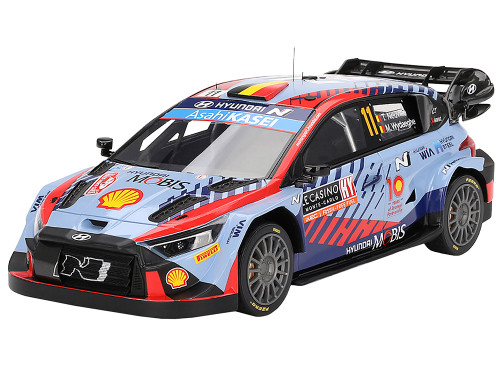
Monte Carlo racing models celebrate the Chevrolet Monte Carlo's important place in American stock car racing and NASCAR history. Introduced for the 1970 model year, the Monte Carlo became one of the most recognizable Chevrolet nameplates associated with NASCAR, appearing in multiple generations of race cars and carrying the liveries of legendary drivers, teams, and sponsors.
This category features Monte Carlo diecast racing models representing competition cars from different eras. Collectors can find scale replicas connected to famous drivers, race teams, championship seasons, race victories, and distinctive NASCAR paint schemes. For enthusiasts of classic stock cars and American motorsport, Monte Carlo models offer a way to collect an important part of NASCAR's transition from production-based automobiles to highly developed racing machines.
Shop Monte Carlo Diecast Racing Models
A Monte Carlo racing model can represent much more than the Chevrolet body style itself. The specific race car may be associated with a particular driver, team, sponsor, race, season, or championship. Details such as the car number, graphics, wheels, body shape, spoiler, and racing livery can help identify the era and competition history represented by a model.
The Monte Carlo's NASCAR story spans several generations. NASCAR's own historical overview identifies Chevrolet Monte Carlo race cars in both the Generation 2 era of 1967–1980 and the Generation 4 era of 1992–2006, illustrating how the model appeared as stock-car design evolved.
This makes Monte Carlo racing models particularly interesting for collectors who enjoy comparing the changing appearance of NASCAR cars over time.
Chevrolet Monte Carlo and NASCAR History
The Chevrolet Monte Carlo was introduced as a personal luxury coupe, but its sleek proportions also made it a significant presence in motorsports. Its connection with NASCAR developed during an era when manufacturers increasingly paid attention to aerodynamics and the relationship between production cars and their racing counterparts.
NASCAR's official historical material identifies a 1977 Chevrolet Monte Carlo as an example of the period when American muscle and increasingly advanced aerodynamics were influencing stock-car design.
The Monte Carlo's racing identity continued through subsequent generations, including the aerodynamic Monte Carlo SS Aerocoupe. Chevrolet's period documentation described the Aerocoupe's sloping rear window and aerodynamic body treatment as developments influenced by its racing program.
For collectors, these differences make models from different Monte Carlo eras visually distinctive even when they represent the same basic Chevrolet nameplate.
Famous Monte Carlo Racing Eras
1970s Monte Carlo Stock Cars
The Monte Carlo entered NASCAR during the 1970s, a period when stock cars were evolving rapidly. Racing versions were becoming increasingly specialized while still retaining recognizable connections to showroom automobiles.
The 1977 Monte Carlo is particularly representative of this transition. NASCAR includes the car in its historical evolution of stock-car design, while drivers such as Darrell Waltrip developed strong associations with Monte Carlo race cars during the period. NASCAR has documented Waltrip's 1977 Chevrolet Monte Carlo, nicknamed “Bertha,” as a particularly successful car that won numerous Cup races between 1977 and 1980.
A diecast model from this period can therefore represent both the Monte Carlo's design and the broader evolution of late-1970s NASCAR.
1980s Monte Carlo and Aerocoupe
The 1980s brought an especially recognizable chapter in Monte Carlo racing history. NASCAR's third-generation stock cars featured a 110-inch wheelbase and increasingly aerodynamic body designs.
The Monte Carlo SS Aerocoupe became one of the most distinctive examples. Its sloped rear window was closely associated with aerodynamic development and NASCAR homologation requirements. Chevrolet's period material specifically connected the production Aerocoupe with its racing development.
A 1986 Monte Carlo Aerocoupe associated with Darrell Waltrip is also preserved as part of the NASCAR Hall of Fame's Glory Road collection, illustrating the model's historical importance within the sport.
For diecast collectors, the Aerocoupe era is especially appealing because the combination of the sloping rear glass, aggressive stock-car proportions, racing numbers, and period liveries creates a very recognizable display piece.
1990s Monte Carlo
The Monte Carlo returned to a prominent position in NASCAR's fourth-generation era. NASCAR describes the 1992–2006 Generation 4 cars as highly modified racing machines, with extensive aerodynamic development and body panels based on their production counterparts.
The Monte Carlo became closely associated with Jeff Gordon's NASCAR career. NASCAR's historical material notes that Chevrolet switched from the Lumina to the Monte Carlo and that Gordon drove the Monte Carlo to four championships.
Monte Carlo models from the 1990s can therefore appeal to collectors interested in one of the most recognizable periods of modern NASCAR, particularly when a model represents a specific driver, team, sponsor, or championship season.
2000s Monte Carlo
The Monte Carlo continued into the early 2000s as NASCAR race cars became increasingly specialized. The generation featured extensive aerodynamic development and race-specific engineering, while the production-based body styling still gave the cars recognizable Chevrolet identity.
The 2006 Chevrolet Monte Carlo SS is especially significant in NASCAR collecting. NASCAR has documented a 2006 Monte Carlo as the championship car associated with Jimmie Johnson, representing the final years of the Monte Carlo's NASCAR-era prominence.
This makes 2000s Monte Carlo diecast models useful for collectors building a chronological NASCAR display or documenting the evolution of Chevrolet's stock-car designs.
Collect Monte Carlo Models by Driver
One of the most popular ways to collect racing diecast is by driver. A Monte Carlo collection can be organized around drivers whose careers included Chevrolet stock cars, with each model representing a particular season or racing achievement.
Depending on the models available, collectors may encounter Monte Carlo race cars associated with names such as:
- Richard Petty
- Darrell Waltrip
- Dale Earnhardt
- Jeff Gordon
- Jimmie Johnson
- Dale Earnhardt Jr.
- Other NASCAR drivers from the Monte Carlo era
Driver-focused collecting becomes especially interesting when the same driver is represented by different Monte Carlo body styles, teams, sponsors, or seasons.
Collect by Race Team, Number, and Livery
Monte Carlo racing models can also be collected according to race team, car number, sponsor, or livery.
The paint scheme is an important part of a NASCAR diecast model because sponsorship graphics and team colors often identify the exact period and entry being represented. Two Monte Carlo models from the same production generation can look dramatically different when they represent different teams or seasons.
Collectors may choose to build a display around:
- A favorite NASCAR driver
- A specific race team
- A car number
- A championship season
- A memorable race
- A particular sponsor or livery
- A single Monte Carlo generation
- The evolution of Chevrolet NASCAR race cars
This approach can turn a group of individual models into a chronological or thematic motorsport collection.
Monte Carlo Models by Scale
Scale is another important consideration when choosing a racing model. The best scale depends on the amount of available display space and whether you want a small group of cars or a detailed collection spanning many seasons.
1:18 Monte Carlo Models
1:18 Monte Carlo models provide a larger format for collectors who want a prominent display piece. The additional size can showcase the body shape, racing graphics, wheels, interior, and other details.
1:24 Monte Carlo Models
1:24 is a popular scale for NASCAR and American racing subjects. It offers a practical combination of display size and detail and works especially well for collections featuring multiple drivers or seasons.
1:64 Monte Carlo Models
1:64 Monte Carlo models provide a compact way to collect multiple racing subjects. They are useful when you want to represent numerous drivers, teams, paint schemes, or seasons without requiring a large display area.
Always check the individual product specifications for exact scale and dimensions, since availability varies by model and manufacturer.
Build a NASCAR Display Around Monte Carlo Models
Monte Carlo racing models can be displayed individually or incorporated into a larger NASCAR and motorsport collection. Collectors can combine different Monte Carlo generations to show how stock-car design changed from the 1970s through the 2000s.
For a broader selection of American racing subjects, explore Racing Models and NASCAR. You can also add Dioramas & Scenes and Figures & Figurine Sets to create a more complete motorsport presentation.
For collectors focused on presentation and protection, Display Cases and Display Stands & Turntables provide additional options for showcasing individual cars or an entire racing collection.
Start or Expand Your Monte Carlo Collection
From the aerodynamic Monte Carlo stock cars of the 1970s and 1980s to the championship-era cars of the 1990s and 2000s, Chevrolet Monte Carlo racing models represent several important chapters in NASCAR history.
Whether you collect a favorite driver, follow a particular team or car number, focus on championship cars, or simply appreciate the evolution of American stock-car design, Monte Carlo diecast models provide a distinctive way to explore NASCAR's past.
Browse the Monte Carlo racing models at DiecastModelsWholesale.com to find scale replicas that can add legendary Chevrolet stock cars, drivers, teams, and racing liveries to your collection.





 $738.99