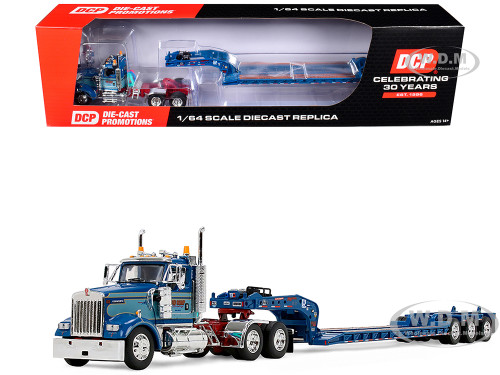
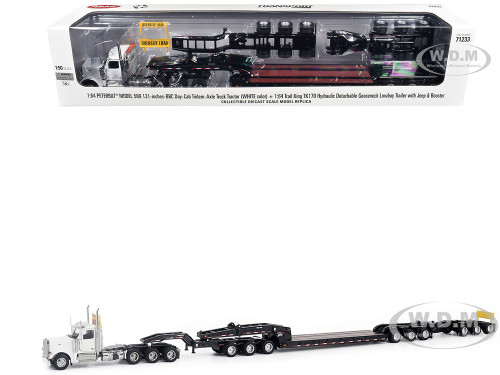
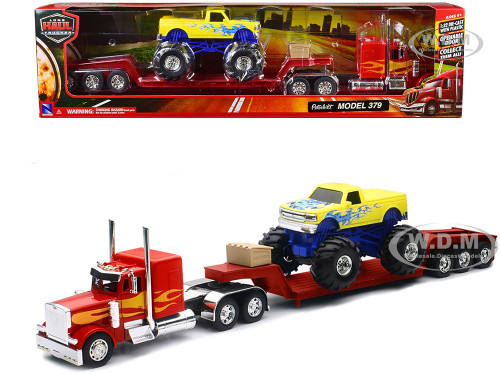
Lowboy trailers are specialized heavy-haul equipment trailers designed to transport tall, heavy, and oversized machinery while keeping the load as low to the ground as practical. Their defining characteristic is a lowered deck positioned between the trailer's front and rear sections. This low deck height helps reduce the overall height of a loaded trailer, an important consideration when transporting construction equipment beneath bridges, overpasses, power lines, and other height-restricted areas.
For diecast collectors, Lowboy trailer models represent one of the most recognizable types of heavy equipment transportation equipment. Their long frames, low decks, multiple axles, ramps, and heavy-duty construction make them especially appealing alongside scale excavators, bulldozers, loaders, cranes, and heavy-duty truck tractors.
What Is a Lowboy Trailer?
A lowboy is a type of semi-trailer specifically designed to haul heavy equipment. It is sometimes called a lowboy trailer, low-bed trailer, low-loader, lowbed, or lowboy equipment trailer, depending on the region and application.
Unlike a conventional flatbed, a lowboy has a depressed center section where the equipment sits. The lower deck allows tall machinery to be carried without making the entire combination excessively high.
The basic design typically consists of a front section that connects to the truck tractor, a lowered main deck for the cargo, and a rear section incorporating the trailer's axles. Loading ramps at the rear allow wheeled or tracked machinery to be driven onto the trailer.
Some lowboys use a detachable gooseneck or detachable front assembly. This configuration can allow the front of the trailer to be removed or lowered so equipment can be loaded directly from ground level. The exact design varies according to the trailer's intended payload and loading requirements.
Built for Heavy Construction Equipment
Lowboy trailers are strongly associated with the construction and heavy-equipment industries. Their low deck and substantial load capacity make them well suited to machinery that would be difficult to transport on a standard trailer.
Common loads include:
- Excavators
- Bulldozers
- Wheel loaders
- Motor graders
- Compactors
- Scrapers
- Pavers
- Forestry equipment
- Mining equipment
- Cranes and specialized machinery
This relationship with heavy equipment makes lowboy trailers particularly interesting for collectors of Construction diecast models. A lowboy loaded with an excavator or dozer can immediately communicate the scale and purpose of a construction transportation scene.
Why the Low Deck Matters
The primary advantage of a lowboy trailer is its reduced deck height. When a large machine is placed on a conventional trailer, the trailer deck and the machine's height are added together. With especially tall equipment, this can create a significant overall transport height.
Lowering the equipment deck reduces that combined height. The machine can therefore be transported while providing more clearance beneath bridges and other overhead structures.
The low deck also creates a distinctive appearance that is easy to recognize in scale. The machinery sits noticeably lower than it would on a standard flatbed, while the trailer's frame rises toward the front and rear.
For collectors, this unusual geometry is one of the main reasons lowboy models make such interesting additions to heavy-haul displays.
Lowboy Trailer Configurations
Not every lowboy looks the same. Trailer manufacturers build different configurations for different equipment and hauling requirements.
Fixed-Neck Lowboys
A fixed-neck lowboy has a permanent front section connecting the deck to the tractor. Ramps at the rear provide the loading route for equipment.
This is a relatively straightforward configuration and can be represented in a variety of scale model designs.
Detachable Gooseneck Lowboys
A detachable gooseneck, commonly abbreviated as RGN, allows the front portion of the trailer to be detached or lowered for loading. When the front is removed or lowered, equipment can often be driven or positioned directly onto the deck without relying solely on long rear ramps.
RGN-style trailers are particularly associated with heavy equipment transportation and are popular subjects for scale models.
Multi-Axle Lowboys
Heavy machinery can require trailers with numerous axles to distribute the load. Multi-axle lowboys have a substantial and highly recognizable appearance, making them especially attractive to collectors interested in heavy-haul equipment.
The number of axles and exact configuration varies by trailer and application, so collectors should check the specifications of individual models rather than assuming that every lowboy represents the same type of trailer.
Lowboy vs. Flatbed vs. Hydra Tail
Several trailer categories can be used to transport construction equipment, but their designs serve different purposes.
Lowboy vs. Flatbed
A Flatbed is essentially an open, level platform. It offers considerable flexibility for cargo but does not provide the same lowered deck arrangement as a lowboy.
Lowboys are specifically designed around the transportation of heavy and tall equipment, with the low center deck being their defining characteristic.
Lowboy vs. Hydra Tail
A Hydra Tail trailer uses a hydraulic loading tail to create a gradual loading path for equipment. Its defining feature is the hydraulic loading system.
A lowboy, on the other hand, is defined primarily by its low deck and heavy-equipment transport configuration. Some specialized trailers may incorporate features associated with more than one design, but the two categories should not be treated as interchangeable.
Lowboy vs. Equipment Trailer
"Equipment trailer" is a broad term that can describe many different trailer designs. A lowboy is a more specialized form of equipment trailer intended particularly for heavy and often tall machinery.
A Brief History of Heavy Equipment Trailers
The development of specialized equipment trailers followed the growth of mechanized construction and road transportation. Early heavy machinery was often moved short distances by its own power or transported using basic wagons and flat platforms. As construction equipment became larger, heavier, and more specialized, ordinary hauling methods became increasingly inadequate.
The expansion of highway transportation created another challenge: equipment needed to be moved between jobsites while remaining within practical height and weight limits. Lower trailer decks provided a solution by allowing large machinery to sit closer to the road surface.
The development of heavy-duty tractor-trailer systems, stronger trailer frames, hydraulic equipment, detachable goosenecks, improved suspension systems, and multi-axle configurations further expanded the capabilities of heavy-haul trailers.
Modern lowboys are the result of this continuing evolution. Their designs can be highly specialized, with configurations selected according to equipment dimensions, weight distribution, loading requirements, and the transportation route.
Details to Look for in Lowboy Diecast Models
A well-detailed lowboy trailer can have numerous mechanical and structural features for collectors to examine.
Depending on the particular model, look for:
- Low-positioned equipment deck
- Raised front neck or gooseneck
- Detachable or folding front assembly
- Loading ramps
- Multiple axles
- Heavy-duty tires and wheels
- Suspension components
- Trailer frame rails
- Hydraulic cylinders
- Landing gear
- Tie-down points
- Safety lighting
- Mudguards
- Deck reinforcement
- Manufacturer markings
These features can make a lowboy considerably more visually interesting than a simple open trailer.
Pairing a Lowboy With Construction Models
One of the best ways to appreciate a lowboy diecast model is to display it with the type of machinery it was designed to transport.
An excavator positioned on the deck can create a realistic equipment-delivery scene. A bulldozer can represent a machine being moved between construction projects, while a wheel loader or grader can create a different type of heavy-equipment transportation display.
Collectors can combine a lowboy with models from the Excavator, Dozer, and Loader categories to create a more complete construction fleet.
The towing vehicle is equally important. A heavy-duty Truck or Truck Tractor can be positioned ahead of the trailer to create a complete heavy-haul combination.
Scale Considerations for Collectors
Scale compatibility is important when adding a lowboy trailer to an existing collection. Heavy construction and commercial vehicle models are frequently produced in 1/50 and 1/64 scale, with other scales available depending on the manufacturer and specific model.
1/50 Scale
1/50 is particularly popular among collectors of construction equipment and heavy-haul vehicles. At this scale, the lowboy can provide enough room for detailed trailer structures, hydraulic components, ramps, and heavy machinery.
1/64 Scale
1/64 allows collectors to build larger transportation and construction scenes while conserving display space. A lowboy, tractor, excavator, and additional equipment can be combined into a compact diorama.
Other Scales
Lowboy-style trailers may also appear in other scales. Always check the individual product specifications to ensure that the trailer will match the equipment and truck models already in your collection.
Creating a Heavy-Haul Diorama
Lowboy trailers are excellent subjects for realistic diecast dioramas because they naturally suggest an active transportation scene.
A display could show a tractor-trailer combination arriving at a construction site with an excavator secured on the deck. Another arrangement could feature a lowboy with its ramps deployed while a dozer is being loaded. A construction equipment yard could include several machines waiting for transportation, with a lowboy positioned nearby.
For collectors who prefer highway scenes, a truck tractor pulling a loaded lowboy can represent an oversized-equipment transport operation. Details such as equipment tie-downs, ramps, support vehicles, and construction accessories can add additional realism.
What Makes Lowboy Models Collectible?
Lowboy trailers appeal to collectors because they combine practical engineering with a distinctive appearance. The low deck immediately identifies their purpose, while the heavy frame, multiple axles, ramps, and specialized neck create plenty of detail to appreciate.
They also expand the possibilities of a construction collection. Instead of displaying equipment only as individual machines, a lowboy provides a way to show how those machines are transported from one location to another.
For collectors interested in construction equipment diecast, heavy-haul models, commercial trucks, and scale transportation scenes, a lowboy trailer can be a particularly useful addition.
Shop Lowboy Trailer Diecast Models
Whether you are building a detailed construction diorama, collecting heavy-haul equipment, or simply looking for a distinctive trailer to pair with your scale trucks and machinery, lowboy models offer plenty of display possibilities.
Browse the Lowboy category at DiecastModelsWholesale.com to explore available scale heavy-equipment trailers and find a lowboy that fits your collection, construction scene, or heavy-haul display.