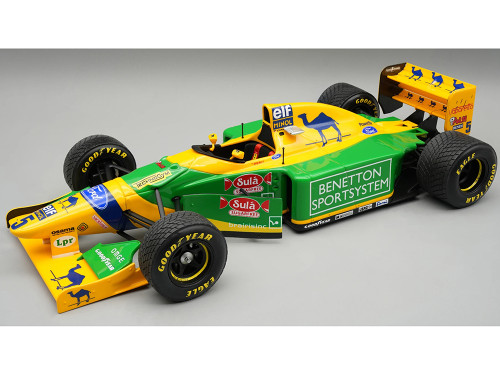
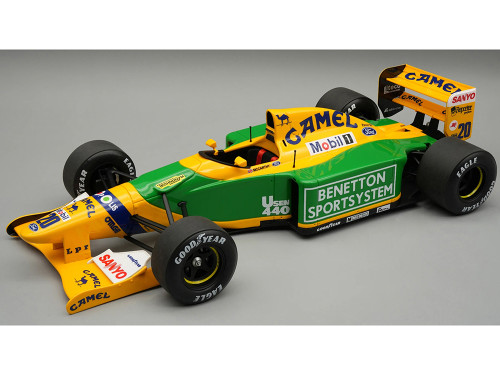
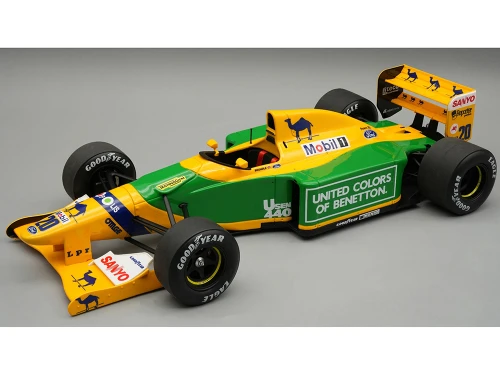
Benetton is one of the most recognizable names in modern Formula 1 history. Although the name is closely associated with the Italian fashion company, Benetton Formula became a significant Formula 1 constructor in its own right, competing from 1986 through 2001. The team is especially remembered for its bold liveries, innovative engineering, talented drivers, and its role in Michael Schumacher's first two Formula 1 World Championships.
For diecast collectors, Benetton Formula 1 models offer a way to collect some of the most memorable Grand Prix cars of the 1980s, 1990s, and early 2000s. From the turbocharged Benetton B186 to the championship-winning B194 and B195, Benetton race car models represent an important period in Formula 1 when technology, sponsorship, aerodynamics, and driver talent were rapidly evolving.
The Origins of Benetton Formula
Benetton's involvement in Formula 1 initially began as a sponsor rather than a constructor. The Benetton clothing company became involved with Formula 1 sponsorship in the early 1980s before purchasing the Toleman Formula 1 team in 1985. The team was officially renamed Benetton Formula for the 1986 season.
The new team inherited much of Toleman's technical organization, including engineers who would later become highly influential in Formula 1. The Benetton name quickly established itself on the grid, and the team's striking multicolor sponsorship liveries made its cars particularly easy to recognize.
The first Formula 1 car to race under the Benetton name was the B186, powered by a BMW turbocharged four-cylinder engine. German driver Gerhard Berger gave Benetton its first Grand Prix victory at the 1986 Mexican Grand Prix.
Benetton's Rise Through the 1980s
The B186 introduced Benetton to Formula 1 during the final years of the turbo era. As Formula 1 transitioned to naturally aspirated engines for 1989, Benetton continued to develop increasingly competitive cars.
Among the important early Benetton designs were the B187, B188, and B189. These cars reflect the rapid technical changes taking place during the late 1980s as teams moved away from turbocharged power and focused increasingly on naturally aspirated engines, aerodynamic efficiency, and chassis development.
The Benetton B190 became another significant car in the team's history. Driven by Alessandro Nannini and later Nelson Piquet, the B190 won two races during the 1990 season. Piquet's victories in Japan and Australia helped establish Benetton as a regular front-running team.
For collectors, these early cars are particularly interesting because they capture Benetton's evolution from a colorful newcomer into a serious championship contender.
Michael Schumacher Joins Benetton
One of the most important moments in Benetton history came in 1991 when Michael Schumacher joined the team. Schumacher quickly demonstrated his potential and became the central figure of Benetton's transformation into a championship-winning organization.
The Benetton B191 was among the cars used during Schumacher's arrival, followed by increasingly sophisticated designs including the B192 and B193. The team finished third in the Constructors' Championship in both 1992 and 1993 while Schumacher collected his first Formula 1 victories.
Behind the scenes, Benetton was also building a highly influential technical organization. Rory Byrne was a key designer, while Ross Brawn became an important technical leader. Together with team management under Flavio Briatore and the driving ability of Schumacher, this group created the foundation for Benetton's championship success.
The Championship-Winning Benetton B194
The Benetton B194 is perhaps the most famous Benetton Formula 1 diecast model.
Introduced for the 1994 season, the B194 was powered by a Ford Zetec-R V8 and featured the compact aerodynamic design characteristic of early-1990s Formula 1. Schumacher drove the B194 to his first Drivers' World Championship, giving Benetton its first Drivers' title. The season was highly competitive and remains one of the most discussed periods in Formula 1 history.
For collectors, a B194 model represents a particularly important point in both Benetton and Schumacher's careers. It can also be displayed alongside Ferrari, Williams, McLaren, and other contemporary Formula 1 models to recreate the competitive landscape of the early 1990s.
The Benetton B195 and the 1995 Double Championship
Benetton reached the peak of its Formula 1 success in 1995 with the B195.
Powered by the Renault V10 engine, the B195 carried Schumacher to his second consecutive Drivers' Championship. More importantly for the team, Benetton won the 1995 Constructors' Championship, its only Formula 1 Constructors' title. Schumacher and Johnny Herbert combined for 11 victories during the season, helping Benetton establish itself as the leading constructor.
The B195 is therefore one of the most important Benetton racing models for collectors. Its Renault-powered configuration also represents an important connection between Benetton's championship-winning period and Renault's subsequent takeover of the team.
Notable Benetton Formula 1 Drivers
Benetton competed with a long list of accomplished and future-star drivers. Some of the most notable include:
- Michael Schumacher – two-time Drivers' Champion with Benetton in 1994 and 1995.
- Nelson Piquet – three-time World Champion who won three Grands Prix for Benetton.
- Gerhard Berger – scored Benetton's first Formula 1 victory in 1986.
- Alessandro Nannini – winner of the 1990 Japanese Grand Prix with Benetton.
- Johnny Herbert – scored two victories for Benetton and was part of the 1995 championship-winning team.
- Jean Alesi – raced for Benetton during the later 1990s.
- Giancarlo Fisichella – competed for Benetton during its final seasons.
- Jenson Button – drove for Benetton during its final Formula 1 season in 2001.
This variety gives collectors plenty of opportunities to build a driver-focused or era-focused Benetton collection.
Benetton's Distinctive Formula 1 Liveries
Benetton's visual identity is an important part of its appeal as a diecast racing brand. The team's cars frequently used bright, colorful liveries that stood apart from the more traditional color schemes used by many competitors.
The appearance of Benetton cars changed substantially over the years as sponsorships changed. Early cars featured combinations of green, red, blue, and yellow, while the 1990s cars became strongly associated with the Camel and later Mild Seven sponsorship liveries.
For collectors, the livery can be just as important as the chassis designation. Two models representing closely related cars can look substantially different depending on the season, sponsor, driver, and race configuration.
Benetton F1 Cars to Look For
A Benetton collection can be organized chronologically around the team's major Formula 1 designs:
Benetton B186
The team's first Formula 1 car, raced in 1986 with BMW turbo power. Gerhard Berger's Mexican Grand Prix victory makes the B186 an important starting point for Benetton's racing history.
Benetton B190
A successful early-1990s car associated with Nelson Piquet and Alessandro Nannini. It represents Benetton's emergence as a consistent front-running team.
Benetton B192 and B193
These cars document the period when Michael Schumacher was developing into one of Formula 1's leading drivers.
Benetton B194
The championship-winning car from Schumacher's first Drivers' World Championship in 1994.
Benetton B195
The championship-winning car from 1995 and the car that delivered Benetton its only Constructors' Championship.
Benetton B196 and B197
These later cars continued Benetton's competitive run after Schumacher's departure. The B197 in particular is associated with the team's final Grand Prix victory, achieved by Gerhard Berger at the 1997 German Grand Prix.
Benetton B200 and B201
These cars represent the final phase of the Benetton name in Formula 1 as Renault prepared to take full control of the team.
From Benetton to Renault
Renault agreed to purchase Benetton Formula in March 2000 for approximately $120 million. The Benetton name was retained through the 2001 season, after which the team became Renault F1 for 2002.
This transition is particularly interesting to collectors because the Benetton-to-Renault lineage continued through the same Enstone-based organization. Later identities included Renault and, eventually, Alpine, making Benetton models part of a much longer Formula 1 team history.
For a collector, this means a Benetton B195 can be more than an isolated racing model. It can serve as an important link in a display tracing the evolution of the Enstone Formula 1 team from Toleman through Benetton and Renault to its later identities.
Collecting Benetton Formula 1 Diecast Models
Benetton models appeal to several types of collectors. Some concentrate specifically on Michael Schumacher Formula 1 cars, while others collect championship-winning cars, individual Grand Prix winners, or the evolution of Formula 1 technology.
When choosing a Benetton diecast model, consider:
- Chassis designation – B186, B190, B194, B195, B197, B200, and others.
- Driver – Schumacher, Piquet, Berger, Herbert, Nannini, Alesi, Fisichella, or Button.
- Season – the same driver or chassis family can have substantially different liveries and specifications from one year to another.
- Race version – some models represent a particular Grand Prix rather than the car's generic season configuration.
- Livery – sponsorship markings can help identify the exact period represented.
- Scale – larger scales generally provide greater visual presence, while smaller models make it easier to build a larger grid of cars.
Choosing a Scale
Benetton Formula 1 models are available in different scales depending on the manufacturer and release.
1/18 scale is particularly well suited to collectors who want a substantial display model with room for details such as the suspension, aerodynamic surfaces, cockpit, wheels, tires, and sponsor markings.
1/43 scale is a popular choice for collectors building a chronological Formula 1 collection. Its compact size makes it practical to display many seasons, drivers, and teams together.
Other scales may also be available depending on the individual Benetton release. Always check the product specifications for the exact scale, driver, season, and race configuration before purchasing.
Shop Benetton Formula 1 Diecast Models
Benetton's Formula 1 history combines colorful racing liveries, pioneering engineering, legendary drivers, and two championship seasons that helped define an important era of Grand Prix racing. Whether you are collecting Michael Schumacher F1 models, championship-winning cars, classic Formula 1 constructors, or simply the most distinctive racing cars of the 1980s and 1990s, Benetton offers an excellent subject for a motorsport collection.
Browse the available Benetton diecast Formula 1 models at DiecastModelsWholesale.com and find the cars, drivers, seasons, and scales that best complement your collection.