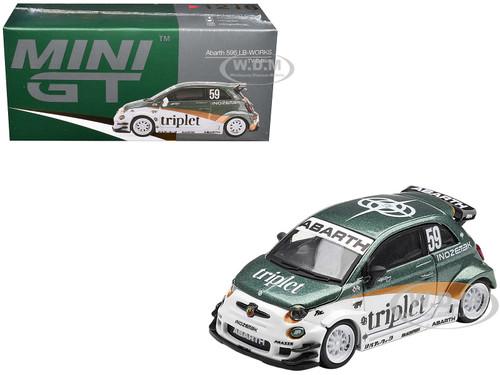
Abarth is an iconic Italian performance marque recognized by its distinctive scorpion badge, compact performance cars, racing heritage, and long association with Fiat. Abarth diecast models give collectors a way to celebrate this distinctive branch of Italian automotive history in miniature, from classic Fiat-based competition cars to modern Abarth 500, 595, 695, and special-edition models.
The Abarth collection at DiecastModelsWholesale.com is designed for collectors who appreciate Italian cars, motorsports, compact performance vehicles, and detailed scale replicas. Depending on current availability, shoppers may find Abarth models in different scales, body styles, colors, liveries, and special editions.
The History of Abarth
Abarth's story begins with Carlo Abarth, an Austrian-born racing enthusiast whose career included motorcycles, sidecars, and automobile competition. In 1949, Carlo Abarth and Guido Scagliarini founded Abarth & C. The company's first car was the 204 A Roadster, derived from the Fiat 1100. It quickly established Abarth's reputation in competition, including victories in Italian racing.
Abarth became particularly well known for improving the performance of relatively small production cars. Rather than simply building large, high-powered sports cars, the company developed a philosophy centered on extracting impressive performance from compact automobiles. Engine modifications, exhaust systems, lightweight construction, suspension improvements, and aerodynamic changes all became important parts of the Abarth formula.
The scorpion became the defining symbol of the company. Carlo Abarth was born under the sign of Scorpio, and the scorpion badge eventually became one of the most recognizable symbols in Italian performance motoring.
Fiat and the Classic Abarth 500
The relationship between Abarth and Fiat produced some of the marque's most collectible automobiles. The original Fiat Nuova 500 provided an especially successful foundation for Abarth's performance philosophy.
The Fiat Abarth 595 was introduced in 1963, based on the Fiat 500, and became one of the defining small performance cars of its era. The 595 and subsequent 695 versions demonstrated how a tiny city car could be transformed into a serious performance machine.
For diecast collectors, these early Fiat-based Abarth cars are particularly interesting because their compact proportions, distinctive Abarth badging, racing-inspired details, and historical importance make them visually different from conventional Fiat 500 models.
Classic Abarth subjects can be an excellent addition to collections focused on:
- Italian automobiles
- Historic racing cars
- Fiat vehicles
- European performance cars
- Classic compact cars
- Motorsport history
- Abarth heritage
Abarth 500, 595 and 695
Abarth returned to prominence as a modern performance brand with the Abarth 500, introduced in 2008 using the contemporary Fiat 500 as its foundation. The modern formula retained the basic Abarth philosophy: take a small, lightweight car and give it substantially more performance-oriented character.
The lineup subsequently expanded around the 595 and 695 names. Depending on version, these cars received more powerful engines, performance brakes, sportier suspension, distinctive wheels, aerodynamic components, performance exhaust systems, and increasingly specialized interiors.
The Abarth 595 and 695 became particularly recognizable for their compact hatchback proportions and aggressive styling. The combination of a small body, turbocharged engine, scorpion branding, and motorsport-inspired equipment made these cars natural subjects for scale-model collectors.
Special Edition Abarth Models
One of the most appealing aspects of collecting Abarth models is the number of special editions produced throughout the marque's history.
Examples include the Abarth 695 Tributo Ferrari, 695 Maserati Edition, 695 Biposto, 695 Rivale, 695 70° Anniversario, 595 Scorpioneoro, and special editions created through Abarth's relationship with Yamaha.
These limited or distinctive versions can be especially attractive as diecast collectibles because differences in paint, wheels, bodywork, graphics, interiors, badges, and aerodynamic equipment can make one version visually distinct from another.
The 695 Biposto is particularly notable. Developed as an extremely focused road-going performance car, it emphasized the connection between Abarth's road cars and competition heritage. Other special editions took a more luxurious or commemorative approach, giving collectors a wide variety of interpretations of the Abarth formula.
Abarth 124 Spider
Abarth's history is not limited to small hatchbacks. The Abarth 124 Spider brought the scorpion badge to a lightweight two-seat roadster.
Introduced in the modern era, the Abarth 124 Spider combined Italian styling with a performance-focused specification and became another important modern Abarth collectible. Although production has ended, the model remains an interesting subject for collectors because of its different body style and its place in the modern history of the brand.
An Abarth 124 Spider model can also add useful variety to a collection dominated by the 500, 595, and 695.
What to Look for in Abarth Diecast Models
When shopping for an Abarth diecast model, collectors should consider more than the badge on the hood or grille. Different releases can represent substantially different versions of the same basic vehicle.
Model and Generation
Determine whether you are looking for a classic Fiat Abarth, modern 500, 595, 695, 124 Spider, or another Abarth performance model. If you are collecting a particular era, checking the generation and body style is especially important.
Special Edition
A special-edition Abarth can have different wheels, body kits, colors, stripes, badges, exhausts, interiors, or other details compared with a standard version. Limited editions such as Tributo Ferrari, Tributo Maserati, Biposto, Rivale, Scorpioneoro, and anniversary models can therefore be appealing to collectors who want more than one version of the same basic car.
Scale
Abarth models can be produced in different scales, so check the individual product listing before purchasing. Common automotive scales include 1/18, 1/24, 1/32, 1/43, and 1/64, although availability depends on the particular model and manufacturer.
Larger scales can make exterior details, wheels, interiors, and badges easier to appreciate, while smaller scales allow collectors to display more cars in the same amount of space.
Color and Livery
Color is an important part of Abarth collecting. Many Abarth models feature highly recognizable performance-oriented color combinations, racing stripes, contrasting trim, or special-edition graphics.
If you are collecting multiple versions of an Abarth, different colors and liveries can make each model visually distinct while still maintaining a consistent theme.
Building an Abarth Collection
A dedicated Abarth collection can be organized in several ways. Some collectors may want to focus on the evolution of the Fiat-based Abarth from the classic 500 and 595 through the modern 500, 595, and 695. Others may prefer to collect special editions or motorsport-related versions.
A chronological collection could include:
- Classic Fiat Abarth models
- Historic Abarth competition cars
- Modern Abarth 500
- Abarth 595 and 595C
- Abarth 695 and special editions
- Abarth 695 Biposto
- Abarth 124 Spider
- Later Abarth performance and electric-era models
Another approach is to collect different scales. For example, a larger Abarth model can serve as the centerpiece of a display while smaller models represent additional versions, colors, or special editions.
Abarth and Motorsport
Motorsport is central to understanding the Abarth identity. From its earliest competition cars onward, Abarth used racing and record-setting activity as a way to develop and demonstrate performance technology.
That competition heritage is reflected in the appearance of many Abarth road cars. Aggressive wheels, performance exhaust systems, aerodynamic components, lightweight materials, racing-inspired interiors, and distinctive graphics all connect the road-going models with the brand's sporting background.
For collectors, this creates an opportunity to combine Abarth road cars with other racing and motorsport diecast models, creating displays that emphasize the connection between competition engineering and production automobiles.
Why Collect Abarth Models?
Abarth occupies a distinctive place in automotive collecting. The cars are relatively small, but their history encompasses Italian engineering, Fiat, motorsport, performance tuning, special editions, and an instantly recognizable brand identity.
Abarth diecast models can appeal to collectors who enjoy:
- Italian sports and performance cars
- Fiat and Abarth history
- Classic European automobiles
- Hot hatchbacks
- Motorsport and racing
- Limited-edition vehicles
- Compact performance cars
- Scorpion-badge collectibles
- Detailed scale replicas
- Multi-generation automotive collections
The brand's evolution also makes it possible to build a collection that tells a story rather than simply accumulating individual cars.
Shop Abarth Diecast Models
From the classic Fiat-based Abarth 595 to the modern 500, 595, 695, 124 Spider, and distinctive special editions, Abarth diecast models capture the compact performance character and unmistakable styling of the Scorpion marque.
Browse the Abarth collection at DiecastModelsWholesale.com to explore the Abarth models currently available and find an Italian performance car that adds something distinctive to your collection.