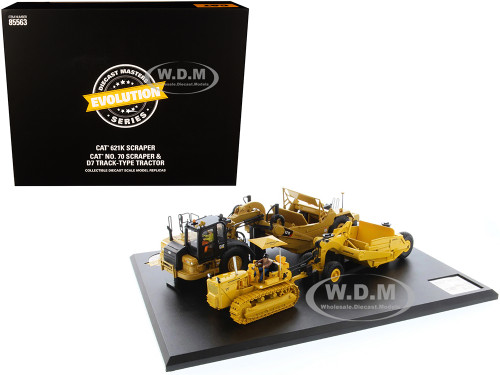
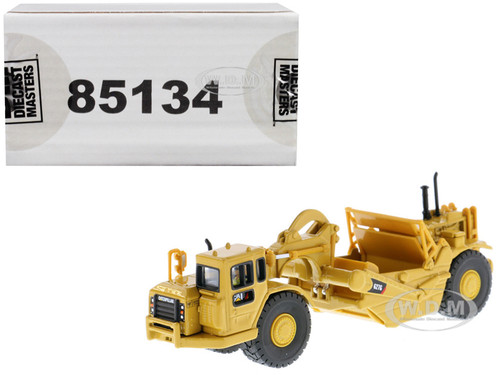
Scrapers are specialized earthmoving machines designed to cut, collect, transport, and spread soil or other loose material. Unlike a dump truck, which carries material in a separate body and unloads it, a scraper uses a large bowl integrated into the machine to cut into the ground, load material, haul it across a job site, and then spread it in a controlled layer.
For collectors, scraper diecast models represent some of the most distinctive machines in the construction-equipment world. Their long wheelbase, large bowl, cutting edge, hydraulic mechanisms, and articulated or tractor-scraper configuration make them immediately recognizable in a scale construction collection.
The Scraper category at DiecastModelsWholesale.com currently includes models such as the CAT Caterpillar 627G Auger Scraper in 1/87 scale and the Mobile Track Solutions 33-38XL Towed Scraper in 1/50 scale. The selection can change as new releases and limited-production models become available.
Shop Scraper Diecast Models
What Is a Scraper?
A scraper is an earthmoving machine that combines several functions into one piece of equipment. As it moves forward, a cutting edge at the front of the bowl can penetrate the ground. Material enters the bowl and is carried until the machine reaches the area where the material is needed.
Depending on the design, the scraper can then raise the bowl, adjust its cutting mechanism, and discharge or spread the material.
This makes scrapers particularly useful for projects involving substantial quantities of earthmoving, including:
- Highway construction
- Airport and runway construction
- Dam and reservoir projects
- Large building sites
- Land grading
- Site preparation
- Embankment construction
- Large-scale earthmoving
- Agricultural land improvement
The ability to cut, carry, and spread material is what makes a scraper different from many other construction machines.
Types of Scrapers
Scrapers have evolved considerably over the history of mechanized earthmoving. Collectors may encounter several different configurations.
Towed Scrapers
A towed scraper, sometimes called a pull scraper, is pulled by a tractor or other prime mover. The scraper itself contains the bowl and cutting mechanism but relies on another machine for propulsion.
Early pull scrapers were mechanically simple, but later designs incorporated hydraulic controls and increasingly sophisticated systems.
The Historical Construction Equipment Association identifies the slip or pan scraper as one of the oldest and simplest scraper designs. Later developments included wheeled scrapers, rubber-tired pull scrapers, hydraulic pull scrapers, and motor scrapers.
Motor Scrapers
A motor scraper has its own powered tractor unit rather than depending entirely on a separate tractor. This configuration allowed scrapers to travel more efficiently between loading and dumping areas.
During the middle decades of the 20th century, motor scrapers became important equipment for large highway and earthmoving projects. Historical examples include Caterpillar DW-series machines and later 600-series scrapers.
Wheel Tractor-Scrapers
The wheel tractor-scraper combines a powered tractor with a scraper bowl. Many machines use an articulated connection between the tractor and scraper portion, allowing the equipment to maneuver while carrying a substantial load.
Caterpillar introduced its first self-propelled wheel tractor-scraper, the DW21, in 1950. The company later introduced its 600-series machines, which became officially identified as wheel tractor-scrapers in the 1960s.
Elevating Scrapers
An elevating scraper uses a conveyor or elevator mechanism to help move material from the cutting edge into the bowl. This differs from a conventional scraper, which generally relies on the machine's forward movement and material flow into the bowl.
Historical construction equipment collections include examples such as the Caterpillar 613B elevating scraper, demonstrating how specialized scraper designs developed for different earthmoving requirements.
A Brief History of Scrapers
The basic idea behind a scraper is much older than modern construction machinery. Early scrapers were simple tools pulled by animals and used to move relatively small quantities of soil. The Fresno scraper, for example, improved upon earlier slip scrapers with a wider design and increased capacity.
Mechanization changed the industry during the early 20th century. Tractor-pulled scrapers allowed substantially more earth to be moved with less manual labor, while the development of rubber tires made faster movement possible.
A major step came in 1932, when R. G. LeTourneau developed a rubber-tired pull scraper operated by cable from the tractor. LeTourneau continued developing the concept of combining a tractor with a scraper, eventually producing the Tournapull family. The Historical Construction Equipment Association identifies these developments as important steps in the evolution of modern scrapers.
LeTourneau's work also influenced the development of self-propelled motor scrapers. Caterpillar's history records the introduction of its first self-propelled wheel tractor-scraper in 1950, while Caterpillar's DW21 became an important machine for major construction contractors.
Scrapers became particularly important during the enormous highway, airport, dam, and infrastructure projects of the postwar period. Historical examples include Caterpillar DW-series machines working on projects such as the St. Lawrence Seaway and major highway construction.
Caterpillar and Scraper History
Caterpillar is one of the most recognizable names associated with scraper equipment, making CAT scraper models particularly interesting to construction-equipment collectors.
Caterpillar's DW21 was introduced as the company's response to LeTourneau's Tournapull concept. The machine was unveiled in 1948 and became available in 1950. Caterpillar later developed its 600-series scrapers, beginning a long-running family of wheel tractor-scrapers.
The CAT 600 series became an important part of scraper history. Historical examples include the 621, 631, and other models that were used for large earthmoving projects. The Historical Construction Equipment Association preserves examples of machines such as the CAT 621B, 631B, and 613B.
For collectors, these machines provide a connection between scale models and the history of heavy construction equipment. A scraper model can represent not only a particular machine but also the era of highway building, dam construction, airport development, and large-scale earthmoving in which these machines played an important role.
Features to Look for in Scraper Diecast Models
Scrapers have numerous mechanical features that translate well into scale models. Depending on the manufacturer and scale, collectors may find details such as:
- Large scraper bowls
- Cutting edges
- Hydraulic cylinders
- Articulated frames
- Tractor and scraper sections
- Large earthmoving tires
- Operator cabs
- ROPS structures
- Engine compartments
- Scraper elevators or conveyors
- Hydraulic lines
- Manufacturer logos
- Model-number markings
- Authentic construction-equipment colors
The bowl is often the most visually distinctive feature. On a detailed model, its shape and relationship to the cutting edge can help identify the particular type of scraper represented.
The tractor section can be equally important. Wheel tractor-scrapers have substantial front and rear assemblies connected by an articulation point, giving them a distinctive appearance that differs from dozers, loaders, and graders.
Scraper Diecast Models and Scale
Scale is an important consideration when selecting construction equipment models. Because real scrapers are large machines, even relatively small-scale replicas can make an impressive addition to a construction collection.
DMW's current Scraper category includes both 1/50 and 1/87 scale examples. The CAT 627G Auger Scraper is offered in 1/87 scale, while the Mobile Track Solutions 33-38XL Towed Scraper is represented in 1/50 scale.
1/50 Scraper Models
1/50 scale is particularly useful for collectors who want a more substantial construction-equipment model with visible mechanical and structural details. It also works well when building a collection around other 1/50 construction machinery.
A 1/50 scraper can be displayed with graders, dozers, excavators, loaders, dump trucks, and other heavy equipment to create a detailed earthmoving scene.
1/87 Scraper Models
1/87 scale, commonly associated with HO model railroading, provides a much smaller representation that can fit into compact displays and construction dioramas.
The current DMW selection includes the CAT 627G Auger Scraper in 1/87 scale, making it a useful option for collectors working with smaller-scale construction or transportation scenes.
Scrapers Compared With Other Construction Equipment
Understanding the role of a scraper can help collectors distinguish it from other earthmoving machines.
Scraper vs. Dozer: A dozer primarily pushes and spreads material with a blade. A scraper can cut material from the ground, carry it in its bowl, and then spread it elsewhere.
Scraper vs. Excavator: An excavator uses a boom, arm, and bucket to dig and load material. A scraper cuts and carries material while traveling across the ground.
Scraper vs. Grader: A motor grader is primarily designed for precise shaping and finishing of surfaces. A scraper is intended for larger-scale excavation and movement of material.
Scraper vs. Dump Truck: A dump truck transports material in a dump body after another machine loads it. A scraper incorporates the loading and carrying functions into one machine.
These differences also make a mixed construction collection more interesting because each machine represents a different stage of the earthmoving process.
Building a Construction Equipment Collection
Scraper diecast models work particularly well as part of a larger construction equipment collection. A large earthmoving scene might include a scraper cutting and transporting material, a dozer pushing material, an excavator performing excavation, a wheel loader loading trucks, and a grader finishing the surface.
Construction Diecast Models
Collectors can also explore related machine categories:
Combining machines from the same scale can create a particularly convincing miniature job site, while collecting different scraper designs allows enthusiasts to compare the evolution of earthmoving technology.
Choosing a Scraper Diecast Model
When selecting a scraper model, consider:
- Scale: Match the model to the other construction equipment in your collection.
- Configuration: Decide whether you prefer a towed scraper, motor scraper, wheel tractor-scraper, or elevating scraper.
- Manufacturer: Caterpillar and other historic equipment manufacturers offer distinctive designs worth collecting.
- Era: Vintage scrapers such as the Caterpillar DW and early 600-series machines have a very different appearance from later equipment.
- Detail level: Look at the bowl, cutting edge, hydraulic components, tires, cab, and articulation.
- Display purpose: Larger scales can provide a stronger standalone display, while smaller models work well for dioramas and larger construction scenes.
Product availability, specifications, packaging, and model releases can change. Check the individual product listing for the current scale, manufacturer, model designation, dimensions, and materials before ordering.
Whether you collect Caterpillar construction equipment, historical earthmoving machinery, 1/50 heavy equipment, HO-scale construction models, or complete miniature job-site scenes, scraper diecast models provide a distinctive representation of the machines that helped transform large-scale earthmoving. Browse the Scraper category at DiecastModelsWholesale.com to explore available models and find a scraper that fits your collection.


 $59.99