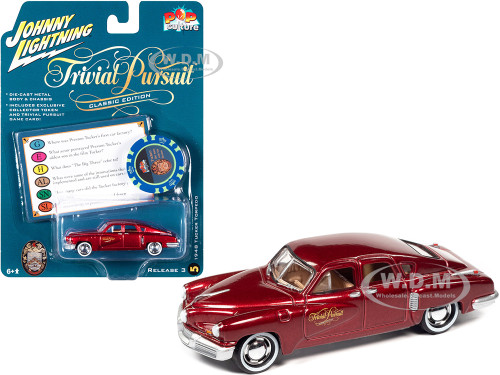
Discover the story of Preston Tucker and his ambitious vision for the American automobile industry through Tucker: The Man and His Dream, the 1988 biographical drama directed by Francis Ford Coppola. Starring Jeff Bridges as automotive innovator Preston Tucker, the film tells the story of a visionary entrepreneur who challenged the established car manufacturers with an unconventional automobile designed to change the way Americans thought about driving.
For classic car enthusiasts, automotive history fans, and movie memorabilia collectors, Tucker: The Man and His Dream brings together two compelling subjects: the history of an ambitious American automobile and the cinematic portrayal of the man behind it. The film's distinctive cars, mid-century styling, and themes of innovation make it particularly relevant to collectors interested in classic American vehicles and automotive history.
The Tucker: The Man and His Dream category at Diecast Models Wholesale is intended for shoppers looking for collectibles associated with this memorable automotive film. Depending on current availability, items may include movie-related collectibles or model vehicles connected to the Tucker story. Check individual product listings for current availability, scale, materials, dimensions, and other specifications rather than assuming a particular model or version is in stock.
The True Story Behind Tucker: The Man and His Dream
Released in 1988, Tucker: The Man and His Dream dramatizes the efforts of Preston Tucker to establish his own automobile company in the years following World War II. Tucker believed the American car industry could be challenged by a vehicle that offered fresh styling, forward-thinking engineering, and features designed around driver and passenger safety.
The film follows Tucker as he attempts to turn his ideas into a production automobile. His ambition brings him into conflict with financial pressures, manufacturing challenges, skeptical investors, and powerful competitors in an industry dominated by established companies. The result is a story about entrepreneurship, invention, risk, and the difficulty of turning a bold idea into a successful business.
Francis Ford Coppola brought a personal connection to the project through his interest in Tucker's story and the automobile itself. The film presents Tucker as an energetic dreamer whose determination is matched by the obstacles facing his company. While the movie dramatizes events for cinematic storytelling, its central subject is a genuine chapter in American automotive history.
For collectors, this combination of film and real-world history gives the category a distinctive appeal. Tucker is not simply a fictional movie car brand: the story is rooted in a real attempt to create an alternative to the mainstream American automobiles of the late 1940s.
The Tucker 48: The Automobile at the Heart of the Film
The most important vehicle associated with Tucker: The Man and His Dream is the Tucker 48, often called the Tucker Torpedo during its development. It was the ambitious passenger car Preston Tucker sought to bring to market after World War II.
The Tucker 48 looked different from many American cars of its era. Its rounded body, aerodynamic profile, distinctive front-end styling, and innovative engineering reflected Tucker's desire to create a modern automobile rather than simply follow existing industry conventions.
The car is particularly famous for its central third headlight, commonly called the Cyclops eye. Positioned in the center of the front end, the light was designed to turn with the steering system to help illuminate the direction of a turn. This unusual feature became one of the Tucker 48's most recognizable visual characteristics.
Other innovations associated with the Tucker project included an emphasis on passenger protection, a padded dashboard, and a design intended to improve visibility and driving safety. The original engineering proposals and the features incorporated into the completed cars were not always identical, but the company's willingness to explore unconventional ideas helped establish Tucker's reputation as an automotive innovator.
For classic car collectors, the Tucker 48 is significant because it represents both a distinctive design and an alternative path that American automotive development might have taken.
Why the Tucker 48 Is So Collectible
The Tucker 48 occupies a special place in automotive history because of its limited production, unusual engineering, and connection to Preston Tucker's ambitious business venture. Unlike mass-produced American sedans of the period, it was built in very small numbers, making surviving examples exceptionally notable among classic automobile enthusiasts.
Collectors may be drawn to several features:
-
Distinctive styling: The rounded body and unusual front-end design make the Tucker 48 recognizable among postwar American cars.
-
Innovative engineering: Its development reflected an interest in safety, handling, and features that differed from conventional designs of the era.
-
Historical significance: The car represents an independent manufacturer's attempt to compete in a challenging and capital-intensive industry.
-
Connection to cinema: The 1988 film introduced Tucker's story to a wider audience and created another reason for enthusiasts to appreciate the vehicle.
-
Rarity and legacy: The small production run contributes to the car's enduring reputation among collectors of American automotive history.
A miniature Tucker 48 can therefore appeal to more than fans of the movie. It may also suit collectors specializing in classic American automobiles, unusual production cars, and historically significant vehicles.
Preston Tucker: An Automotive Visionary
Preston Tucker was an American entrepreneur who believed the automobile industry could be improved through new ideas and a willingness to challenge established practices. His ambition was to create a car that would offer drivers something meaningfully different from the vehicles already available.
The postwar period offered opportunities for new automobile companies, but it also presented major challenges. Manufacturing a car required substantial investment, specialized equipment, reliable suppliers, a distribution network, and the ability to compete with manufacturers that already had extensive industrial infrastructure.
Tucker's company faced these obstacles while trying to develop its new vehicle. Financing, production delays, business disputes, and scrutiny of the company's operations complicated its efforts. Although the Tucker 48 reached production, the company did not establish the lasting automotive business Tucker had envisioned.
The film emphasizes Tucker's determination and the tension between individual ambition and powerful institutional interests. Its portrayal encourages viewers to consider how innovation can be affected by financial realities, manufacturing constraints, competition, and public perception.
For automotive enthusiasts, the story provides valuable context for understanding why certain vehicles become historically important even when their manufacturers do not survive. A car's significance is not measured solely by sales volume or commercial success. In some cases, an unsuccessful business venture can leave behind a design that remains influential in automotive culture.
Francis Ford Coppola's Automotive Film
True Romance is a crime romance, while Tucker: The Man and His Dream is an automotive biographical drama. Coppola's film is particularly notable for its focus on the relationship between a creator and his invention, with the Tucker 48 serving as a physical expression of the main character's ambitions.
Jeff Bridges portrays Preston Tucker, bringing energy and optimism to a character determined to challenge the established automotive order. The supporting cast includes Joan Allen as Vera Tucker, alongside performances by Martin Landau and other actors who help bring the business, family, and historical aspects of the story to life.
The film's production design and period setting are important to its appeal. The automobiles, clothing, industrial environments, and mid-century visual details help place the story in the postwar era when American car design was undergoing significant change.
For collectors, this makes the movie interesting from two perspectives: it celebrates a particular automobile and documents a moment in the broader history of American industry. Collectibles associated with the film may be especially meaningful to enthusiasts who enjoy the intersection of Hollywood storytelling and real-world automotive heritage.
Tucker Collectibles for Classic Car Enthusiasts
Tucker-related collectibles occupy a specialized niche within the wider world of diecast cars and automotive memorabilia. The appeal comes from the vehicle's unusual history rather than a large number of generations or model variants.
Depending on current product availability, shoppers may encounter items associated with the Tucker 48, the movie, or its place in American automotive culture. The exact selection can change, so review the individual listings to establish whether a product depicts the historical automobile, a film-related interpretation, or another type of collectible.
What to Look for in a Tucker Model
If you are considering a miniature Tucker 48, pay attention to details that distinguish the car from other classic American vehicles.
-
Front-end styling: Look for the distinctive central headlight and the Tucker's recognizable nose design.
-
Body shape: The rounded, aerodynamic profile is one of the defining characteristics of the original car.
-
Paint and trim: Compare the listed model's appearance with the specific Tucker version it represents.
-
Scale and dimensions: Confirm the stated scale and measurements to determine whether the model will fit your display.
-
Materials: Check whether the model uses diecast metal, plastic, or a combination of materials.
-
Packaging and presentation: Consider whether you prefer a boxed collectible or a model intended to be displayed outside its packaging.
Not every miniature representation will reproduce every feature of the original automobile. Product descriptions and images should guide your decision, particularly if historical accuracy is important to your collection.
Understanding Scale and Display Options
Scale is an important consideration when adding a classic automobile model to an established collection. Common diecast scales include 1:18, 1:24, 1:43, and 1:64, although the scale of any particular Tucker-related product must be confirmed in its listing.
A larger model may offer more visible detail and occupy more display space, while a smaller model can make it easier to build a collection of different historic vehicles. The best choice depends on your available space, collecting preferences, and the size of your existing models.
When planning a display, consider grouping the Tucker with other significant American automobiles from the 1940s and 1950s. A period-focused arrangement can highlight the differences between the Tucker's unconventional design and the styling of more widely produced cars from the same era.
You can also create a movie-inspired display that combines automotive collectibles with other memorabilia from films about real people, inventions, and historical events. This approach is particularly suitable for collectors whose interests span both classic cars and cinema.
Protect models from direct sunlight, excessive heat, and dust. If you keep collectibles in their original packaging, make sure shelves provide sufficient space and support to avoid damaging boxes or display cases.
Tucker: The Man and His Dream as a Gift
Tucker-related collectibles can make a thoughtful gift for classic car enthusiasts, automotive historians, movie fans, and collectors who appreciate unusual vehicles. The story has a special appeal for people interested in American manufacturing, independent automotive companies, and the personalities behind significant engineering projects.
A model representing the Tucker 48 may be particularly appropriate for someone who collects historically important American cars. A movie-related collectible may suit a fan of Francis Ford Coppola's films or someone who enjoys stories about inventors and entrepreneurs.
When choosing a gift, consider the recipient's preferred scale, available display space, and interest in historical accuracy. If the item is intended to complement a specific collection, compare its dimensions and appearance with the recipient's existing models.
As with any collectible, verify the exact product details before ordering. The movie's subject matter does not guarantee that a specific Tucker model, scale, or type of memorabilia is currently available.
Explore the available Tucker: The Man and His Dream products at Diecast Models Wholesale to discover collectibles connected to Preston Tucker's automotive vision, the distinctive Tucker 48, and this memorable chapter in American car history.