
1/242
1/242 scale diecast models represent real-world vehicles at approximately one two-hundred-and-forty-second of their original size. This is an uncommon scale, making it a specialized choice for collectors searching for models produced outside the more familiar diecast scales.
At 1/242 scale, one unit of measurement on the model represents 242 of the same units on the real vehicle. The finished size therefore depends entirely on the dimensions of the original subject. For example, a 200-foot-long aircraft would be approximately 9.9 inches long at 1/242 scale, while a 100-foot aircraft would be approximately 5 inches long.
The scale sits between several commonly encountered compact aircraft scales, including 1/200 and 1/250. This makes it useful to understand the differences when planning a display, particularly for collectors who want models to maintain consistent proportions.
Because 1/242 is relatively uncommon, the selection can vary according to current production and availability. Individual product specifications should always be reviewed to confirm the exact subject, dimensions, and features.
What Does 1/242 Scale Mean?
The scale ratio describes how much smaller the model is than the real vehicle. A 1/242 scale model is approximately 1/242 the size of its full-size counterpart in every linear dimension.
For perspective:
- A 20-foot vehicle would be approximately 0.99 inches long.
- A 40-foot vehicle would be approximately 1.98 inches long.
- A 100-foot aircraft would be approximately 4.96 inches long.
- A 150-foot aircraft would be approximately 7.44 inches long.
- A 200-foot aircraft would be approximately 9.92 inches long.
- A 250-foot aircraft would be approximately 12.40 inches long.
These figures are mathematical approximations rather than specifications for individual products.
The same scale relationship applies to an aircraft's wingspan and height as well as its length. As a result, a large wide-body aircraft will still have a substantial wingspan even though it is represented at a compact scale.
Why Collect 1/242 Scale Diecast Models?
The appeal of 1/242 diecast models is their combination of compact dimensions and specialized scale. Collectors may encounter 1/242 models while searching for a particular aircraft, airline, transportation subject, or other vehicle that has significance to their collection.
An uncommon scale can also be attractive to enthusiasts who enjoy collecting subjects that are not widely represented in standard formats. In this situation, the exact subject can be more important than whether the scale is one of the most popular choices.
Potential benefits of the scale include:
- Relatively compact display dimensions
- A specialized option for scale-focused collections
- Suitable proportions for compact aviation displays
- An alternative to larger 1/144 or 1/200 aircraft models
- More physical presence than smaller formats such as 1/400
- An interesting choice for collectors of uncommon scales
The availability of specific subjects will vary, so collectors should evaluate the current selection rather than assume that every type of vehicle is regularly produced in 1/242.
What Can You Expect to Find?
The exact selection of 1/242 scale models depends on current manufacturer production. Aviation and transportation subjects are natural possibilities for a compact scale of this size, although specialized vehicle models may also be available.
Depending on current availability, shoppers may find subjects such as:
- Commercial aircraft
- Airline aircraft
- Cargo aircraft
- Transport aircraft
- Military aircraft
- Aviation collectibles
- Transportation models
- Other specialized scale vehicles
When shopping in an uncommon scale, the individual product listing is particularly important. Product photographs and specifications can help verify the subject, manufacturer, dimensions, markings, construction, and included accessories.
1/242 Scale Aircraft Models
Aircraft are a natural application for compact scales because full-size aircraft can occupy considerable space when represented in larger formats.
A 1/242 aircraft model provides a relatively compact representation that can work well on shelves, desks, or in display cabinets. Larger aircraft will naturally have longer fuselages and wider wingspans than smaller aircraft at the same scale.
For aviation collectors, the aircraft type is only one part of the collectible. Airline livery, registration, aircraft variant, markings, and historical configuration can all make a model distinct.
A collection can be organized around:
- Commercial aviation
- Individual airlines
- Aircraft manufacturers
- Aircraft families
- Cargo airlines
- Military aviation
- Historic aircraft
- Airline liveries
- Personal aviation interests
If collecting a specific aircraft family, verify the exact variant represented by each model. Differences in fuselage length, engines, wings, and other equipment can affect both the model's appearance and dimensions.
1/242 Scale Airline Models
Airline collectors can use 1/242 scale models to create compact fleet or airline-themed displays.
A collection might focus on one airline and feature different aircraft from its fleet, or it might compare several airlines operating similar aircraft. Another approach is to collect aircraft from different eras and illustrate changes in commercial aviation design and airline liveries.
When choosing an airline model, consider details such as:
- Aircraft type and variant
- Airline and livery
- Registration, when provided
- Tail markings
- Fuselage graphics
- Engine configuration
- Display stand or accessories
- Model dimensions
For collectors who display multiple aircraft together, using models with known and consistent scales helps maintain proportional relationships.
1/242 Scale Military Aircraft
Depending on current availability, 1/242 military aircraft models can provide another option for collectors interested in compact aviation displays.
Military aviation collections can be organized by country, service branch, aircraft family, historical era, or conflict. Fighters, bombers, transport aircraft, patrol aircraft, and other specialized aircraft may be represented when manufacturers produce them in this scale.
Details such as national insignia, camouflage patterns, squadron markings, and aircraft designations can be especially important for military collectors. These details help identify the particular aircraft or configuration represented by a model.
Always review the product information carefully when purchasing a historically specific military aircraft to ensure that the designation and markings match the subject you are looking for.
Choosing a 1/242 Diecast Model
Verify the Scale
Collectors maintaining a scale-specific display should confirm that the product is specifically listed as 1/242 scale. Nearby scales can look very similar, but they are not technically interchangeable.
Identify the Subject
Look beyond the general aircraft or vehicle name. Verify the exact aircraft variant, airline or operator, markings, and other identifying information supplied with the product.
Check Model Dimensions
The scale ratio does not determine the finished size without knowing the dimensions of the original vehicle. A large wide-body aircraft can be much longer and wider than a smaller aircraft at the same scale.
Check the manufacturer's listed dimensions when available and make sure the model will fit comfortably in your intended display space.
Review Product Features
Individual diecast models can differ in construction and features. Product photographs and specifications may provide information about landing gear, display stands, movable components, materials, and other details.
1/242 vs. Nearby Scales
Understanding the relationship between nearby scales can help collectors determine whether 1/242 is the appropriate size for their collection.
- 1/144 — Considerably larger than 1/242 and creates a more substantial aircraft display.
- 1/200 — Larger than 1/242 and commonly used for aircraft models.
- 1/242 — An uncommon compact scale between 1/200 and 1/250.
- 1/250 — Slightly smaller than 1/242 and useful for a more compact representation.
- 1/400 — Much smaller than 1/242 and well suited to space-conscious aircraft collections.
The difference between 1/242 and 1/250 is relatively small. A model at 1/242 is approximately 3.3% larger in each linear dimension than a model of the same subject at 1/250.
The difference from 1/200 is more noticeable: a 1/200 model is approximately 21% larger in each linear dimension than a 1/242 model.
These differences may be important to collectors building an exact-scale display. For a general aviation display, the subject and available space may be more important than a relatively small difference between neighboring compact scales.
Building a 1/242 Scale Collection
An uncommon scale can provide a distinctive direction for a collection. Rather than trying to find every possible 1/242 subject, collectors can establish a theme based on their own interests.
An airline enthusiast could collect different aircraft from one carrier. An aviation historian might focus on aircraft from a particular period. Another collector could concentrate on cargo aviation, military aircraft, aircraft manufacturers, or memorable aircraft from personal travel.
Collectors who already own models in nearby scales may also consider how the models will appear together. Because 1/242 is relatively close to 1/250, these models can have similar overall proportions and display footprints, although they remain different scales.
Keeping track of each model's scale, aircraft type, operator, manufacturer, and other identifying information can make an uncommon-scale collection easier to organize.
Displaying 1/242 Scale Models
The compact format of 1/242 makes it suitable for many types of displays. Shelves, desks, cabinets, and dedicated aviation displays can all work well, provided there is adequate clearance for the model's wingspan and other dimensions.
When displaying multiple aircraft, leave enough room between models to prevent wings, engines, tails, or landing gear from contacting one another.
For a more cohesive display, models can be grouped by airline, aircraft family, manufacturer, country, historical era, or mission. Even a small collection can make an effective presentation when the models are arranged around a clear theme.
The Appeal of an Uncommon Scale
The world of diecast collecting extends far beyond the most recognizable scales. 1/242 scale diecast models can appeal to collectors who enjoy specialized subjects, unusual production scales, or models that fill a particular space within an existing collection.
For some collectors, the subject will be the deciding factor. A particular airline, aircraft, livery, or military subject may be worth adding regardless of whether it is produced in one of the industry's most common scales.
The proximity of 1/242 to 1/200 and 1/250 also makes it useful to consider when choosing a compact aircraft display. Comparing the exact scale, finished dimensions, subject, markings, construction, and available features can help you select the model that best fits your collection.
Find 1/242 Scale Diecast Models
Explore the 1/242 scale diecast models at Diecast Models Wholesale to find specialized compact models for your collection and display. Review the individual product information, including scale, subject, dimensions, markings, and features, before making your selection.
Browse the 1/242 scale category and discover an uncommon format for aviation enthusiasts, diecast collectors, hobbyists, and anyone searching for specialized scale models.
Filter
-
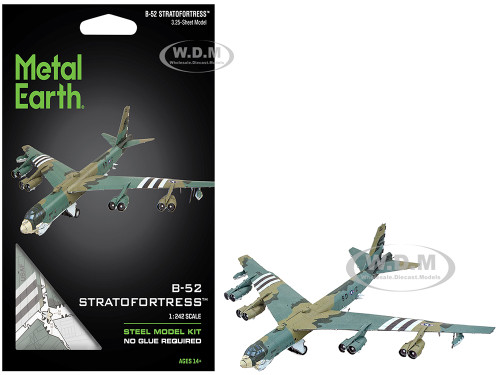
Metal Earth
Model Kit Boeing B-52 Stratofortress Bomber Aircraft "United States Air Force" (Challenging Difficulty) Steel Model by Metal Earth
$24.95WasAdd to Cart The item has been added$24.95WasAdd to Cart The item has been added