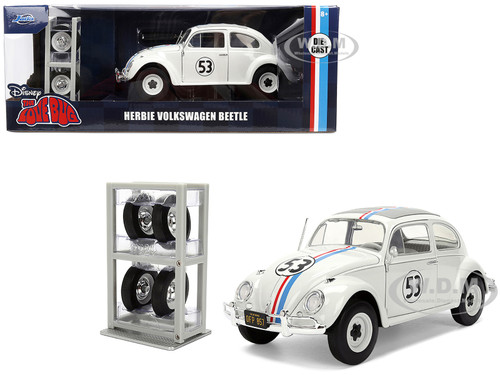
Herbie the Love Bug is one of the most recognizable cars in movie history. This lovable, self-driving Volkswagen Beetle became a Disney icon through a series of family films featuring a white Beetle with racing stripes, the number 53, and a personality all its own. Unlike ordinary movie cars, Herbie is more than a vehicle: he is the central character, known for his independent behavior, competitive spirit, loyalty, and unexpected ability to get out of trouble.
The Herbie the Love Bug category at Diecast Models Wholesale is for fans of the classic Disney films, Volkswagen Beetles, and memorable movie vehicles. Depending on available products, collectors may find Herbie-inspired die-cast cars and scale models that capture the character’s distinctive appearance.
For automotive enthusiasts, Herbie combines the familiar shape of a classic Volkswagen Beetle with instantly recognizable movie details. For film collectors, the car represents decades of Disney storytelling and a character whose appeal reaches across generations. Whether you grew up watching Herbie race, are building a collection of famous movie cars, or are searching for a gift for a Volkswagen enthusiast, Herbie the Love Bug offers a distinctive subject for any collection.
The History of Herbie the Love Bug
The Original Disney Film
Herbie made his feature-film debut in The Love Bug (1968), a Disney comedy directed by Robert Stevenson. The story follows race car driver Jim Douglas, played by Dean Jones, who discovers that a seemingly ordinary Volkswagen Beetle has an extraordinary personality.
Herbie chooses his own actions, responds to people around him, and develops a remarkable talent for racing. His independent behavior creates both comedy and conflict, especially when other characters underestimate the small car or try to control him.
The film helped establish Herbie as a character in his own right rather than simply a vehicle used in the story. His expressive movements, mischievous actions, and determination made the Beetle an unlikely but memorable hero.
The success of The Love Bug led to further films and television appearances, making Herbie one of Disney’s best-known live-action characters. His familiar white body, red and blue racing stripes, and black number 53 became visual trademarks recognized by fans around the world.
The Love Bug Film Series
Herbie’s adventures continued through several Disney productions, each adding to the character’s history and appeal.
-
The Love Bug (1968): Introduced Herbie, Jim Douglas, and the story of a Volkswagen Beetle with a mind of his own.
-
Herbie Rides Again (1974): Returned Herbie to the screen in a story involving an effort to protect a San Francisco building from a property developer.
-
Herbie Goes to Monte Carlo (1977): Took Herbie into an international racing adventure, combining competition, comedy, and a European setting.
-
Herbie Goes Bananas (1980): Sent Herbie on another adventure involving travel, mishaps, and a new group of characters.
-
The Love Bug (1997 television film): Reintroduced the character to television audiences with a new story.
-
Herbie: Fully Loaded (2005): Brought Herbie to a new generation through a story centered on aspiring race car driver Maggie Peyton, played by Lindsay Lohan.
Across these productions, Herbie remained recognizable while appearing in different racing situations and storylines. Collectors may be especially interested in models that reflect a particular film or period, as racing markings, presentation, and other details can vary between versions.
The Volkswagen Beetle Behind Herbie
A Classic Automotive Design
Herbie is based on the Volkswagen Type 1, commonly known as the Volkswagen Beetle. Designed before the Second World War and produced in large numbers in the postwar era, the Beetle became one of the most recognizable automobiles in the world.
Its rounded body, compact dimensions, rear-mounted air-cooled engine, and distinctive silhouette helped separate it from many other cars of its time. The Beetle was produced in numerous versions over several decades, and its familiar shape became associated with practical transportation, popular culture, and automotive nostalgia.
Herbie’s connection to the Beetle gives the character a special place among movie vehicles. The car is not an exotic supercar or a purpose-built racing machine in its original form. Instead, his story begins with a small, everyday automobile that proves capable of extraordinary things.
For Volkswagen collectors, Herbie brings together the history of a famous production car and the imaginative world of Disney. A model can appeal to fans of classic European automobiles even if they are not dedicated movie memorabilia collectors.
Herbie’s Signature Appearance
Herbie’s traditional appearance is central to his identity. His white Volkswagen Beetle body is decorated with red, white, and blue racing stripes and the number 53, typically displayed on the hood, doors, and rear engine cover.
These markings distinguish Herbie from a standard Volkswagen Beetle and make the character recognizable at a glance. The combination of a familiar production-car design and distinctive racing graphics is one reason Herbie remains popular among collectors.
When comparing Herbie die-cast models, look for the details that define the particular version:
-
Body shape: The model should reflect the Beetle generation and styling represented by its source material.
-
Racing stripes: The colors, placement, and proportions of the stripes contribute to Herbie’s recognizable appearance.
-
Number 53: The number’s location and presentation may vary depending on the film or model version.
-
Wheels and trim: Details can differ between standard Beetles and film-specific interpretations.
-
Film-specific features: Particular productions may feature different markings or details, so compare the model with the version you want to collect.
Not every white Volkswagen Beetle model represents Herbie. The number 53, racing stripes, and other identifying features help distinguish the famous movie character from an ordinary classic Beetle.
Herbie as a Racing Car
Although the Volkswagen Beetle was not originally designed as a purpose-built racing car in the same way as specialized competition vehicles, Herbie’s movie adventures made racing a defining part of his identity.
The character competes against more powerful and imposing opponents, often winning through intelligence, determination, and unexpected maneuvers rather than brute force. This contrast is central to the films’ humor and appeal.
Herbie’s racing identity is particularly prominent in The Love Bug and Herbie Goes to Monte Carlo. His number 53 and racing stripes visually connect him to motorsports, while his small size makes him an unconventional competitor.
For collectors interested in racing-themed die-cast cars, Herbie occupies a distinctive niche. He is recognizable as both a fictional character and a movie interpretation of a classic automobile. This makes him a natural addition to collections featuring film cars, vintage racing subjects, and iconic Volkswagen models.
When selecting a racing-themed Herbie model, consider whether you prefer the classic appearance associated with the original film or a version inspired by one of his later racing adventures.
What Makes Herbie Different from Other Movie Cars?
Many famous movie vehicles are remembered for their speed, futuristic equipment, weapons, or dramatic styling. Herbie’s appeal comes from a different source: personality.
The films portray him as a car capable of expressing emotions, making decisions, and forming relationships with the people around him. He can be stubborn, playful, jealous, courageous, and protective. These characteristics make the Beetle feel like a member of the cast rather than a background prop.
Herbie also stands out because his basic design remains rooted in a real production automobile. Fans can recognize the Volkswagen Beetle’s familiar shape even when the character is performing extraordinary stunts or competing in races.
This combination of automotive authenticity and fantasy storytelling creates several reasons to collect Herbie:
-
Movie history: Herbie has appeared in Disney films across multiple decades.
-
Classic Volkswagen appeal: The Beetle’s distinctive shape connects the character to real automotive history.
-
Recognizable markings: The white finish, racing stripes, and number 53 create a unique appearance.
-
Motorsports connection: Racing is a recurring part of Herbie’s adventures.
-
Family entertainment nostalgia: The character appeals to fans who remember the original films as well as viewers discovering them later.
-
Display versatility: Herbie can fit into a movie-car collection, a Volkswagen display, or a collection of classic racing-themed vehicles.
These qualities help explain why Herbie continues to attract interest beyond the audience of the original film.
Collecting Herbie the Love Bug Die-Cast Models
Herbie die-cast models offer collectors a miniature representation of one of cinema’s most familiar cars. Depending on the specific product, a model may emphasize accurate Beetle proportions, movie-inspired markings, decorative details, or a particular version of the character.
The term die-cast generally refers to models made using metal cast components, often combined with plastic parts. However, the materials and construction methods of individual products can vary. Check the product listing to confirm how a specific Herbie model is made.
Choosing a Scale
Scale indicates the relationship between a model’s dimensions and those of the full-size vehicle. For example, a 1:18 scale model is larger than a 1:43 or 1:64 model of the same car.
The most suitable scale depends on your collecting goals, available space, and preference for detail. Larger models may offer more visible exterior features, while smaller models can be easier to display alongside other vehicles.
When considering a Herbie model, review both the stated scale and the actual dimensions. A model’s size can affect how well it fits into a display cabinet or alongside other Volkswagen and movie-car collectibles.
Details Worth Comparing
Before choosing a model, consider the following:
-
Film or version represented: Confirm whether the design is associated with the original film or a later Herbie production.
-
Accuracy of markings: Look for the familiar number 53 and the correct stripe arrangement for the represented version.
-
Exterior finish: Paint color, trim, and wheel details can affect the overall appearance.
-
Construction: Review the listed materials and any stated opening parts or moving features rather than assuming every model has them.
-
Packaging: Original packaging may matter to collectors who preserve their models boxed.
-
Display compatibility: Consider the model’s dimensions and how its style fits with other cars in your collection.
Product details and availability vary, so use the individual listing to confirm specifications before ordering.
Herbie the Love Bug as a Gift
A Herbie die-cast model can be a thoughtful gift for a Volkswagen enthusiast, a fan of classic Disney films, or someone who enjoys collecting famous movie vehicles.
For longtime fans, Herbie can bring back memories of the original film and its sequels. For automotive enthusiasts, the model offers a recognizable Volkswagen Beetle with a unique movie history. For younger fans, Herbie’s humorous personality and unlikely racing victories provide an introduction to a classic character.
If the recipient already collects movie cars, consider whether they prefer a particular film version, scale, or level of detail. A model that matches an existing collection may be especially appealing. For someone new to collecting, Herbie’s unmistakable design makes him an accessible and memorable choice.
As with any collectible, reviewing the product description helps ensure that the model’s size, materials, and specific design match the recipient’s expectations.
Explore the available Herbie the Love Bug products at Diecast Models Wholesale to find a miniature tribute to Disney’s beloved Volkswagen Beetle and add a memorable movie car to your collection.