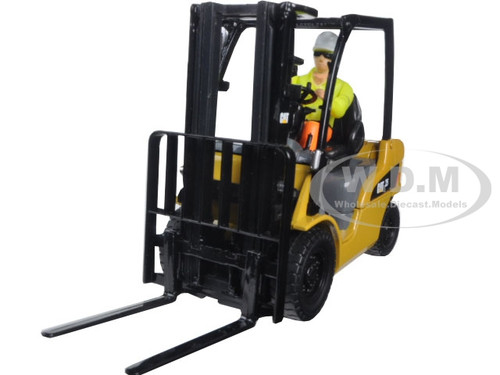
Lift trucks are industrial vehicles designed to lift, move, and position materials using forks or other specialized attachments. The term lift truck encompasses a range of powered material-handling vehicles, with forklifts being the most familiar example. These machines are commonly used in warehouses, distribution centers, manufacturing facilities, construction sites, freight terminals, agricultural operations, and industrial yards.
The Lift Truck Diecast Models category at DiecastModelsWholesale.com features scale models representing these specialized material-handling vehicles. Lift trucks are an interesting subject for collectors because their compact proportions, upright masts, forks, counterweights, and working mechanisms give them a very different appearance from conventional road trucks.
These models can be especially appealing to collectors of construction equipment, industrial vehicles, commercial equipment, and working machinery. Some lift truck models also include movable components such as raising and lowering masts, adjustable forks, steering features, or other equipment details.
Lift Truck Diecast Models
A lift truck is built around a simple but highly effective concept: use a powered vehicle and lifting mechanism to move loads that would otherwise be difficult or impossible to handle manually.
A typical counterbalance forklift consists of a vehicle chassis, operator compartment, mast, carriage, forks, lifting mechanism, and counterweight. The counterweight helps balance the load being carried in front of the machine.
Depending on the particular model, lift truck diecast replicas may feature:
- Raising and lowering masts
- Adjustable or removable forks
- Detailed operator compartments
- Counterweights
- Steering wheels and axles
- Solid or pneumatic-style tires
- Hydraulic cylinders and lifting components
- Safety overhead guards
- Detailed chassis and bodywork
- Manufacturer markings and model numbers
- Pallets or other miniature accessories
The combination of mechanical components and compact industrial styling makes lift trucks particularly recognizable even at small scales.
What Is a Lift Truck?
"Lift truck" is a broad term for powered industrial vehicles designed to lift and transport materials. A forklift is one of the most common types, but the wider category can include specialized machines designed for different loads, environments, and lifting requirements.
In everyday collecting and industry terminology, forklift, lift truck, and fork truck are often closely associated, although individual types can differ significantly in design and application.
A conventional counterbalance forklift carries its load in front of the vehicle and uses a counterweight at the rear to maintain balance. Other lift trucks may be designed for narrow aisles, rough terrain, high stacking, side loading, or specialized industrial applications.
For diecast collectors, the particular configuration is often what makes one model different from another.
A Brief History of Lift Trucks
The modern forklift developed from earlier material-handling equipment used to move heavy loads more efficiently. Early industrial facilities relied on hand-operated carts, hoists, cranes, and other mechanical devices, but increasing industrial production created demand for mobile equipment capable of lifting and transporting loads.
During the early 20th century, manufacturers developed powered industrial trucks with lifting mechanisms. Clark is particularly important in forklift history; its early powered industrial vehicles evolved into machines designed specifically for moving materials around factories and warehouses.
The development of the standardized pallet also played an important role in modern material handling. Palletized loads could be lifted as a unit, allowing warehouses and distribution facilities to move goods more quickly and organize storage more efficiently.
Electric lift trucks became increasingly important for indoor applications because they produced no exhaust emissions at the point of operation and could operate in enclosed environments. Internal-combustion forklifts continued to serve applications requiring greater outdoor capability, heavier loads, or longer operating periods.
Today, lift trucks range from compact electric warehouse machines to large heavy-duty vehicles designed for demanding industrial environments.
Types of Lift Trucks
Counterbalance Forklifts
Counterbalance forklifts are among the most recognizable lift trucks. Their forks extend forward from the mast while a counterweight at the rear balances the load.
These machines are widely associated with warehouses, factories, loading areas, freight terminals, and general material handling.
Scale models of counterbalance forklifts often capture the characteristic rear counterweight, upright mast, overhead guard, and front forks.
Electric Lift Trucks
Electric forklifts are commonly used indoors and in applications where low noise and the absence of tailpipe emissions are important.
Their batteries and compact layouts can give them a distinctive appearance compared with gasoline-, diesel-, or LPG-powered machines.
Rough-Terrain Lift Trucks
Rough-terrain forklifts are designed for outdoor applications where surfaces may be uneven or unpaved. They can feature larger pneumatic tires, higher ground clearance, and robust chassis designs.
These machines can overlap with construction-equipment collecting because they are often used on building sites and around outdoor material yards.
Specialized Lift Trucks
Certain industrial environments require specialized lift trucks for particular materials or operating conditions. Examples can include high-capacity machines, narrow-aisle trucks, reach trucks, side loaders, and other purpose-built configurations.
The specialized nature of these machines gives collectors opportunities to explore lift trucks beyond the familiar standard forklift.
Lift Truck Features Collectors Can Look For
The mechanical design of a lift truck provides plenty of interesting details for scale-model collectors.
Mast
The mast is the vertical structure that guides the lifting mechanism. On some diecast models, the mast can raise and lower, creating a more realistic representation of the working machine.
Forks
Forks are the familiar horizontal components that slide underneath pallets or other loads. Some models feature adjustable or removable forks, allowing collectors to change the display configuration.
Counterweight
The rear counterweight is an important functional feature of a conventional counterbalance forklift. It balances the weight of the load carried at the front.
Operator Compartment
The operator's area can include a seat, steering wheel, controls, overhead guard, and protective structure. Larger-scale models can reproduce these features with considerable visual detail.
Tires and Wheels
Lift trucks can use different tire designs depending on their intended environment. Solid tires are common in some indoor industrial applications, while pneumatic tires are useful for outdoor operations.
Lift Truck Manufacturers and Subjects
Collectors may encounter scale models representing major industrial-equipment manufacturers such as Caterpillar, Clark, Linde, Yale, Hyster, Toyota, Komatsu, and other manufacturers, depending on the particular diecast release.
Manufacturer identity can be an important part of collecting because different companies have developed distinctive approaches to mast design, chassis configuration, operator protection, counterweights, and industrial styling.
For example, DMW has carried scale lift truck subjects such as CAT Caterpillar and Linde models. Individual releases can vary in scale, features, and configuration.
Collectors who enjoy construction equipment can also compare lift trucks with wheel loaders, excavators, cranes, and other material-handling machines.
Lift Trucks vs. Other Material-Handling Equipment
Lift trucks are sometimes confused with other types of industrial equipment, but their functions are different.
Lift truck vs. wheel loader: A forklift primarily lifts and transports palletized or discrete loads using forks or an attachment. A wheel loader generally uses a large bucket to scoop, carry, and load loose material.
Lift truck vs. crane: A crane uses a boom, hoist, cable, or other lifting mechanism to move suspended loads. A forklift normally carries its load directly on forks or an attachment.
Lift truck vs. pallet jack: A pallet jack is designed primarily to move pallets horizontally and generally has a much simpler lifting mechanism and lower lifting height.
Lift truck vs. telehandler: A telehandler uses a telescopic boom to extend a load outward and upward, making it particularly useful in construction and agricultural applications.
Understanding these distinctions can help collectors identify the type of industrial vehicle represented by a model.
Lift Truck Diecast Scales
Lift truck models are available in several scales depending on the manufacturer and subject. Common scales for industrial and construction equipment include 1/18, 1/24, 1/25, 1/32, 1/43, 1/50, 1/64, and 1/87.
Larger models provide more space for details such as the operator compartment, mast, forks, hydraulic components, and tires. Smaller models can be particularly useful for creating warehouse, factory, construction, or industrial dioramas.
Scale is especially important when displaying a lift truck with other equipment. A forklift intended for a 1/50 construction display will have very different proportions from a 1/18 automotive workshop model.
Lift Trucks in Industrial and Construction Displays
Lift truck models work particularly well in miniature scenes because their real-world applications are easy to recreate. A forklift can be positioned next to pallets, crates, a loading dock, warehouse, truck, or trailer to create a realistic material-handling environment.
Collectors can combine lift trucks with Truck Diecast Models and Trailer Diecast Models to represent the movement of goods between warehouses and transportation vehicles.
They can also be displayed alongside Construction Diecast Models to represent a construction site where materials and equipment are being loaded and moved.
For collectors interested in agricultural equipment, a lift truck can also represent the handling of pallets, supplies, packaged products, or materials around a farm or agricultural facility.
Lift Trucks in Diecast Collections
Lift trucks are an excellent choice for collectors who want to add something different to a traditional vehicle collection. They are neither conventional road trucks nor typical construction machines, but specialized working vehicles designed around a specific task.
Their compact dimensions also make them useful for dioramas. A single lift truck can add activity to a miniature warehouse or workshop scene, while several models can represent an entire material-handling operation.
Collectors can focus on particular manufacturers, scales, vehicle types, historical periods, or mechanical features. Models with movable forks and masts can be especially appealing for displays where the equipment is positioned as though it is actively handling a load.
Choosing a Lift Truck Diecast Model
When selecting a lift truck model, consider the type of machine, scale, manufacturer, and level of detail that best fits your collection.
For a traditional forklift collection, a counterbalance model provides the familiar industrial appearance. Collectors interested in construction may prefer a rough-terrain or heavy-duty lift truck. Those building a warehouse diorama may want smaller electric or warehouse-oriented models.
Also consider whether movable features are important to you. A model with a working mast or adjustable forks can provide additional display possibilities, while a static model may emphasize detailed casting and decoration.
Lift trucks may be small compared with many construction machines, but their distinctive design and important role in material handling make them an interesting and highly recognizable subject for scale-model collecting.
Browse the Lift Truck Diecast Models at DiecastModelsWholesale.com to find forklifts and other specialized lifting vehicles for your collection, industrial display, or miniature worksite scene.