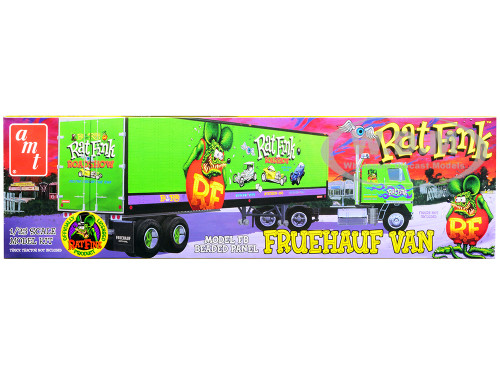
Fruehauf diecast models represent an important chapter in the development of commercial trucking and the modern tractor-trailer. Unlike many truck manufacturers whose names are primarily associated with the tractor itself, Fruehauf is especially significant for its history as a trailer manufacturer and pioneer of the semi-trailer. For collectors, Fruehauf models can add historically important trailers, transport equipment, and classic commercial vehicles to a diecast truck collection.
The Fruehauf category at DiecastModelsWholesale.com is intended for collectors of diecast trucks, semi-trailers, commercial vehicles, transportation equipment, vintage trucking subjects, and scale model trailers. Depending on the individual product, shoppers may find Fruehauf-branded trailers and truck-related models representing different periods, configurations, and applications.
The History of Fruehauf
The Fruehauf story began in Detroit, Michigan, in 1914, when blacksmith and carriage builder August Fruehauf was asked by Detroit lumberman Frederic M. Sibley to develop a way to transport a boat using a Ford Model T. Fruehauf, working with Otto Neumann, developed a trailer that attached to the modified automobile and carried the boat.
The concept proved practical beyond its original purpose. Sibley subsequently ordered additional trailers for use in his lumber business, and other businesses recognized the advantages of separating the cargo-carrying trailer from the vehicle providing the motive power. Fruehauf's design became associated with the term semi-trailer and helped establish the basic tractor-and-trailer concept that remains fundamental to freight transportation today.
In 1918, August Fruehauf incorporated the Fruehauf Trailer Company in Detroit. The business expanded its range of trailers and continued developing equipment for commercial transportation. Among its important innovations was an automatic semi-trailer coupling system introduced in the 1920s, helping make connecting and disconnecting trailers more practical for trucking operations.
Fruehauf's historical importance therefore extends beyond a particular truck model. The company helped shape the equipment and operating concept behind modern freight hauling.
Fruehauf Semi-Trailers and Trucking History
Early Fruehauf trailers were developed around the needs of businesses transporting lumber and other heavy or bulky materials. As road transportation expanded, the company developed additional trailer types for different cargoes and industries.
The company's historical product range included platform trailers, van trailers, refrigerated trailers, specialized trailers, and other commercial transportation equipment. Fruehauf's development of enclosed and specialized trailer bodies helped trucking companies move an increasingly broad range of goods by road.
For diecast collectors, this history makes Fruehauf particularly interesting because a trailer model can represent a major development in transportation even when it is displayed behind a tractor from another manufacturer.
Fruehauf Trailers and Classic American Trucks
A Fruehauf trailer can be paired with many different tractor manufacturers to create a historically inspired truck combination. Depending on the era, collectors may display Fruehauf equipment with tractors from manufacturers such as Freightliner, Kenworth, Peterbilt, Mack, International, White, Ford, or other American truck makers.
This makes Fruehauf models particularly useful for collectors who enjoy building complete tractor-trailer combinations rather than collecting individual truck cabs.
A classic Fruehauf trailer behind a period-correct tractor can also help recreate the appearance of American trucking from a particular decade. Fleet colors, trailer graphics, wheel arrangements, chassis details, and cargo configurations can all contribute to the authenticity of a display.
Fruehauf Trailer Types
One of the advantages of collecting Fruehauf models is the variety of trailer configurations associated with the company.
Van Trailers
Enclosed van trailers became an important part of road freight transportation. A Fruehauf van trailer can represent the classic box-shaped semi-trailer commonly used to transport general freight.
These models are especially recognizable when decorated with period-correct company graphics or fleet markings.
Refrigerated Trailers
Refrigerated, or reefer, trailers are designed for temperature-sensitive cargo. Fruehauf was involved in the development and production of refrigerated trailer bodies during the company's history.
For collectors, refrigerated trailers can provide a useful contrast to conventional dry vans and help create more varied commercial trucking displays.
Flatbed and Platform Trailers
Platform-style trailers are closely connected to the earliest Fruehauf designs. They are also useful for representing industries that transport machinery, lumber, construction materials, and other oversized or irregular loads.
A scale platform trailer can be especially effective in a diorama featuring construction equipment or other heavy machinery.
Specialized Transportation Equipment
Fruehauf's long history also included equipment developed for specialized commercial applications. Collectors interested in historical trucking may therefore encounter models representing equipment beyond the standard enclosed semi-trailer.
The exact configurations available depend on the individual diecast manufacturer and release.
Fruehauf and the Development of the Semi-Trailer
One of the most important reasons to collect Fruehauf models is their connection to the development of the modern semi-trailer.
The original 1914 Fruehauf trailer preserved by The Henry Ford demonstrates how the early concept evolved from a simple trailer designed to carry a boat into equipment intended for commercial freight transportation. The surviving trailer was built by August Fruehauf and Otto Neumann and is recognized as an ancestor of the trailers used to transport freight on American roads today.
The idea of separating the tractor from the cargo-carrying unit offered major practical advantages. A powered vehicle could move different trailers, while trailers could be loaded or unloaded independently. As trucking developed, this flexibility became an important part of efficient freight transportation.
For collectors, a Fruehauf model therefore represents an important piece of transportation history rather than simply another commercial vehicle.
Fruehauf in Europe and International Transportation
Although Fruehauf began in the United States, the company's influence eventually extended internationally. Fruehauf established operations and licensing arrangements in other markets, including France, where Fruehauf trailers became part of the European transportation industry after World War II.
This international history can be useful for collectors because the Fruehauf name may appear on trailers with distinctly different configurations depending on the market and period.
European Fruehauf models can also complement collections focused on historic European trucks and trailers.
Collecting Fruehauf Diecast Models
Fruehauf models can be collected in several different ways. Some collectors focus specifically on the company's historical development, while others use Fruehauf trailers to complete displays featuring tractors from different manufacturers.
Build Complete Tractor-Trailer Combinations
One of the most rewarding approaches is to match a Fruehauf trailer with a compatible tractor. Consider the period, trailer type, wheel configuration, paint scheme, and overall styling when selecting a combination.
A vintage Fruehauf trailer can be particularly effective behind a classic American conventional truck, while a later trailer can be paired with a more modern highway tractor.
Collect by Trailer Type
Another approach is to collect different forms of Fruehauf equipment:
- Dry van trailers
- Refrigerated trailers
- Platform and flatbed trailers
- Specialized commercial trailers
- Vintage transportation equipment
- Different axle and chassis configurations
This approach allows a collection to demonstrate how freight transportation equipment evolved over time.
Fruehauf Diecast Model Scales
Scale is an important consideration when choosing a Fruehauf model, particularly because trailers can require substantial display space.
Common commercial vehicle scales include 1/18, 1/24, 1/34, 1/43, and 1/50, although the exact scale available depends on the individual product.
1/50 Scale
1/50 scale is particularly useful for collectors interested in commercial trucks, construction equipment, and detailed transportation models. It offers a good combination of manageable display size and visible detail.
1/43 Scale
1/43 scale is another established scale for vehicle collecting and can work well when combining commercial vehicles with other models in the same scale.
Larger Scales
Models in 1/34, 1/24, or 1/18 scale can have a larger display presence and may make details such as trailer doors, chassis components, wheels, and exterior graphics easier to appreciate.
Always check the individual product specifications for the exact scale, dimensions, construction, and features.
What to Look For in a Fruehauf Model
When choosing a Fruehauf diecast model, consider more than just the brand name. The trailer's type, era, scale, configuration, graphics, and compatibility with other models can all influence how it fits into a collection.
Collectors may also want to look for details such as:
- Detailed trailer body and chassis
- Realistic wheels and tires
- Accurate axle configuration
- Opening trailer doors on selected models
- Detailed landing gear
- Period-correct graphics and markings
- Diecast metal construction with plastic detail components
- Compatibility with scale tractor models
- Vintage or modern trailer styling
Features vary from one manufacturer and product to another, so review the specifications for the individual model before purchasing.
Why Collect Fruehauf Diecast Models?
Fruehauf offers something distinctive to truck collectors. Its history is centered on one of the fundamental pieces of modern road freight transportation: the semi-trailer.
A Fruehauf diecast model can represent early American trucking, the growth of commercial freight transportation, the evolution of trailer technology, or a particular trucking era. It can also provide the missing component needed to turn a scale tractor into a complete tractor-trailer combination.
For collectors interested in vintage trucks, semi-trailers, American trucking history, commercial vehicles, transportation equipment, and scale model trucks, Fruehauf provides a historically meaningful subject.
Whether you are looking for a classic Fruehauf trailer, a detailed semi-trailer for a trucking display, or a model to complete a tractor-and-trailer combination, browse the available Fruehauf diecast models at DiecastModelsWholesale.com and find a piece of transportation history for your collection.