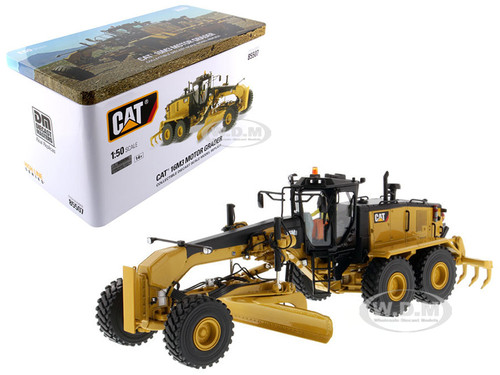
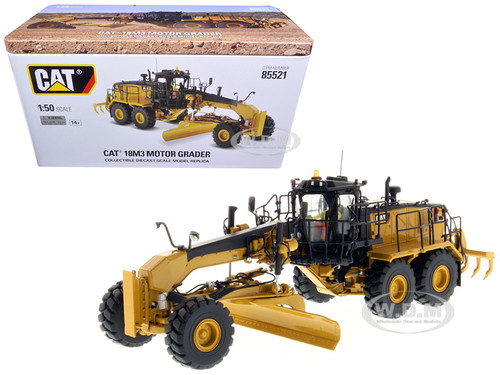
Grader diecast models bring one of the most distinctive machines in road construction and heavy equipment into miniature form. Also known as motor graders, road graders, or road maintenance graders, these machines are designed primarily for precise leveling, shaping, and finishing of soil, gravel, aggregate, and other surfaces.
Unlike a bulldozer, which is generally used to push and move larger quantities of material, a motor grader is designed for controlled surface work. Its long adjustable moldboard, multiple axles, articulated frame, and operator cab give the machine a distinctive appearance that is easy to recognize in both real construction sites and scale-model collections.
At DiecastModelsWholesale.com, the Grader category is part of the broader Vehicle Type collection. Collectors can use motor grader models to complement other construction equipment such as Dozer diecast models, Excavator diecast models, and other heavy machinery.
What Is a Motor Grader?
A motor grader is a self-propelled construction machine with a long frame and a centrally mounted moldboard, commonly called the grader blade. The blade can be positioned at different angles and depths to cut, move, spread, and shape material.
The machine's configuration is particularly suited to fine grading. Rather than simply pushing material forward, the angled blade can move material laterally while the operator makes controlled passes across a road, construction site, shoulder, or other surface.
Modern motor graders commonly feature:
- Long adjustable moldboard
- Circle and drawbar assembly supporting the blade
- Hydraulic blade controls
- Front axle and steering wheels
- Tandem rear axles
- Operator cab
- Articulated frame on many models
- Diesel engine and transmission
- Optional scarifier or ripper equipment
- Grade-control and positioning technology on some modern machines
The combination of a long frame, six wheels, central blade, and articulated chassis gives a motor grader a silhouette that is very different from other construction vehicles.
What Are Graders Used For?
Motor graders are particularly valuable when a surface needs to be shaped accurately rather than simply excavated or pushed.
Common applications include:
Road Construction and Maintenance
Grading is an important part of preparing and maintaining roads. A grader can shape the road surface, establish the desired crown or slope, distribute aggregate, and prepare the surface for subsequent construction work.
Graders are also widely associated with maintaining unpaved and gravel roads. Their adjustable blades allow operators to redistribute loose material and repair irregularities while maintaining the desired road profile. John Deere describes motor graders as important equipment for road construction, site preparation, and gravel-road maintenance.
Site Preparation
Before construction begins, a site may need to be brought to a specified elevation and slope. A motor grader can perform finishing work after larger machines have moved the bulk of the earth.
This makes the grader an important complement to excavators, dozers, loaders, and other earthmoving equipment.
Ditching and Sloping
The moldboard can be positioned to form drainage ditches, shoulders, embankments, and slopes. This ability to control the angle of the blade is one of the machine's defining characteristics.
Mining and Haul Roads
Motor graders are also used to maintain roads at mines, quarries, and other large industrial sites. Keeping haul roads properly shaped and maintained helps create suitable surfaces for heavy trucks and other equipment.
Snow Removal
In areas with significant snowfall, graders can also be equipped for snow removal. Their long blades and maneuverability make them useful for clearing and shaping roads and other large surfaces.
A Brief History of the Motor Grader
The modern motor grader developed from earlier grading equipment that was pulled by horses or attached to tractors. As road construction became increasingly mechanized during the early 20th century, manufacturers began developing self-propelled grading machines.
One of the important names in this development was the Russell Grader Manufacturing Company of Minnesota. Russell began building graders in the early 1900s and introduced the Motor Patrol in 1920, an early self-propelled grader based around a tractor and grader frame.
Caterpillar acquired Russell Grader Manufacturing Company in 1928. The acquisition helped combine tractor and grading technology into a purpose-built machine. In 1931, Caterpillar introduced the Auto Patrol, which Caterpillar identifies as the world's first motor grader designed as an integrated machine rather than a separate grader frame fitted to a tractor.
This development is especially relevant to collectors because early motor graders established many of the design characteristics still recognizable today.
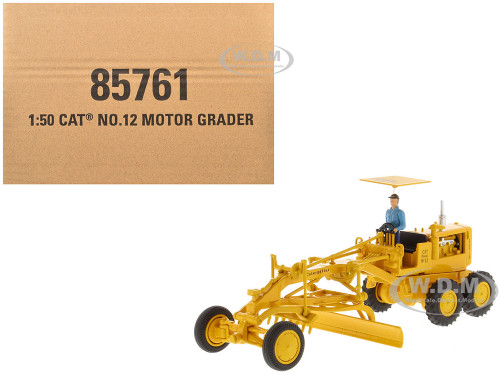
The Caterpillar No. 12
Another important historical grader is the Caterpillar Diesel No. 12 Auto Patrol, introduced in 1938. Caterpillar describes the No. 12 as a heavy-duty, self-propelled road grader whose blade could be positioned for different types of grading work. The design became an important part of Caterpillar's motor grader lineage.
Historic machines such as the Auto Patrol and No. 12 are interesting subjects for collectors because they show how modern road-building equipment evolved from earlier tractor-based machinery.
Grader Diecast Models and Collector Details
Grader models are particularly appealing to construction-equipment collectors because the working components are visually prominent even at relatively small scales.
When comparing a grader diecast model, collectors may want to look at:
Moldboard and Blade
The central moldboard is the most recognizable working component. Its position and shape distinguish a grader from many other construction machines.
A detailed scale model may reproduce the blade, cutting edge, circle, supports, and hydraulic cylinders used to position the assembly.
Articulated Frame
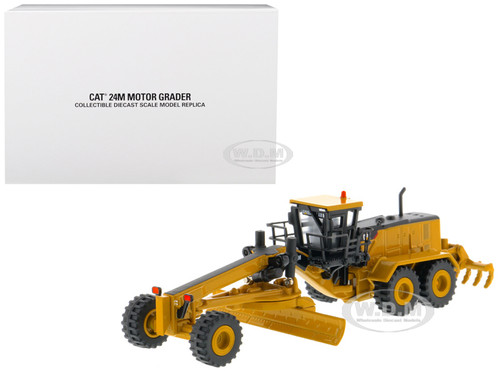
Many modern graders use an articulated frame that allows the front and rear sections of the machine to pivot relative to one another. This is an important visual and functional characteristic and can be especially noticeable on a detailed scale replica.
Wheels and Tandem Axles
The typical motor grader has multiple wheels distributed along its long chassis. The front axle supports the steering section while tandem rear axles provide traction.
The wheel arrangement gives grader models a distinctive appearance and can help differentiate them from other construction equipment.
Operator Cab
The cab provides another opportunity for detail. Depending on the model, collectors may find a visible operator seat, steering wheel, controls, windows, mirrors, and interior features.
Scarifiers and Rippers
Some graders can be fitted with additional equipment for loosening compacted material before grading. A scale replica equipped with a scarifier or rear ripper can represent a more specialized configuration.
Grader vs. Other Construction Equipment
A motor grader performs a different role from several other machines commonly found in a construction-equipment collection.
Grader vs. Dozer: A dozer is primarily designed to push and move large quantities of material for rough shaping, while a grader is intended for more controlled leveling, shaping, and finishing.
Grader vs. Excavator: An excavator is designed primarily for digging, excavation, lifting, and material handling. A grader specializes in shaping and finishing surfaces.
Grader vs. Loader: A wheel loader is designed primarily to scoop, carry, and load material using a front bucket. A grader instead uses its centrally mounted blade to manipulate material across a surface.
Grader vs. Scraper: A scraper can cut, collect, transport, and spread substantial quantities of earth. A grader is generally associated with the more precise shaping and finishing stage.
These differences make grader diecast models a useful addition to collections centered on complete construction-site equipment.
Grader Diecast Models by Scale
Construction equipment is produced in several popular scales, depending on the manufacturer and individual model. Grader diecast models may be available in scales such as 1/18, 1/24, 1/32, 1/43, 1/50, and 1/64.
1/50 scale is particularly common throughout the broader construction-model hobby and can work well for collectors building displays around heavy equipment. Larger scales can provide additional room for blade, cab, hydraulic, and chassis details, while smaller scales make it easier to build a larger construction scene in limited display space.
When adding a grader to an existing collection, matching scale is useful if you plan to display it alongside excavators, dozers, loaders, dump trucks, and other equipment.
Collecting Grader Models
Motor graders can be collected in several different ways. Some collectors focus on a particular manufacturer, while others collect machines according to era, scale, or construction application.
Possible collecting themes include:
- Historic motor graders
- Modern road graders
- Caterpillar graders
- Construction-equipment manufacturers
- Road-building equipment
- Mining and quarry machinery
- 1/50 scale construction models
- Vintage construction equipment
- Complete construction-site displays
Manufacturer markings are another important part of collecting. Brands associated with motor graders include Caterpillar, John Deere, Komatsu, Volvo, CASE, and other heavy-equipment manufacturers, depending on the particular machine and model.
For collectors who focus on Caterpillar history, early Russell and Caterpillar graders are especially interesting because of their role in the development of the integrated motor grader. Caterpillar's historical records document the transition from tractor-mounted grading equipment to dedicated motor graders during the late 1920s and early 1930s.
Building a Construction Equipment Display
A grader can play an important role in a construction diorama because it represents a different stage of earthmoving than an excavator or dozer.
For example, a display might combine:
- Excavator for digging
- Dozer for rough earthmoving and shaping
- Loader for material handling
- Dump truck for hauling
- Grader for final shaping and leveling
- Road roller for compaction
- Concrete mixer for concrete work
This combination helps illustrate how different machines contribute to a larger construction or road-building operation.
The grader's long blade also makes it visually distinctive in a display. A model positioned at an angle can immediately communicate its intended function even when the model is stationary.
Explore Grader Diecast Models
From historic motor graders to modern road-building machinery, grader diecast models represent an important part of construction and infrastructure history. Their distinctive blades, articulated frames, tandem axles, and industrial details make them natural additions to collections of heavy equipment and construction vehicles.
Browse the Grader category at DiecastModelsWholesale.com to explore available scale models and find a motor grader that fits your collection, construction diorama, or display.






 $94.95