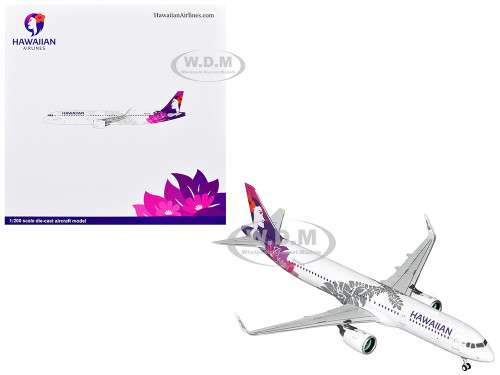
Explore Hawaiian Airlines diecast airplane models inspired by the largest airline based in the Hawaiian Islands and a familiar name in transpacific aviation. Known for its distinctive purple, red, and white branding and the elegant Pualani emblem featuring a woman's profile, Hawaiian Airlines has built a strong identity around its Hawaiian heritage and the islands it serves.
Hawaiian Airlines aircraft connect the Hawaiian Islands with destinations across the United States and the Pacific, making the airline an appealing subject for aviation enthusiasts, airline memorabilia collectors, and travelers with a special connection to Hawaii. Scale models featuring Hawaiian Airlines markings can bring a recognizable Pacific carrier into an aircraft display, complement a collection of U.S. airlines, or represent the development of long-distance passenger travel across the Pacific Ocean.
This category is dedicated to Hawaiian Airlines airplane collectibles. Available products may differ by aircraft type, scale, manufacturer, registration, and livery. Browse the listings to discover which models are available and check the individual product descriptions for confirmed specifications.
The History of Hawaiian Airlines
Hawaiian Airlines began operations on November 11, 1929, under the name Inter-Island Airways. Its early service connected communities across the Hawaiian Islands, helping residents and visitors travel between islands where ocean distances made air transportation especially valuable.
The airline adopted the name Hawaiian Airlines in 1941 as its operations developed. Over time, it transitioned from an island-focused carrier to an airline serving a broader network of destinations. Improvements in aircraft technology made longer routes practical, allowing Hawaiian Airlines to expand its role in connecting Hawaii with the continental United States and international markets.
The arrival of larger and more capable commercial aircraft helped transform the airline's operations. Jet aircraft made longer journeys faster and more practical, while successive generations of passenger planes brought changes in capacity, range, passenger comfort, and operating efficiency. Hawaiian Airlines' fleet history reflects this broader evolution of commercial aviation.
The airline's identity remains closely connected to Hawaii. Its branding, aircraft names, and visual themes draw on Hawaiian culture and the islands' natural beauty. For collectors, these features make Hawaiian Airlines models distinctive among the many liveries represented in commercial aircraft collecting.
A scale model can represent more than the shape of an airplane. It can also capture a particular period in an airline's history, from earlier generations of passenger aircraft to modern long-haul jets. Collectors interested in Hawaiian Airlines may therefore choose models based on aircraft design, airline branding, or the era they want to represent.
Hawaiian Airlines Aircraft and Fleet History
Hawaiian Airlines has operated several types of aircraft throughout its history, reflecting its changing route network and the development of commercial aviation. Its fleet has included aircraft for interisland travel, mainland routes, and longer international services across the Pacific.
Boeing 717 for Interisland Services
The Boeing 717 has been an important part of Hawaiian Airlines' interisland operations. Designed for shorter routes, this twin-engine jet is well suited to frequent services connecting airports across the Hawaiian Islands.
The 717 has a distinctive appearance, with its rear-mounted engines and tail-mounted horizontal stabilizer setting it apart from many other modern passenger jets. For collectors, a Hawaiian Airlines Boeing 717 model represents a specialized role in aviation: moving passengers between islands on short flights rather than operating long-distance international routes.
This aircraft is especially relevant to collectors who want their displays to reflect the practical variety of airline operations. An interisland jet can complement widebody aircraft and help illustrate how airlines use different aircraft types for different distances and passenger demands.
Airbus A321neo for Longer Domestic Routes
The Airbus A321neo is a narrowbody aircraft designed for improved efficiency and longer-range operations compared with earlier versions of the A321. Hawaiian Airlines introduced the A321neo to serve routes connecting Hawaii with selected destinations on the U.S. mainland.
The aircraft's single-aisle design makes it visibly different from widebody jets, while its longer fuselage gives it a distinctive profile within the Airbus A320 family. For collectors, the Hawaiian Airlines A321neo offers a way to represent modern narrowbody aircraft used on routes that cross substantial stretches of ocean.
When considering an A321neo model, look for the precise aircraft variant and livery represented. Similar-looking aircraft from other airlines may share the same basic airframe, but their markings and registrations distinguish them as individual collectibles.
Airbus A330 for Transpacific Travel
The Airbus A330 has been an important widebody aircraft in Hawaiian Airlines' long-distance operations. Its twin-aisle cabin and twin-engine configuration make it suitable for routes linking Hawaii with mainland North America and other destinations across the Pacific.
Compared with narrowbody aircraft, the A330 has a wider fuselage and a larger overall presence, making it a natural centerpiece for an airline model display. Its shape, wing design, and engine proportions also give collectors distinctive features to compare with other widebody aircraft.
Hawaiian Airlines has used the A330-200, a variant designed for medium- to long-haul operations. Models of this aircraft can appeal to collectors interested in Pacific aviation, widebody aircraft, and the airline's role in connecting Hawaii with distant destinations.
Boeing 787 Dreamliner
The Boeing 787 Dreamliner represents a newer generation of long-haul aircraft. Its composite airframe, distinctive swept wing design, and modern engine nacelles make it recognizable to aviation enthusiasts.
Hawaiian Airlines introduced the Boeing 787-9 into its fleet in 2024. The type adds another chapter to the airline's long-distance fleet development and provides collectors with a modern aircraft design associated with the carrier.
As fleet configurations and operations can change, check individual listings to confirm the exact aircraft type represented by any Hawaiian Airlines model. Not every aircraft operated by the airline will necessarily be available as a scale replica.
Hawaiian Airlines Livery and Pualani Branding
One of the most recognizable features of Hawaiian Airlines is its Pualani emblem. The name is commonly translated as “flower of the sky,” and the profile of a Hawaiian woman surrounded by a tropical flower has become a defining part of the airline's visual identity.
The airline's purple, red, and white colors distinguish its aircraft from other U.S. carriers. The branding draws on Hawaii's cultural identity and creates a strong visual connection between the airline and the islands it represents.
Hawaiian Airlines has updated its aircraft appearance over time while retaining recognizable elements of its identity. This makes the airline interesting to collectors who compare liveries across different aircraft generations. A model featuring an earlier design may complement a modern aircraft replica, illustrating how an airline's branding evolves while maintaining continuity.
When choosing a Hawaiian Airlines airplane model, consider the following details:
-
Pualani emblem: Check the placement and appearance of the airline's distinctive profile logo.
-
Fuselage and tail colors: Compare the livery represented on the model with the particular aircraft or period.
-
Aircraft registration: Registration markings can help identify a specific aircraft rather than a generic example of the type.
-
Special liveries: Promotional, commemorative, or other distinctive paint schemes may appeal to collectors seeking something different from the standard design.
-
Aircraft version: Confirm whether the model represents a Boeing 717, Airbus A321neo, A330, Boeing 787, or another aircraft type.
Specific aircraft and special liveries may not be available in every scale or release, so use the individual product listing to confirm what is represented.
Choosing a Hawaiian Airlines Scale Model
Scale is an important consideration when selecting an airplane model, particularly if you are building a collection of aircraft from several airlines. It describes the relationship between the model's dimensions and those of the full-size aircraft.
Common scales used for commercial airplane models include:
-
1:200 scale: Offers a larger display model with a substantial presence on a shelf or desk.
-
1:400 scale: Suits collectors who want to display multiple aircraft in a relatively compact space.
-
1:500 scale: Provides another compact option for collectors interested in representing many airlines or creating miniature airport scenes.
These are common scales in aircraft collecting, not a guarantee of current Hawaiian Airlines inventory. Confirm the scale and measurements of each product before purchasing.
The size of the full-size aircraft also affects the model's dimensions. A widebody Airbus A330 or Boeing 787 will generally be larger than a Boeing 717 model at the same scale. Keeping this in mind can help you plan a display and choose aircraft that work well together.
Other features worth checking include construction materials, landing gear, display stands, printed markings, and packaging. Details vary by manufacturer and release, so review the product specifications if a particular feature is important to your collection.
Building a Hawaiian Airlines Collection
Hawaiian Airlines models can fit several collecting themes, whether you are interested in the airline's history, Pacific aviation, or specific aircraft designs.
-
Hawaiian aviation: Build a display centered on the airlines and aircraft associated with travel between the Hawaiian Islands and the wider world.
-
Boeing and Airbus collections: Compare Hawaiian Airlines aircraft with models of similar aircraft operated by other carriers.
-
Transpacific aviation: Feature aircraft associated with long-distance routes connecting Hawaii with mainland destinations and international markets.
-
Aircraft-generation displays: Pair older and newer aircraft types to show how airline fleets change over time.
-
Airline livery collecting: Focus on Pualani branding, the airline's distinctive colors, and different aircraft appearances.
A Hawaiian Airlines diecast airplane can also make a thoughtful gift for an aviation enthusiast, airline memorabilia collector, aircraft spotter, or traveler with a connection to Hawaii. If you are buying for another collector, consider their preferred scale, aircraft type, and interest in standard versus special liveries.
Explore the available Hawaiian Airlines diecast airplane models at Diecast Models Wholesale to compare aircraft, scales, liveries, and product details, and find a collectible that brings a distinctive piece of Pacific aviation to your display.