Heinkel diecast aircraft models represent an important and technologically ambitious chapter in German aviation history. Founded by aircraft designer Ernst Heinkel, the company became known for fast aircraft, bombers, reconnaissance aircraft, seaplanes, fighters, and pioneering work in rocket and jet propulsion. For aviation collectors, Heinkel models provide an opportunity to explore aircraft ranging from the elegant He 70 Blitz and famous He 111 bomber to the He 177 Greif, He 219 Uhu, and pioneering He 162 jet fighter.
The Heinkel category at DiecastModelsWholesale.com is intended for collectors, military aviation enthusiasts, and model aircraft shoppers looking for miniature representations of aircraft developed by Heinkel Flugzeugwerke. Depending on the individual product, collectors may find World War II bombers, fighters, reconnaissance aircraft, naval aircraft, and early jet aircraft in a variety of collectible scales.
The History of Heinkel Aircraft
Ernst Heinkel established his own aircraft company at Warnemünde in 1922, following an earlier career as an aircraft designer. During the 1920s and early 1930s, Heinkel became increasingly recognized for innovative aircraft designs and high-speed aviation.
One of the company's early successes was the Heinkel He 70 Blitz, a fast, streamlined aircraft developed for commercial transportation and mail service. Its aerodynamic design helped establish Heinkel's reputation for high-performance aircraft and influenced later designs.
The company subsequently developed the Heinkel He 111, which became one of the most recognizable German aircraft of the Second World War. Heinkel also produced fighters, seaplanes, reconnaissance aircraft, and specialized military aircraft.
Heinkel's engineering work extended beyond conventional piston-engine aircraft. In 1939, the Heinkel He 176 became an important experimental rocket-powered aircraft, while the Heinkel He 178 made aviation history as the world's first aircraft to fly under turbojet power. The company later developed the He 280 prototype jet fighter and the He 162, one of Germany's final operational jet fighters of the Second World War.
For collectors, this combination of conventional aircraft and pioneering technology makes Heinkel an especially interesting manufacturer to collect.
Heinkel He 111 Diecast Models
The Heinkel He 111 is the aircraft most closely associated with the company and one of the most recognizable German bombers of World War II.
Originally developed from a high-speed civil aircraft concept, the He 111 evolved into a military bomber. Later versions are particularly recognizable for their extensively glazed forward fuselage, which gave the aircraft its distinctive appearance.
The He 111 participated in major operations during the early years of the Second World War, including the Battle of Britain, and was subsequently used in bombing, transport, maritime, and other roles.
Numerous variants were developed during its long production career. Collectors may encounter models representing different He 111 variants, camouflage schemes, Luftwaffe units, aircraft codes, or historical periods.
The aircraft's combination of historical importance and highly recognizable shape makes a Heinkel He 111 diecast model a natural centerpiece for a World War II German aircraft collection.
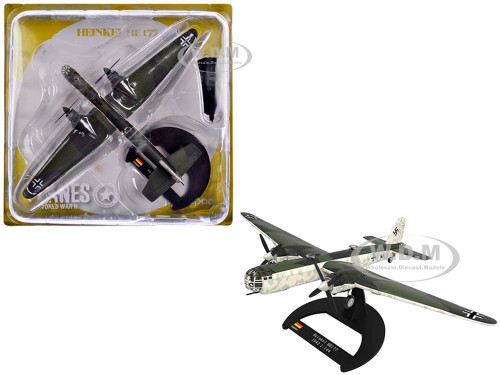
Heinkel He 177 Greif
The Heinkel He 177 Greif was developed as a long-range heavy bomber and became Germany's only operational aircraft in that category during World War II.
The He 177 was an ambitious design with unusually powerful engines and a requirement for capabilities that created significant engineering challenges. Early engine installations contributed to reliability and overheating problems, which affected the aircraft's operational effectiveness.
Despite its difficulties, the He 177 remains an important aircraft in German bomber history. Its large size, distinctive engine arrangement, and relatively limited production compared with the He 111 make it an interesting subject for aviation collectors.
A He 177 model can complement a He 111 or other Axis aircraft in a collection focused on the development of German bomber design.
Heinkel He 219 Uhu
The Heinkel He 219 Uhu, or "Eagle-Owl," was a specialized night fighter developed for the Luftwaffe.
The He 219 incorporated several advanced features for its time, including retractable tricycle landing gear and ejection seats. It was designed around the requirements of night interception, with radar and specialized equipment intended to locate and attack Allied bombers in darkness.
The aircraft's unusual configuration and advanced equipment make it one of the most technically interesting Heinkel aircraft. He 219 diecast models are particularly appealing to collectors interested in World War II night-fighter operations and German aviation technology.
Heinkel He 162 Spatz
The Heinkel He 162 Spatz, also known as the Volksjäger or "People's Fighter," represents the company's contribution to Germany's final generation of wartime jet aircraft.
The He 162 was designed and produced very quickly in response to the urgent need for a lightweight jet fighter late in the war. It featured a distinctive configuration with a single jet engine mounted above the fuselage and a relatively compact airframe.
Although the aircraft entered service only near the end of the war and saw limited operational use, it has become an important subject for aviation historians and model collectors because of its place in early jet-fighter development.
A He 162 diecast model provides an interesting contrast with earlier Heinkel aircraft such as the He 111, showing the rapid technological transition from piston-engine aircraft to jet propulsion.
Heinkel He 178 and Early Jet Aviation
The Heinkel He 178 holds a special place in aviation history. Powered by a turbojet engine developed by Hans von Ohain and his team, it made its first flight in 1939.
Although it was an experimental aircraft rather than a production combat aircraft, the He 178 demonstrated the practical potential of jet propulsion. Its development was followed by the Heinkel He 280, an early twin-engine jet fighter prototype.
For collectors interested in aviation technology, these aircraft can represent a different side of Heinkel history than the company's more familiar World War II bombers.
Heinkel He 70 Blitz
The Heinkel He 70 Blitz was one of the company's most important prewar aircraft. Developed as a fast transport and mail aircraft, it was designed by the Günter brothers and became known for its streamlined construction and impressive performance.
The He 70 was also adapted for military applications, demonstrating how rapidly civil aircraft technology could influence military aviation during the 1930s.
Collectors interested in the evolution of Heinkel aircraft can use an He 70 model as an early-generation counterpart to the later He 111.
Other Notable Heinkel Aircraft
Heinkel developed a broad range of aircraft beyond the best-known bombers and jets. Depending on the individual diecast release, collectors may encounter models associated with:
- Heinkel He 51 – Biplane fighter and ground-attack aircraft
- Heinkel He 59 – Twin-engine reconnaissance and seaplane
- Heinkel He 60 – Shipboard reconnaissance floatplane
- Heinkel He 70 Blitz – High-speed transport and mail aircraft
- Heinkel He 72 Kadett – Trainer aircraft
- Heinkel He 100 – High-performance fighter developed before World War II
- Heinkel He 112 – Fighter developed during Germany's prewar fighter competition
- Heinkel He 114 – Reconnaissance floatplane
- Heinkel He 115 – Twin-engine maritime aircraft and floatplane
- Heinkel He 116 – Long-range transport and reconnaissance aircraft
- Heinkel He 177 Greif – Long-range heavy bomber
- Heinkel He 219 Uhu – Specialized night fighter
- Heinkel He 162 Spatz – Late-war jet fighter
- Heinkel He 176 – Experimental rocket-powered aircraft
- Heinkel He 178 – Pioneering turbojet aircraft
- Heinkel He 280 – Early twin-engine jet fighter prototype
Not every aircraft was produced as a collectible diecast model, and available scales and variants vary by manufacturer and release. Always check the individual product listing for the exact aircraft, version, markings, scale, and construction.
Collecting Heinkel Diecast Aircraft
Heinkel models can be collected in several different ways. Some collectors concentrate on the He 111, while others build a broader historical display showing the progression of Heinkel aircraft from the 1930s through the end of the Second World War.
Collect by Aircraft Type
A focused collection might include several versions of the He 111, He 177, He 219, or He 162. Collectors can compare different variants, markings, camouflage schemes, and configurations.
Collect by Historical Era
A chronological collection provides another useful approach:
Prewar aviation: He 51, He 70, He 100, He 112, and related designs.
Second World War: He 111, He 177, He 219, He 115, and other operational aircraft.
Experimental aviation: He 176, He 178, and He 280.
Late-war jet aviation: He 162 and other advanced designs developed during the final stages of the war.
This type of collection illustrates the rapid development of German aircraft technology during one of the most transformative periods in aviation history.
Collect by Operator and Markings
Military aircraft collectors may also focus on individual Luftwaffe units, aircraft codes, camouflage schemes, and historical missions. Some Heinkel aircraft were also exported or operated by foreign air forces, giving collectors additional possibilities when particular models are available.
Choosing a Heinkel Diecast Aircraft Scale
The best scale depends on the aircraft and the type of collection you are building. Heinkel aircraft models may be available in scales such as 1/72, 1/48, 1/100, 1/144, 1/200, and 1/400, depending on the particular release.
1/72 Scale
1/72 scale is a popular choice for military aircraft collectors because it provides a good balance between model size and visible detail. It works particularly well for fighters such as the He 51, He 100, He 112, He 162, and He 219.
1/48 Scale
1/48 scale offers a larger presentation and can provide more visual impact. It is particularly appealing to collectors who want aircraft details to be more prominent in a display.
1/144 and Smaller Scales
Smaller scales allow collectors to display more aircraft in the same amount of space. This can be useful when building a chronological collection containing multiple Heinkel aircraft.
1/200 and 1/400 Scale
These smaller scales are useful for compact aviation displays and collections containing many aircraft. The appropriate scale ultimately depends on the specific model release and the collector's available space.
Because the He 111 and He 177 are substantially larger aircraft than many Heinkel fighters, finished model dimensions can vary significantly even when two aircraft are represented at the same scale.
Heinkel Models for Aviation History Collections
Heinkel aircraft offer collectors an opportunity to explore several major developments in aviation. The He 70 represents the company's early emphasis on aerodynamic performance, the He 111 and He 177 represent German bomber development, and the He 219 demonstrates advances in specialized night-fighter technology.
The He 176, He 178, He 280, and He 162 add another dimension by illustrating Heinkel's pioneering work with rocket and jet propulsion.
For collectors interested in World War II aviation, German aircraft, early jet technology, or the history of aircraft engineering, a Heinkel model can provide a distinctive and historically significant addition to a display.
Find Heinkel Diecast Aircraft Models
From the streamlined He 70 Blitz to the famous He 111 bomber, the large He 177 Greif, advanced He 219 Uhu night fighter, and pioneering He 162 Spatz, Heinkel aircraft cover a remarkable range of aviation development.
Whether you are searching specifically for a Heinkel He 111, He 177, He 219, He 162, He 70, or another Heinkel aircraft, review each product listing for its exact variant, scale, markings, and manufacturer.
Browse the Heinkel diecast aircraft collection at DiecastModelsWholesale.com to explore available models and add an important piece of German aviation history to your collection.

 $30.95


