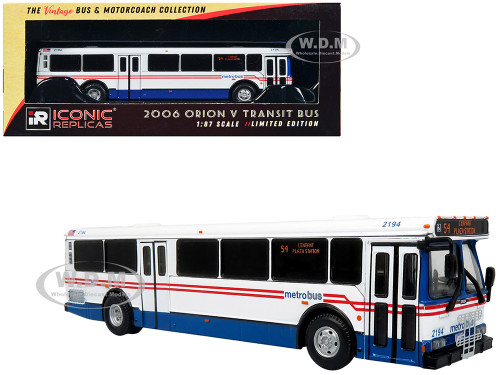
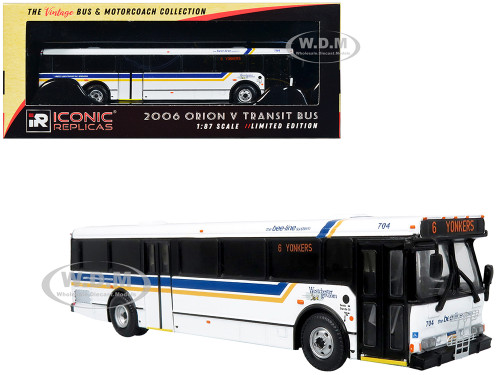
Discover Orion diecast bus models inspired by one of the most recognizable transit bus manufacturers in North American public transportation history. Known for its practical city bus designs, accessible low-floor vehicles, and buses serving major transit agencies across the United States and Canada, Orion Bus Industries helped shape urban transportation for several decades.
The Orion category at Diecast Models Wholesale is designed for bus collectors, transit enthusiasts, model vehicle hobbyists, and anyone interested in the history of public transportation. Depending on current product availability, the selection may include miniature Orion V transit buses decorated in the liveries of real transportation agencies, including GO Transit, the Toronto Transit Commission (TTC), the Metropolitan Transportation Authority (MTA) in New York, the Washington Metropolitan Area Transit Authority (WMATA), and Westchester Bee-Line System.
Many Orion V miniature buses have been produced by Iconic Replicas in 1:87 scale, also known as HO scale. These models combine recognizable bus bodywork with transit agency colors, destination displays, fleet markings, and other details that make individual vehicles meaningful to collectors.
Orion buses are particularly interesting because their history spans the transition from traditional high-floor city buses to modern low-floor transit vehicles. Models from different generations can illustrate how bus design changed to improve accessibility, accommodate different propulsion systems, and meet the demands of urban transit operations.
Whether you collect buses from your hometown, recreate a miniature city transportation network, or appreciate the vehicles that served generations of commuters, Orion diecast bus models offer a distinctive addition to a transit collection.
The History of Orion Bus Industries
Orion's history began in Ontario, Canada, in 1975, when the company was established as Ontario Bus and Truck. The business developed a range of transit buses for Canadian and American transportation systems, eventually becoming known as Ontario Bus Industries, or OBI, in 1977.
The company introduced its Orion I bus in the late 1970s, establishing the foundation for a growing family of urban transit vehicles. Its buses were designed for regular public transportation service, with practical layouts and configurations suited to municipal and regional transit operations.
In 1981, the company established a United States subsidiary, Bus Industries of America, to support the American market. This allowed Orion to expand its manufacturing and assembly operations to serve transit agencies on both sides of the border.
In 1995, following a change in ownership, Ontario Bus Industries adopted the Orion Bus Industries name. The company subsequently became part of Western Star Trucks and later Daimler. In 2009, the Orion business adopted the Orion International name.
Orion continued developing transit buses until production ended in 2013. Although the company no longer manufactures new buses under the Orion name, its vehicles remain an important part of North American transit history, and surviving buses have continued to interest transit enthusiasts and preservation groups.
For diecast collectors, Orion's history offers a range of recognizable bus designs, from older high-floor models to later low-floor vehicles. The Orion V, in particular, became a familiar sight in many cities and is an especially relevant subject for collectors of late-20th-century and early-21st-century transit buses.
Orion V Diecast Bus Models
The Orion V is one of the best-known bus designs associated with Orion Bus Industries. Introduced in 1989, it was produced through 2009 and served transit agencies in Canada and the United States.
Unlike low-floor buses developed specifically to reduce boarding height, the Orion V used a traditional high-floor layout. Its design included a conventional passenger compartment, a recognizable two-piece windshield, large side windows, and a body intended for regular urban transit service.
Orion V buses were manufactured in several lengths, including approximately 32-foot, 35-foot, and 40-foot versions. Transit agencies selected configurations according to route requirements, passenger demand, and operating needs.
The Orion V's long production history and widespread service make it particularly appealing to collectors. Its recognizable shape appeared in a variety of local transit liveries, meaning that models of the same basic bus can represent very different cities and fleets.
Why Collect Orion V Models?
An Orion V diecast model can represent a familiar part of a city's transportation history. Many transit enthusiasts remember these buses from everyday commutes, school journeys, downtown routes, or trips to regional destinations.
The models are also suitable for collectors who enjoy comparing transit fleets. Differences in agency logos, vehicle numbers, destination displays, paint schemes, and other markings can distinguish one miniature from another.
Depending on the product, Orion V replicas may represent specific buses operated by municipal transit systems or regional transportation authorities. A model with a particular route display can be especially interesting to someone familiar with the represented service.
When selecting an Orion V model, review the operator, destination sign, fleet number, exterior graphics, and stated year. These details help identify the particular vehicle depicted rather than simply the general bus type.
GO Transit Orion V Models
GO Transit is a regional public transportation system serving the Greater Toronto and Hamilton Area in Ontario. Its familiar green-and-white branding makes its buses recognizable to many Canadian transit enthusiasts.
Orion V buses used in GO Transit service offer an interesting subject for collectors interested in suburban transportation and regional commuter networks. Unlike city buses that primarily serve closely spaced urban stops, GO Transit buses support longer regional journeys and connections with other forms of public transportation.
A GO Transit Orion V miniature can represent an important part of the region's transit history. Models may feature the agency's distinctive exterior colors, fleet identification, and destination displays.
One example in the diecast hobby is a 1:87 Orion V representing GO Transit service associated with the Newmarket area. Such models are especially useful for collectors who want to recreate a regional transit fleet in miniature.
A GO Transit model can also complement other Canadian buses, including vehicles representing the Toronto Transit Commission and other Ontario operators.
Toronto Transit Commission Orion Bus Models
The Toronto Transit Commission, commonly known as the TTC, operates one of Canada's largest urban public transportation networks. Its buses are a familiar part of Toronto's streets and connect neighborhoods with subway, streetcar, and other transit services.
Orion V buses served the TTC fleet and became part of the city's transit history. For collectors, a TTC Orion miniature represents both a distinctive bus design and a recognizable part of everyday transportation in Toronto.
Collecting TTC Orion V Liveries
TTC Orion V replicas can appeal to collectors who focus on Toronto's public transportation history. The agency's fleet identification, destination signs, and exterior graphics distinguish its buses from otherwise similar Orion models used in other cities.
When comparing TTC bus miniatures, look for the specific destination displayed and any fleet number included in the product description. These details can help identify the vehicle being represented.
A TTC Orion V model can also be displayed with other Toronto transit vehicles, creating a collection centered on the evolution of public transportation in the city.
MTA New York City Orion V Models
New York City's Metropolitan Transportation Authority operates an extensive public transportation network, including the city's subway and bus systems. Its bus operations serve neighborhoods throughout the five boroughs, providing connections between residential areas, commercial districts, and transit hubs.
The MTA used Orion V buses as part of its city fleet. These vehicles are an interesting subject for collectors because New York transit buses operate in a dense urban environment and carry distinctive local markings.
Route and Destination Details
Some Orion V miniature buses depict specific New York City routes and destinations. A model might identify a route number and destination such as St. George Ferry Terminal, giving the miniature a closer connection to a particular service.
For collectors, destination details can be just as important as the body design. They help distinguish individual models and make a transit display more representative of real-world bus operations.
An MTA New York City Orion V is a natural choice for collectors building a metropolitan transit collection or gathering buses from agencies that operated Orion vehicles during the 1990s and 2000s.
WMATA Washington Orion V Models
The Washington Metropolitan Area Transit Authority, commonly known as WMATA, operates regional bus and rail services in the Washington, D.C., metropolitan area. Its bus network connects neighborhoods, commercial districts, government destinations, and other transportation facilities.
WMATA Orion V buses form part of the region's transit history and provide another example of how the same bus manufacturer supplied vehicles to different local transportation systems.
A WMATA Orion V miniature may feature the agency's distinctive exterior graphics and a destination display representing a particular route. These details can make the model a meaningful addition for collectors with an interest in Washington's transportation network.
One example of this type of replica represents a 2006 Orion V bus displaying the route 54 destination "L'Enfant Plaza Station."
For collectors, the model combines a recognized Orion vehicle with destination details associated with a specific urban transit environment.
Westchester Bee-Line Orion V Models
The Westchester Bee-Line System serves Westchester County, New York, connecting communities with local destinations and regional transportation services.
Bee-Line Orion V buses provide another example of the brand's use across different urban and suburban environments. Their livery and fleet markings distinguish them from Orion buses used by larger metropolitan agencies.
A Westchester Bee-Line Orion V miniature can be an appealing choice for collectors interested in the New York metropolitan area's broader transit network rather than only New York City's buses.
For those collecting by geography, Bee-Line models can complement replicas from the MTA and other regional operators, highlighting the different visual identities used by neighboring transit systems.
Orion Bus Models and North American Transit History
Orion's bus designs evolved alongside major changes in public transportation. During its production history, the company developed conventional buses, articulated vehicles, smaller transit buses, and several generations of low-floor designs.
Orion I
The Orion I was the company's original major transit bus design. Produced in several lengths, it used a traditional high-floor layout and served Canadian and American transit agencies.
It represents an early chapter in Orion's development and provides context for the later Orion V.
Orion II
The Orion II was a smaller, low-floor bus developed for applications requiring a compact transit vehicle. It was among the early North American low-floor bus designs and reflected efforts to make public transportation more accessible.
Its smaller size distinguished it from the full-length urban buses that became common in major city fleets.
Orion III
The Orion III was an articulated bus developed through a collaboration involving Orion and Hungarian manufacturer Ikarus. Its extended body and articulated center section allowed it to accommodate more passengers than a conventional bus.
The Orion III was used by selected Canadian transit operators, including Toronto and Ottawa. Its distinctive shape makes it an interesting historical subject, although product availability as a miniature may differ from that of the more common Orion V.
Orion VI
The Orion VI was a low-floor transit bus introduced during the 1990s. Its design reflected a growing emphasis on passenger accessibility, with a low boarding height intended to make entering and exiting easier.
The model was also notable for the introduction of hybrid-electric propulsion as a regular production option, marking an important development in the use of hybrid technology in North American transit buses.
Orion VII
The Orion VII was a low-floor transit bus introduced in 2001. Produced in several generations, it became one of the company's most recognizable designs during its final years of bus manufacturing.
The Orion VII was available with different propulsion configurations, including diesel, compressed natural gas, and hybrid-electric systems, depending on the version.
For collectors, Orion VII models represent a later stage in the brand's history and offer a useful comparison with the traditional high-floor Orion V.
Not every Orion generation will necessarily be represented in the category at all times. Review the available products to determine which model types, operators, and configurations can be added to your collection.
Orion Diecast Bus Models by Iconic Replicas
Iconic Replicas is associated with detailed miniature transit buses, including Orion V models decorated in the liveries of real transportation agencies.
Many Orion V replicas from Iconic Replicas are made in 1:87 scale, also known as HO scale. This size is particularly useful for bus collectors who want to display multiple vehicles or incorporate buses into model railroad layouts and miniature city scenes.
Depending on the particular product, features may include:
-
Diecast metal construction with some plastic components.
-
Detailed exterior bodywork and window glazing.
-
Rubber tires.
-
Transit agency colors, logos, and fleet markings.
-
Destination displays representing specific routes.
-
Original manufacturer packaging.
These features vary by product, so check the individual listing to confirm its construction, dimensions, and included details. Many models are static display collectibles and may not include opening doors or other moving parts.
Choosing the Right Orion Diecast Bus
Identify the Bus and Transit Agency
Start by choosing the specific Orion model that interests you. The Orion V is particularly suitable for collections focused on North American city buses, while earlier or later generations may appeal to collectors exploring the development of transit bus design.
If you collect buses from a particular city, confirm the transit agency, destination display, and exterior markings. These details can be as important as the vehicle itself.
Consider the Scale
The 1:87 scale is popular for Orion V transit bus models. At this scale, a full-size bus approximately 40 feet long would measure roughly 5.5 inches in length.
This compact format allows collectors to display several buses together without requiring extensive shelf space. It also works well for HO-scale model railroad layouts and miniature urban scenes.
Always check the actual dimensions listed for the specific model, especially if you're planning a display with several vehicles.
Review the Product Details
Before purchasing, examine the model description for the bus year, model designation, transit operator, destination display, paint scheme, and construction materials.
Collectors who retain original packaging should also review the condition and packaging details where provided. Confirming the exact product specifications helps ensure that the model fits your collection.
Explore Orion Diecast Transit Bus Models
From the familiar Orion V city bus to earlier high-floor models and later low-floor transit designs, Orion represents an important chapter in North American public transportation.
Browse the Orion category at Diecast Models Wholesale to explore available miniature buses, compare transit agency liveries and destination displays, and find a distinctive addition to your diecast bus collection.