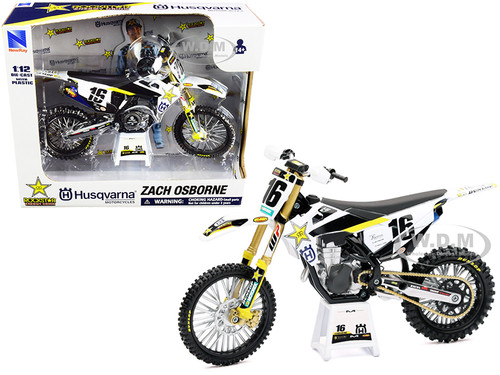
Husqvarna diecast models bring more than a century of motorcycle history into collectible scale. With origins in Sweden and a heritage spanning early motorcycles, road bikes, motocross, enduro, and modern urban and adventure motorcycles, Husqvarna offers collectors an unusually diverse range of subjects.
The Husqvarna category at DiecastModelsWholesale.com is for collectors, motorcycle enthusiasts, and shoppers looking for scale models representing Husqvarna motorcycles from different eras. Depending on the available selection, shoppers may find models inspired by classic Husqvarna dirt bikes, motocross and enduro machines, as well as modern motorcycles such as the Vitpilen and Svartpilen families.
Husqvarna is especially interesting for collectors because the brand has passed through several distinct periods of motorcycle development. Its early Swedish racing heritage, pioneering off-road success, transition through different ownership eras, and modern return to the premium motorcycle market give Husqvarna models a strong historical context.
The History of Husqvarna Motorcycles
Husqvarna's roots extend far beyond motorcycles. The Husqvarna company was established in Sweden in the 17th century, and its manufacturing history eventually expanded into bicycles and other products. Motorcycle production began in 1903, making Husqvarna one of the oldest motorcycle manufacturers still represented in the modern motorcycle industry.
The company's early motorcycles were influenced by European motorcycle engineering, with Husqvarna developing and producing its own machines as motorcycle technology evolved. During the first half of the 20th century, Husqvarna motorcycles competed in road racing and other forms of motorcycle competition.
The brand's identity changed significantly after World War II. Husqvarna increasingly focused on lightweight off-road motorcycles, and this decision would ultimately become one of the most important chapters in its history.
By the 1960s and 1970s, Husqvarna had established a formidable reputation in motocross and enduro competition. Its lightweight two-stroke motorcycles became influential in the development of modern off-road motorcycles, and Husqvarna machines attracted riders and racers around the world.
This period is particularly important for diecast collectors because many of the classic Husqvarna motorcycles are instantly recognizable for their compact proportions, minimalist bodywork, long-travel suspension, and distinctive Swedish styling.
Husqvarna and Off-Road Racing
Husqvarna's competition history is one of the strongest reasons to collect its motorcycles in scale.
Motocross
Husqvarna became an important force in motocross during the 1960s and 1970s. The company's lightweight two-stroke motorcycles were particularly competitive against heavier machines, and Husqvarna riders achieved success in international competition.
One of the most famous riders associated with the brand was Torsten Hallman, who won four 250cc Motocross World Championships for Husqvarna during the 1960s. Other championship riders helped establish the company as one of the defining names in European motocross.
Husqvarna's influence extended beyond competition results. Its lightweight off-road motorcycles demonstrated the potential of small-displacement two-stroke engines combined with carefully developed chassis designs.
For collectors, classic Husqvarna motocross models can represent a fascinating period when European manufacturers played a major role in shaping international off-road motorcycle competition.
Enduro
Husqvarna also became strongly associated with enduro and long-distance off-road competition. The demanding nature of enduro required motorcycles capable of handling rocks, mud, forest trails, hills, water crossings, and extended competition stages.
The brand's off-road expertise made Husqvarna motorcycles popular with riders who wanted a combination of lightweight handling and competitive performance.
Husqvarna's success in the International Six Days Trial, now known as the International Six Days Enduro, further strengthened its reputation. These endurance competitions placed enormous demands on both rider and motorcycle and became an important part of Husqvarna's racing heritage.
Classic Husqvarna Dirt Bikes
Classic Husqvarna motorcycles are among the most historically interesting subjects for scale-model collectors.
Models from the 1960s and 1970s typically feature narrow seats, simple fuel tanks, high front fenders, exposed frames, wire-spoke wheels, and long-travel suspension. Their appearance is very different from today's motocross motorcycles, making them visually distinctive in a collection.
The Husqvarna 400 Cross is one particularly famous example. The model gained additional recognition after Steve McQueen was photographed and filmed riding Husqvarna motorcycles, helping connect the brand with American motorcycle culture and the emerging popularity of European off-road motorcycles in the United States.
The Husqvarna 500 Cross and other large-displacement competition motorcycles are also significant examples of the company's classic off-road era.
For collectors, these motorcycles provide an opportunity to represent a period when lightweight European motocross machines were becoming increasingly influential in North America.
Husqvarna's Transition to Modern Ownership
Husqvarna's motorcycle history includes several major ownership changes. The motorcycle business moved from Swedish ownership to Cagiva in the late 1980s, and production subsequently became associated with Italy.
BMW acquired Husqvarna Motorcycles in 2007, continuing the brand's development while retaining its strong off-road identity.
In 2013, KTM's parent company acquired Husqvarna Motorcycles from BMW. The brand was subsequently repositioned as a premium motorcycle marque within the KTM group, alongside KTM and GASGAS.
This period marked the beginning of a new chapter for Husqvarna. Rather than concentrating exclusively on dirt bikes, the modern company expanded its range to include street-oriented, adventure, and urban motorcycles while continuing to produce competition-focused off-road machines.
The ownership changes are relevant to collectors because a Husqvarna motorcycle can belong to a very different historical period depending on its model year. A Swedish-built classic motocross motorcycle, an Italian-era enduro bike, and a modern Husqvarna street motorcycle can all carry the same famous name while representing substantially different engineering eras.
Modern Husqvarna Motorcycles
Modern Husqvarna motorcycles combine the brand's traditional Scandinavian design influence with contemporary motorcycle technology.
Vitpilen
The Vitpilen, meaning "White Arrow" in Swedish, represents Husqvarna's minimalist approach to modern street motorcycles. Its clean bodywork, distinctive tank shape, compact proportions, and unconventional styling make it immediately recognizable.
For diecast collectors, the Vitpilen is particularly interesting because its appearance differs significantly from conventional naked motorcycles. The minimalist design provides a striking contrast to classic Husqvarna dirt bikes.
Svartpilen
The Svartpilen, or "Black Arrow," follows a related design philosophy while incorporating a more rugged, scrambler-inspired appearance.
Depending on the generation, Svartpilen motorcycles feature upright ergonomics, compact bodywork, spoke or cast wheels, and styling influenced by both urban and off-road motorcycles.
A Svartpilen scale model can therefore fit naturally into a modern street motorcycle collection while still reflecting Husqvarna's broader off-road identity.
Norden
The Norden family represents Husqvarna's move into adventure touring. These motorcycles combine long-distance road capability with off-road-oriented chassis characteristics and styling.
Adventure motorcycles make interesting diecast subjects because they include a wide range of recognizable equipment, including windscreens, protective bodywork, luggage, long-travel suspension, large fuel tanks, and specialized tires.
Off-Road Models
Husqvarna continues to produce competition-oriented motocross and enduro motorcycles. Modern FC motocross and FE/TE enduro families connect the present-day company directly with the off-road heritage that made the Husqvarna name famous.
These motorcycles retain many of the characteristics collectors associate with competition dirt bikes: lightweight construction, knobby tires, long-travel suspension, number plates, exposed mechanical components, and race-oriented bodywork.
What to Look for in Husqvarna Diecast Models
Husqvarna motorcycles have many details that translate particularly well into scale models. When comparing models, collectors should consider the motorcycle's era, family, competition role, and scale.
Important details include:
- Model family: Classic motocross, enduro, Vitpilen, Svartpilen, Norden, or another Husqvarna motorcycle.
- Era: Early Swedish motorcycles, classic off-road models, later Italian-era machines, or modern Husqvarna motorcycles.
- Engine configuration: Two-stroke and four-stroke motorcycles have different engine and exhaust characteristics.
- Frame: The frame is often highly visible on both classic and modern off-road motorcycles.
- Suspension: Forks, swingarms, shocks, and linkage components contribute to the realism of a model.
- Wheels and tires: Spoke wheels and aggressive off-road tire tread are important features on motocross and enduro models.
- Bodywork: Fuel tanks, number plates, fenders, side panels, and modern minimalist panels can identify specific generations.
- Graphics: Racing numbers, period colors, sponsor-style graphics, and factory markings can help establish a model's historical context.
- Accessories: Adventure and touring motorcycles may include windscreens, luggage, guards, and other equipment.
- Rider figures: Some motorcycle models may include riders, while others are designed for standalone display.
Choosing the Right Husqvarna Scale
The scale of a motorcycle model affects both its level of detail and how easily it fits into an existing collection.
1/12 scale motorcycles are ideal for collectors who want a substantial display piece. The larger dimensions allow details such as engines, frames, suspension, controls, and wheels to become prominent features.
1/18 and 1/24 scale models provide a practical balance between size and detail. They are particularly useful for collectors who want several motorcycles from different generations.
1/32 and 1/43 scale models are compact enough for broader vehicle displays and motorcycle-themed dioramas.
1/64 scale motorcycles are useful when display space is limited or when a collector wants to create a larger group of motorcycles.
The actual scales available can vary by model and manufacturer, so shoppers should check individual product specifications before purchasing.
Building a Husqvarna Motorcycle Collection
There are several compelling ways to collect Husqvarna diecast models.
A classic Husqvarna collection could focus on the company's Swedish motocross and enduro heritage, including motorcycles from the 1960s and 1970s. This approach highlights the period when Husqvarna established itself as a major international off-road manufacturer.
A racing collection could focus on motocross and enduro competition motorcycles. Models representing different generations can demonstrate how off-road motorcycle design changed over time.
A modern Husqvarna collection could combine Vitpilen, Svartpilen, Norden, and modern competition motorcycles. This approach highlights how the brand expanded from its traditional dirt-bike identity into modern street and adventure motorcycles.
Collectors can also combine Husqvarna models with motorcycles from other manufacturers in the broader Motorcycle category. This makes it possible to build displays comparing European, American, and Japanese motorcycle design.
Display Ideas for Husqvarna Models
Husqvarna motorcycles can be displayed according to era, model family, or riding discipline.
Classic motocross and enduro models work especially well in an off-road-themed display. Their high fenders, knobby tires, exposed frames, and competition styling immediately establish the setting.
Modern Vitpilen and Svartpilen models can instead be used in contemporary urban or showroom-style displays. Norden adventure motorcycles can complement outdoor or exploration-themed scenes.
A chronological collection is another effective option. Placing an early Husqvarna competition motorcycle next to a classic 400 Cross and then a modern FE, Vitpilen, or Norden can demonstrate the remarkable transformation of the brand over more than a century.
Larger-scale motorcycles can be displayed individually, while smaller models allow collectors to build larger groups without requiring as much shelf space.
Why Collect Husqvarna Diecast Models?
Husqvarna has a particularly compelling story for motorcycle collectors because its identity has changed while its connection to specialized motorcycles has remained strong.
The company began producing motorcycles in Sweden in 1903, became a major force in international motocross and enduro competition, developed legendary lightweight two-stroke machines, passed through Swedish, Italian, German, and Austrian ownership eras, and eventually expanded into modern street and adventure motorcycles.
That history gives Husqvarna diecast models considerable variety. A classic Swedish motocross bike can look completely different from a modern Vitpilen, yet both represent important chapters in the same motorcycle marque.
For collectors who appreciate European motorcycle history, off-road competition, unusual design, or the evolution of motorcycle engineering, Husqvarna provides an especially rewarding subject.
Browse the Husqvarna diecast models at DiecastModelsWholesale.com to explore the available scale motorcycles and find a Husqvarna model that adds a distinctive piece of Swedish and European motorcycle history to your collection.