
Cockshutt
Cockshutt diecast models bring the history of one of Canada's most important agricultural machinery manufacturers to the collector's shelf. Best known for its distinctive red farm tractors and agricultural equipment, Cockshutt developed a strong reputation for practical engineering and played an important role in the mechanization of Canadian agriculture.
For collectors, Cockshutt tractor models offer an opportunity to preserve the history of a Canadian manufacturer whose equipment was used on farms across Canada, the northern United States, and other markets. The brand is particularly interesting to collectors of vintage tractors, agricultural machinery, farm equipment, Canadian history, and classic diecast models.
This category features Cockshutt diecast tractor models and scale replicas, with the exact models, scales, configurations, and finishes depending on the manufacturer and release. Collectors may encounter representations of historically important Cockshutt tractors such as the Model 20, Model 30, Model 40, Model 50, Blackhawk 35, and 500 Series tractors.
The History of Cockshutt
The roots of Cockshutt's agricultural business extend back to 1877, when James G. Cockshutt established the Brantford Plow Works in Brantford, Ontario. The company initially produced agricultural implements including plows and other farm equipment.
Over time, the Cockshutt business expanded into a broader agricultural manufacturing operation. The company developed equipment for Canadian farmers and established export markets, eventually becoming a significant agricultural machinery manufacturer.
The Cockshutt name is particularly important in Canadian tractor history because the company developed its own modern tractor line after World War II. Its tractors became known for their distinctive styling and engineering features, while the company continued producing a broader range of agricultural equipment.
Cockshutt's history also extended beyond tractors. The company manufactured implements, combines, swathers, and other equipment and contributed to Canadian wartime production during World War II.
Cockshutt Model 30
The Cockshutt Model 30 is one of the most significant tractors in the company's history. Introduced into production in 1946, it was developed during the wartime period and became the foundation of Cockshutt's postwar tractor program.
The Model 30 is particularly important because it was among the first modern production tractors manufactured in Canada. Its engineering included live power take-off, a feature that allowed the PTO-driven implement to continue receiving power when the tractor's forward motion was stopped.
The Model 30's streamlined styling also gave it a distinctive appearance compared with many contemporary agricultural tractors.
For collectors, a Cockshutt 30 diecast model represents both an important tractor and a significant chapter in Canadian agricultural manufacturing.
Cockshutt Model 20
The Cockshutt Model 20 was introduced in the early 1950s as a smaller general-purpose tractor. It was intended for lighter farm work and was particularly suited to operations where a compact tractor could handle jobs without tying up larger equipment.
The Model 20 is notable within the Cockshutt lineup because it did not receive the live PTO system used on several of the company's larger tractors. Later versions included changes in styling and equipment, including the Deluxe version introduced during the model's production run.
Its smaller dimensions make a Cockshutt 20 tractor model an appealing addition to collections focused on vintage compact and row-crop tractors.
Cockshutt Model 40 and Model 50
Cockshutt expanded its postwar tractor lineup with larger machines.
The Model 40, introduced in 1949, was positioned above the Model 30 and provided additional capability for larger farming operations. The Model 50, introduced in 1953, extended the range further into heavier-duty agricultural work.
Together, the Model 20, 30, 40, and 50 demonstrate how Cockshutt developed a progressively broader tractor lineup during the postwar period.
For collectors, these tractors are useful subjects for building a chronological or model-series display rather than collecting a single tractor type.
Cockshutt Blackhawk 35
The Cockshutt Blackhawk 35 was introduced in the mid-1950s as a mid-range tractor. Its name and distinctive cream-and-red styling differentiate it from some of the company's other tractors.
The Blackhawk 35 is an especially interesting subject for collectors because it represents a particular period of Cockshutt's history and provides a visual contrast to the more familiar red tractors.
Collectors interested in unusual paint schemes, special editions, or less-common Cockshutt models may find the Blackhawk 35 particularly appealing.
The Cockshutt 500 Series
In 1958, Cockshutt introduced a completely new range of tractors known as the 500 Series. The lineup included the 540, 550, 560, and 570, with the 570 positioned at the top of the initial range. A later 570 Super was also produced.
The 500 Series introduced modernized styling and represented Cockshutt's attempt to compete with much larger agricultural equipment manufacturers. The sheet metal was designed by industrial designer Raymond Loewy, whose work had also influenced major developments in transportation and industrial design.
The 500 Series is therefore significant not only for its agricultural engineering but also for its visual design. A Cockshutt 570 model or another 500 Series tractor can be an excellent subject for collectors interested in the intersection of industrial design and agricultural machinery.
Cockshutt Farm Equipment Beyond Tractors
Although tractors are the primary focus of many Cockshutt collections, the company's agricultural history was considerably broader.
Cockshutt produced a variety of equipment, including:
- Farm plows and tillage equipment
- Swathers
- Harvesting equipment
- Self-propelled combines
- Tractor implements
- Wagons and other agricultural equipment
The company's Tiller Combine was developed during the difficult agricultural conditions of the late 1920s and was designed around conserving moisture and reducing soil disturbance.
Cockshutt also developed a lightweight swather that became an important product during the early 1940s.
For collectors, this broader history provides useful context for understanding why Cockshutt was more than simply a tractor manufacturer.
Cockshutt During World War II
Cockshutt's history also includes an important wartime manufacturing chapter.
During World War II, the company shifted significant manufacturing capacity toward war-related production. Cockshutt produced aircraft components and other military-related equipment, including plywood fuselage components associated with aircraft such as the Avro Anson and de Havilland Mosquito.
The company also produced truck bodies, ambulances, gun trailers, and other wartime products.
This connection makes Cockshutt particularly interesting to collectors whose interests extend beyond agriculture into Canadian industrial history, aviation history, and military manufacturing.
The End of the Cockshutt Tractor Era
Cockshutt continued developing agricultural equipment into the late 1950s and early 1960s. However, changes in corporate ownership eventually brought the independent Cockshutt tractor brand to an end.
In 1962, White Motor Corporation acquired Cockshutt's farm equipment business, with the operation becoming associated with Oliver. The Cockshutt name was subsequently phased out as the agricultural operations were consolidated under the White Farm Equipment organization.
This transition explains why Cockshutt tractors occupy a defined historical period and why surviving examples and accurately represented scale models are of interest to vintage farm-equipment enthusiasts.
Why Cockshutt Diecast Models Are Collectible
Canadian Agricultural History
Cockshutt represents an important part of Canada's agricultural manufacturing history. A Cockshutt tractor model can therefore serve as a miniature historical artifact as well as a farm-equipment collectible.
Distinctive Styling
Cockshutt tractors have recognizable proportions, colors, grilles, hoods, and bodywork. The differences between the company's various generations also make them visually interesting when displayed together.
Important Engineering
Features such as the live PTO on the Model 30 demonstrate how agricultural tractor engineering was evolving during the postwar period.
Vintage Farm Equipment
Cockshutt models are a natural fit for collections focused on antique tractors, vintage farm equipment, agricultural machinery, and rural history.
Choosing a Cockshutt Tractor Model
When selecting a Cockshutt diecast model, start with the tractor itself. Model numbers can represent significantly different generations and sizes, so the specific designation matters.
Collectors may want to consider:
- Cockshutt model number
- Production era
- Tractor configuration
- Exterior color and paint scheme
- Scale
- Manufacturer
- Diecast and plastic construction
- Wheel and tire details
- Engine and grille detailing
- Hitch and implement connections
- Opening or moving components, when applicable
For collectors interested in historical accuracy, identifying the exact tractor represented by a model can be more important than simply choosing a vehicle with the Cockshutt name.
Popular Cockshutt Models for Collectors
Several Cockshutt tractors stand out as particularly useful subjects for a collection:
Cockshutt 20
A smaller general-purpose tractor that represents the company's postwar expansion into different agricultural applications.
Cockshutt 30
An important Canadian tractor and one of the best-known models associated with Cockshutt's postwar engineering.
Cockshutt 40
A larger tractor that expanded the company's postwar range and represents the progression toward more capable farm machinery.
Cockshutt 50
A heavier tractor from the company's 1950s lineup that demonstrates Cockshutt's move into higher-power agricultural applications.
Cockshutt Blackhawk 35
A distinctive mid-1950s tractor with styling and paintwork that make it particularly interesting to collectors.
Cockshutt 500 Series
The 540, 550, 560, and 570 provide a later-generation representation of Cockshutt tractor design and are especially recognizable for their modernized styling.
Building a Cockshutt Collection
A chronological Cockshutt collection can be an effective way to show the evolution of the brand. Starting with an early postwar Model 30 and progressing through the Model 20, 40, 50, Blackhawk 35, and 500 Series illustrates how Cockshutt expanded its tractor lineup during the 1940s and 1950s.
Another approach is to concentrate on one model family. Collectors may focus on the 500 Series, for example, or seek different versions and configurations of a particular tractor.
Cockshutt models can also be displayed alongside other historic agricultural brands, creating a broader collection of Canadian and North American farm equipment.
Scale and Display
The appropriate scale depends on the size of your existing collection and the amount of display space available. Agricultural diecast models can be produced in a variety of scales, so collectors should check the specific scale of each model before combining it with other tractors or farm equipment.
Larger scales can provide more room for detailed engine compartments, tires, steering wheels, hitches, and other components. Smaller scales make it easier to build a larger farm scene containing multiple tractors, implements, trailers, and other agricultural machinery.
For a historically themed display, keeping models in compatible scales can help create a more consistent presentation.
A Distinctive Piece of Canadian Farm History
Cockshutt's contribution to agricultural equipment is an important part of Canadian industrial history. The company evolved from a 19th-century plow manufacturer into a full-line agricultural equipment producer, developed an important postwar tractor program, and introduced engineering and design features that helped distinguish its machines from competitors.
Today, Cockshutt tractors remain recognizable among vintage farm-equipment enthusiasts, while their distinctive designs make them excellent subjects for collectible scale models.
Whether you are looking for a Cockshutt 30 model, a 500 Series tractor, a Blackhawk 35, or another vintage Cockshutt machine, these replicas offer a way to preserve the appearance and history of Canadian agricultural equipment in a compact display.
Browse the Cockshutt diecast models available at DiecastModelsWholesale.com and explore the tractors and agricultural subjects available for your collection. Whether you collect Canadian farm equipment, vintage tractors, or agricultural machinery from around the world, a Cockshutt model can add an important piece of North American farming history to your display.
Filter
-
SpecCast
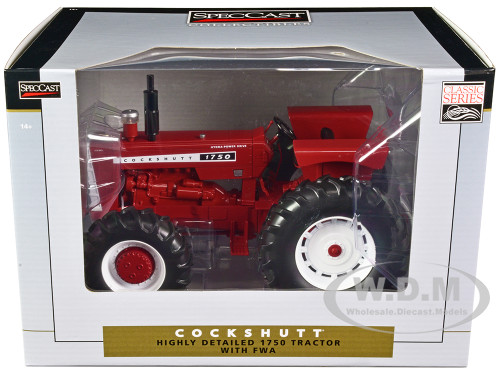
Cockshutt 1750 FWA (Front Wheel Assist) Tractor Red "Classic Series" 1/16 Diecast Model by SpecCast
$95.99WasAdd to Cart The item has been added$95.99WasAdd to Cart The item has been added