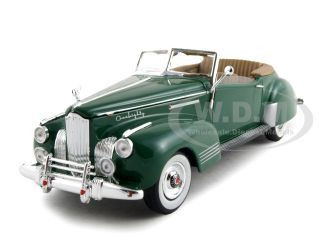
Discover Packard diecast model cars inspired by one of America's most celebrated luxury automobile manufacturers. Renowned for elegant styling, refined engineering, powerful engines, and distinctive craftsmanship, Packard built a reputation for producing some of the most prestigious American automobiles of the first half of the 20th century.
The Packard category at Diecast Models Wholesale is designed for classic-car collectors, vintage automobile enthusiasts, and hobbyists looking for miniature replicas of historic Packard vehicles. Depending on current product availability, models may represent early brass-era automobiles, luxurious prewar sedans, the legendary Packard Twelve, postwar Clipper models, elegant Caribbean convertibles, and distinctive coupes from the company's final production years.
Packard automobiles are particularly interesting to collectors because their history reflects several important periods of American automotive development. Early vehicles helped establish the brand's reputation for quality and innovation, while the classic-era models became known for their long bonnets, imposing grilles, elaborate trim, and carefully crafted interiors. Postwar models introduced updated styling while retaining Packard's emphasis on comfort and engineering.
From the luxurious Packard Twelve and streamlined Clipper to the glamorous Caribbean and distinctive Packard Hawk, Packard diecast models offer an opportunity to explore the evolution of American luxury cars.
Available miniature replicas may include scales such as 1:12, 1:18, 1:24, and 1:43, depending on the model and manufacturer. Whether you prefer a substantial display car or a compact vintage automobile for a broader collection, Packard models bring an important part of American automotive history into miniature form.
The History of Packard Automobiles
Packard's story began in 1899 in Warren, Ohio, when James Ward Packard built his first automobile. Along with his brother William and business partner George Lewis Weiss, Packard established the foundation of the Packard Motor Car Company. The company subsequently moved its operations to Detroit, Michigan, as the American automobile industry developed.
From its early years, Packard emphasized engineering, quality, and dependable performance. Its automobiles attracted customers who valued refined construction and advanced mechanical design. The brand became especially associated with luxury vehicles, competing with other prestigious American manufacturers.
During the early 20th century, Packard introduced increasingly sophisticated automobiles. Its larger engines, smooth-running powertrains, and attention to body and interior presentation helped establish the company as a leading luxury marque.
Packard's reputation grew further during the 1920s and 1930s. The company produced Eight and Twelve models that combined substantial performance with elaborate styling and high-quality appointments. These vehicles became associated with successful businesspeople, public figures, and customers seeking premium automobiles.
The Great Depression created serious challenges for luxury-car manufacturers. In response, Packard introduced the One-Twenty in 1935, a more affordable model that retained much of the brand's engineering identity while appealing to a broader market. Its success helped Packard remain competitive during a difficult economic period.
World War II brought another major change. Packard shifted away from civilian automobile production and manufactured wartime equipment, including Rolls-Royce Merlin aircraft engines under license and marine engines used in military vessels.
After the war, Packard resumed automobile production with updated models. The company introduced distinctive postwar designs, including the Clipper, and continued developing luxury cars through the early 1950s.
Packard merged with Studebaker in 1954, forming Studebaker-Packard Corporation. The company faced significant financial and competitive challenges, and Packard's Detroit production ended in 1956. Packard-badged automobiles continued to be assembled in South Bend, Indiana, through the 1958 model year, using Studebaker-based vehicles with Packard-specific styling changes.
For diecast collectors, Packard's history offers several distinct collecting periods, from early automobiles and classic luxury cars to postwar sedans, convertibles, and unusual final-era models.
Classic Packard Diecast Models
Packard's classic-era automobiles are among the most recognizable subjects for collectors of vintage American luxury cars. Their tall grilles, sweeping fenders, long hoods, and carefully detailed bodywork reflect a period when manufacturers used distinctive styling to express prestige and individuality.
Packard Model A
The Packard Model A was the company's first automobile, introduced in 1899. It represents the earliest chapter of Packard's development and belongs to the pioneering era of powered personal transportation.
Early automobiles looked very different from the sedans and coupes that followed. They often featured upright seating, exposed mechanical components, narrow wheels, and relatively simple bodywork.
For collectors, a Model A replica represents the origins of a manufacturer that would later become synonymous with American luxury. It can also provide historical variety in a collection dominated by vehicles from the 1930s, 1940s, and 1950s.
When available, an early Packard model can be especially interesting alongside other brass-era automobiles, illustrating how quickly automotive engineering and design changed during the industry's formative years.
Packard Twin Six
Introduced in 1915 for the 1916 model year, the Packard Twin Six was an important early luxury car powered by a V12 engine. It reflected Packard's emphasis on refined power and advanced engineering at a time when multi-cylinder engines were becoming a symbol of automotive prestige.
The Twin Six name was later revived for Packard's V12-powered automobiles of the 1930s, marketed as the Packard Twelve.
For collectors, early Twin Six models represent a distinctive stage in the development of American luxury cars. Their period body styles and substantial proportions differ significantly from postwar Packards.
Packard Eight and Super Eight
Packard's Eight models helped establish the company's reputation for refined power and premium engineering. The straight-eight engine became an important part of Packard's identity during the 1920s and 1930s.
The Super Eight represented a more prestigious and powerful part of the company's lineup. These automobiles often featured larger bodies, elegant styling, and carefully appointed interiors.
A Packard Eight or Super Eight diecast model can suit collectors interested in prewar American luxury cars. Depending on the particular miniature, body styles may include sedans, coupes, convertibles, or custom-bodied automobiles.
Collectors should examine the year, engine designation, and body configuration when comparing models, as the Eight and Super Eight names covered different versions over time.
Packard Twelve
The Packard Twelve, introduced in 1933, was one of the company's most prestigious automobiles. Its V12 engine and elegant body styles positioned it at the upper end of the American luxury-car market.
Packard Twelves were available in a variety of body configurations, including formal sedans, touring cars, and open-bodied automobiles. Some vehicles received custom coachwork, further distinguishing individual examples.
For diecast collectors, the Packard Twelve is an especially appealing subject because it combines historical significance with distinctive styling. Its long hood, imposing grille, and classic proportions make it a natural centerpiece for a vintage automobile collection.
A Packard Twelve miniature can be displayed alongside other prewar luxury cars to represent an era when premium automobiles often featured large engines, elaborate bodywork, and extensive customization.
Packard One-Twenty: A Turning Point in Packard History
Introduced for the 1935 model year, the Packard One-Twenty helped the company broaden its customer base during the Great Depression. Rather than relying exclusively on expensive luxury cars, Packard developed a model that offered much of its traditional appeal at a more accessible price.
The One-Twenty used a straight-eight engine and featured styling that retained Packard's recognizable appearance. Its introduction was an important commercial step, allowing the company to reach customers who wanted a well-engineered automobile without buying one of its more expensive senior models.
The One-Twenty continued through several model years and helped establish the foundation for Packard's broader mid-priced offerings.
For collectors, One-Twenty diecast models represent a key chapter in American automotive history. They illustrate how a luxury manufacturer adapted to difficult economic conditions while maintaining its identity.
Depending on the model year, replicas may depict sedans, coupes, convertibles, or other body styles. Exterior details evolved throughout production, so check the specific year and configuration when selecting a miniature.
Packard Clipper Diecast Model Cars
The Packard Clipper was introduced for the 1941 model year and became one of the brand's most recognizable designs. Its more streamlined bodywork represented a major departure from the upright styling associated with many earlier luxury cars.
The Clipper featured an integrated appearance, with rounded body contours and fenders that flowed more naturally into the overall design. Its styling reflected the growing influence of aerodynamic forms and modern production-car design.
After World War II, the Clipper returned as an important part of Packard's lineup. Postwar versions retained a recognizable connection to the original design while receiving updated trim and styling treatments.
Why Collect Packard Clipper Models?
The Clipper is appealing to collectors because it bridges the company's prewar and postwar histories. Its rounded bodywork and distinctive front end make it recognizable among other American cars from the 1940s and early 1950s.
A Packard Clipper diecast model can complement a collection of classic American sedans or serve as a representative example of the transition toward more modern postwar styling.
When comparing Clipper replicas, consider the model year, body style, grille design, bumpers, and other exterior details. The name covers several versions, so checking the individual product specifications helps identify the particular vehicle represented.
Packard Caribbean: A Glamorous Postwar Convertible
The Packard Caribbean was introduced in 1953 as a distinctive, high-end convertible. It became one of the company's most recognizable postwar models, featuring special styling details and a more exclusive position within the Packard lineup.
The Caribbean combined a powerful engine, premium equipment, and elaborate exterior finishes. Early versions were especially notable for their styling, including distinctive wheel openings and decorative trim.
Later Caribbean models continued the luxury theme with updated bodywork, richer detailing, and two-door hardtop versions introduced during the model's final years.
Collecting Packard Caribbean Models
The Caribbean is a particularly appealing subject for collectors of 1950s American convertibles. Its long body, elegant proportions, and distinctive trim make it visually different from the more conventional sedans in Packard's range.
Two-tone paint schemes can be especially striking on Caribbean replicas, emphasizing the body's design and the decorative elements typical of the period.
When selecting a Caribbean model, check whether it represents a convertible or hardtop and identify the model year. Early and later versions have noticeable differences in body details, grille design, and trim.
A Caribbean diecast model can serve as a centerpiece in a display of postwar American luxury cars or complement other high-end convertibles from the 1950s.
Packard Patrician and Packard 400 Models
The Patrician was Packard's flagship sedan during the early and mid-1950s. Introduced for the 1951 model year, it represented the more luxurious end of the company's passenger-car lineup.
The Patrician featured distinctive exterior trim, a substantial body, and a well-appointed interior. It was intended to compete with other premium American sedans during a period when large, comfortable automobiles remained popular.
The Packard Four Hundred name was used for a two-door hardtop within the company's senior model range during the 1955 and 1956 model years. This model offered a more personal-luxury interpretation of Packard's traditional styling.
For collectors, the Patrician and Four Hundred illustrate two different body styles within the senior Packard range. The Patrician's formal four-door profile contrasts with the Four Hundred's two-door hardtop design.
When comparing replicas, look for specific model-year details, including grille treatment, side trim, roofline, wheel design, and exterior color. These characteristics can help distinguish individual versions.
Packard Hawk: A Distinctive Final-Era Model
The Packard Hawk was introduced for the 1958 model year, near the end of the Packard name's automotive production history. It was based on the Studebaker Golden Hawk but received Packard-specific front-end styling and trim.
The Hawk differed considerably from the traditional Packard luxury sedans of earlier decades. Its low, sporty body, prominent front styling, and performance-oriented character reflected an effort to give the Packard name a distinctive presence in the changing American car market.
The 1958 Packard Hawk used a supercharged Studebaker V8 engine, making it an unusual final chapter in the Packard story. Its styling and engineering reflected the realities of the Studebaker-Packard organization during its final years of Packard production.
For collectors, a Packard Hawk model is especially interesting because it represents the brand at the end of its history. Its origins, styling, and mechanical relationship to the Studebaker Golden Hawk make it different from earlier Packards.
A Hawk miniature can add variety to a collection of American sports coupes and classic luxury cars, especially when displayed alongside earlier Packard models.
Why Collect Packard Diecast Model Cars?
Packard models offer several collecting opportunities because the company produced vehicles with very different styling and mechanical characteristics across its history.
-
Historic luxury: The Eight, Super Eight, and Twelve represent Packard's reputation for refined engineering and prestigious automobiles.
-
Classic American styling: The Clipper, Caribbean, Patrician, and Four Hundred illustrate the evolution of Packard design from the 1940s through the 1950s.
-
Engineering significance: Packard's early V12 cars, straight-eight engines, and other developments provide historical interest beyond exterior styling.
-
Distinctive body styles: Sedans, convertibles, hardtops, and custom-bodied cars offer variety within a single marque.
-
A complete historical story: From the early Model A to the final-era Packard Hawk, the brand's models reflect several stages of American automotive development.
Collectors may focus on a particular era, such as the prewar luxury period, or build a broader collection that traces Packard's evolution through its final production year in 1958.
Choosing the Right Packard Diecast Model
Identify the Model and Year
Start by deciding which Packard interests you most. Early models such as the Twin Six and Twelve suit collectors of prewar luxury cars, while the Clipper and Caribbean represent the company's postwar styling.
The Patrician and Four Hundred are useful choices for collectors interested in the early 1950s, and the Packard Hawk represents the company's final production period.
Check the specific model designation and year listed for each miniature. Similar names can cover several generations with noticeably different styling.
Select a Scale That Fits Your Display
Packard diecast models may be available in scales such as 1:12, 1:18, 1:24, and 1:43, depending on the manufacturer and product.
-
1:12 scale: A large model that can make a prominent display centerpiece, where available.
-
1:18 scale: A popular size for collectors who prefer substantial replicas with a strong display presence.
-
1:24 scale: A practical option for balancing display size and space requirements.
-
1:43 scale: A compact choice for collections that include multiple classic automobiles.
These are general scale comparisons rather than a guarantee that every Packard model is offered in each size. Check the individual product dimensions before purchasing.
Review Paint, Trim, and Construction
Packard models are often distinguished by exterior color, chrome trim, grille design, wheels, hood ornaments, and body configuration. These details can be particularly important for classic luxury cars, where trim and paint combinations contribute strongly to the vehicle's appearance.
Construction materials, opening components, interior features, display accessories, and packaging vary by manufacturer and product. Review the individual listing to confirm the specific features of the replica.
Explore Packard Diecast Model Cars
From the pioneering Packard Model A and luxurious Twelve to the streamlined Clipper, glamorous Caribbean, elegant Patrician, and final-era Packard Hawk, Packard represents an important chapter in American automotive history.
Browse the Packard category at Diecast Models Wholesale to compare available replicas, explore different model generations and scales, and find a distinctive addition to your classic-car collection.