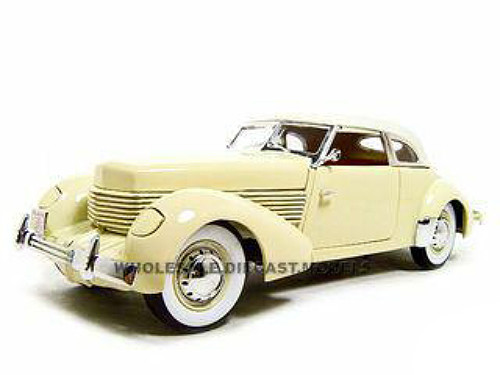
Cord Diecast Model Cars
The Cord automobile is one of the most distinctive names in American automotive history. Although the Cord brand existed for only a relatively short period, its cars introduced advanced engineering and dramatic styling that made them stand apart from other American automobiles of the 1920s and 1930s.
For diecast collectors, Cord models are especially appealing because they represent an important chapter in the history of American luxury and performance automobiles. The marque is best known for the Cord L-29 and the groundbreaking Cord 810 and 812, cars that combined innovative engineering with styling that remains recognizable nearly a century later.
This category features Cord diecast model cars and scale models, with collectible examples available in popular scales such as 1/12, 1/18, 1/24, and 1/43, depending on the specific model and manufacturer.
The History of Cord Automobiles
Cord was created under the direction of Errett Lobban Cord, the businessman who also controlled the Auburn Automobile Company and became associated with the growing group of companies that would eventually be known as the Auburn-Cord-Duesenberg organization.
The Cord brand was positioned above Auburn and below the extraordinary Duesenberg in the company's automotive hierarchy. Rather than simply building another conventional luxury automobile, Cord was intended to offer advanced engineering, distinctive styling, and features that were unusual for American cars of the period.
The result was a series of automobiles that became known for their front-wheel-drive layouts, unusual proportions, innovative mechanical features, and striking appearance.
Today, Cord automobiles are considered important examples of American automotive design and engineering. The Antique Automobile Club of America even maintains an Auburn-Cord-Duesenberg Award recognizing outstanding examples of these marques at its national meets.
Cord L-29
The Cord L-29 was introduced in 1929 and became the first American production automobile to use front-wheel drive. This was a major engineering departure at a time when most American automobiles used conventional rear-wheel-drive layouts.
Instead of placing the engine behind the front axle and driving the rear wheels, the L-29 placed its engine and drivetrain toward the front of the vehicle, driving the front wheels. This allowed Cord to create a long, low profile that contributed to the automobile's distinctive appearance.
The L-29 used a Lycoming straight-eight engine and was offered in several body styles. Its long hood and low stance made it visually different from many contemporary luxury automobiles.
Why the L-29 Matters to Collectors
The L-29 is particularly interesting because it combines three important elements of automotive history:
- Early American front-wheel-drive engineering
- Luxury automobile design of the late 1920s
- The beginnings of the Cord marque
A Cord L-29 diecast model can therefore appeal to collectors interested in engineering history as well as those who simply appreciate unusual classic cars.
Cord 810
The Cord name returned in the mid-1930s with a car that became one of the most celebrated American designs of the era: the Cord 810.
Introduced in late 1935, the 810 was designed by Gordon Buehrig, one of the most influential American automotive stylists of the period. The car featured a low, streamlined body with no conventional radiator grille, hidden headlights, concealed door hinges, and distinctive front-wheel-drive engineering.
Its famous front end became known as the "coffin nose", a nickname inspired by the shape of the automobile's streamlined hood and grille-less front treatment.
The design was dramatically different from the upright styling common among luxury automobiles of the 1930s.
Cord 810 Engineering and Design
The Cord 810 was not simply a styling exercise. Its engineering was equally significant.
The car used a front-wheel-drive layout, allowing the engine and transmission to be positioned ahead of the passenger compartment. This helped create a low seating position and long, uninterrupted body profile.
One of the most recognizable details was the hidden headlight system. Rather than mounting headlights externally on the front fenders, the lamps were concealed within the front bodywork and rotated into position when needed.
The 810 also used a pre-selector transmission, operated through controls mounted near the steering wheel. This was another unusual feature for an American production automobile of the time.
These details make a Cord 810 especially interesting as a scale model because the miniature can preserve the design characteristics that made the original car so innovative.
Cord 812
The Cord 812 followed the 810 for the 1937 model year. Although closely related to the 810, the 812 incorporated further development and became the final production version of the Cord automobile.
The 812 was available in several body styles, including sedans, Beverly and Westchester configurations, and open models such as the Phaeton.
A particularly desirable version was the supercharged Cord 812, which used a supercharged Lycoming V8. Supercharged cars are recognizable by their external exhaust pipes running along the sides of the hood.
The 812's combination of front-wheel drive, streamlined styling, hidden headlights, and available supercharging made it one of the most technologically ambitious American automobiles of its time.
Gordon Buehrig and Cord Styling
The Cord 810 and 812 are strongly associated with Gordon Buehrig, whose design work helped establish the visual identity of the cars.
Buehrig's approach eliminated many traditional styling elements. Instead of a large upright radiator shell and separate headlamps, the Cord used a smooth, rounded front end with hidden headlights and a narrow central grille treatment.
The design also minimized brightwork compared with many luxury automobiles of the period. The result was a clean, streamlined appearance that has continued to attract designers, historians, and collectors.
For diecast enthusiasts, this makes the Cord particularly rewarding because the design remains highly recognizable even in small scales.
Cord in the Auburn-Cord-Duesenberg Era
Cord models are often collected alongside Auburn and Duesenberg automobiles because all three marques were closely connected through Errett Lobban Cord's automotive organization.
The three brands occupied different positions within the group:
- Auburn offered comparatively accessible performance-oriented automobiles.
- Cord emphasized advanced engineering and distinctive luxury.
- Duesenberg represented the highest level of American luxury and performance.
Together, these marques represent one of the most fascinating chapters in prewar American automotive history.
A collector interested in American classics can therefore use Cord models as part of a broader Auburn-Cord-Duesenberg display.
The End of Cord Production
Despite the technological sophistication and distinctive styling of the 810 and 812, the Cord automobile business faced significant challenges.
The 810 was introduced with ambitious engineering and styling, but production and development difficulties affected the company's ability to compete successfully in the luxury automobile market. The Cord 812 followed, but production ended after the 1937 model year.
Only a relatively small number of 810 and 812 automobiles were produced. Their limited production, unusual engineering, and distinctive styling have contributed to their lasting status among significant American classics.
For collectors, this makes a Cord diecast model an accessible way to represent a historically important automobile that is considerably rarer in full-size form.
Cord Diecast Models for Collectors
A Cord diecast model car can fit into several different types of collections. The most obvious is a classic American automobile collection, but Cord models are also appropriate for displays focused on automotive engineering, Art Deco-era design, prewar luxury cars, or historically significant automobiles.
Collectors may want to focus on:
- Cord L-29 models
- Cord 810 models
- Cord 812 models
- Supercharged Cord 812 models
- Cord Phaeton models
- Gordon Buehrig-designed automobiles
- Auburn-Cord-Duesenberg collections
- Prewar American luxury cars
- Front-wheel-drive automotive history
- Classic American automobiles of the 1920s and 1930s
The unusual appearance of Cord automobiles also makes them excellent conversation pieces in a general diecast collection.
Choosing the Right Cord Scale Model
Cord diecast models are available in several scales, although availability varies by vehicle and manufacturer.
1/12 Scale
A 1/12 Cord model provides a large display presence and allows the distinctive bodywork, hidden headlights, wheels, interior, and other details to be represented more prominently.
1/18 Scale
1/18 Cord diecast models are popular with collectors who want a substantial display model without moving to the very large 1/12 scale. This scale is particularly well suited to detailed classic automobile collections.
1/24 Scale
A 1/24 Cord model offers a practical balance between size and detail and can be displayed alongside many other classic American cars.
1/43 Scale
1/43 Cord models are useful for collectors who prefer compact displays or want to assemble a larger collection of historically significant automobiles.
When choosing a model, check the individual product specifications for the exact scale, body style, year, manufacturer, materials, and available features.
Cord Model Details Worth Collecting
Because the 810 and 812 changed in important ways during their short production history, collectors may want to compare individual models carefully.
Important details include:
- 810 or 812 designation
- Sedan, coupe, or Phaeton body style
- Standard or supercharged configuration
- Model year
- Exterior color
- Wheel and tire design
- Hidden-headlight treatment
- Hood-side exhaust pipes on supercharged versions
- Interior configuration
- Scale and manufacturer
A supercharged 812, for example, provides a noticeably different visual subject from a standard 810 because of its external exhaust pipes.
Why Cord Diecast Cars Stand Out
Cord automobiles are particularly compelling because their significance comes from both engineering and design.
The L-29 demonstrated that front-wheel drive could be applied to a large American automobile. The 810 and 812 pushed the concept further with a low, streamlined body, hidden headlights, unusual transmission technology, and available supercharged performance.
At the same time, the cars remain immediately recognizable because of Gordon Buehrig's styling.
That combination makes Cord models valuable additions to collections that go beyond familiar American classics. They represent a time when manufacturers were experimenting with radically different approaches to automobile engineering and design.
Shop Cord Diecast Model Cars
From the pioneering Cord L-29 to the revolutionary Cord 810 and Cord 812, these automobiles represent some of the most distinctive vehicles produced during the classic era of American automotive design.
Browse the Cord category at DiecastModelsWholesale.com to explore available Cord diecast model cars in 1/12, 1/18, 1/24, 1/43, and other available scales, and find a classic Cord model that adds a unique piece of automotive history to your collection.