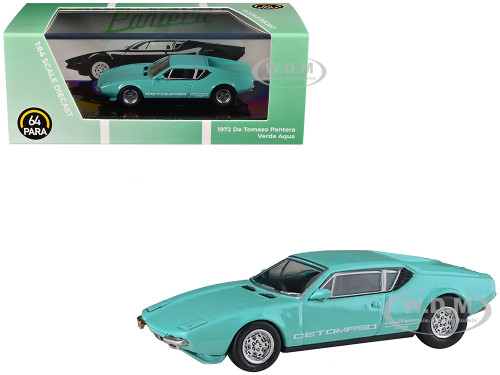
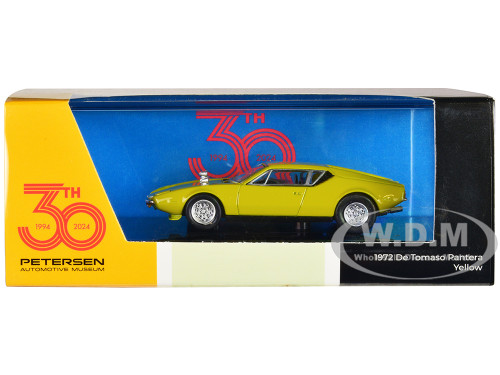
De Tomaso diecast model cars represent one of the most distinctive chapters in Italian performance-car history. Founded by Argentine-born Alejandro de Tomaso in Modena, Italy, De Tomaso Automobili became known for combining Italian styling and chassis engineering with powerful engines and components from Ford and other manufacturers. The result was a unique collection of sports cars and grand tourers that occupy an interesting position between European exotic cars and American-powered performance automobiles.
The De Tomaso category at DiecastModelsWholesale.com features collectible model cars representing the marque's most recognizable designs. Depending on availability, shoppers may find De Tomaso diecast models in scales such as 1/12, 1/18, 1/24, and 1/43, including the famous Pantera as well as other classic De Tomaso automobiles.
The History of De Tomaso
Alejandro de Tomaso was born in Argentina in 1928 and moved to Italy in the 1950s. After competing in motorsport, he established De Tomaso Automobili in Modena in 1959. The company initially focused on racing cars before moving into road-going sports cars.
De Tomaso developed a reputation for taking an international approach to sports-car engineering. Italian styling, chassis development, and manufacturing were combined with engines and other components sourced from established manufacturers. This approach became particularly important when De Tomaso developed a relationship with Ford.
The company produced a relatively small number of different road-car designs compared with larger manufacturers, but several became highly recognizable. The Vallelunga, Mangusta, Pantera, Deauville, Longchamp, and later Guarà each represented a different interpretation of the De Tomaso formula.
For diecast collectors, this limited and distinctive model history makes it possible to build a collection around specific De Tomaso generations rather than simply accumulating a large number of variations of ordinary production cars.
De Tomaso Vallelunga
The Vallelunga was one of De Tomaso's earliest road cars and an important step in the company's development. Introduced during the 1960s, it used a mid-engine layout and a Ford Cortina-derived four-cylinder engine. The car's lightweight construction and compact proportions reflected De Tomaso's racing background.
The Vallelunga is particularly interesting to collectors because it establishes the engineering philosophy that would later become more famous with the Mangusta and Pantera. Its small size and mid-engine configuration also make it visually different from the larger grand touring models that followed.
A Vallelunga model can therefore add historical depth to a De Tomaso collection, especially when displayed alongside later cars.
De Tomaso Mangusta
The Mangusta was the car that helped bring De Tomaso greater international attention. Introduced in the late 1960s, the Mangusta was a mid-engine exotic designed by Giorgetto Giugiaro during his time at Ghia. Its dramatic styling included the characteristic split engine-cover arrangement at the rear.
The Mangusta was powered by a Ford V8, reinforcing the combination of Italian design and American mechanical power that would become one of De Tomaso's signatures.
The car also played an important role in De Tomaso's relationship with Ford. Ford executives, including Lee Iacocca, took an interest in the Mangusta, although Ford ultimately pursued a new project that became the Pantera.
For collectors, the Mangusta offers a fascinating alternative to the better-known Pantera and is an excellent representation of late-1960s Italian exotic-car design.
De Tomaso Pantera
The Italian-American Supercar
The De Tomaso Pantera is the model most closely associated with the marque. Developed through a relationship between De Tomaso and Ford, the Pantera combined Italian styling and engineering with Ford V8 power.
The Pantera was designed by Tom Tjaarda at Ghia, while Gianpaolo Dallara was responsible for important aspects of its chassis and engineering. The car used a mid-engine layout, a steel monocoque chassis, and a Ford 351 Cleveland V8 connected to a five-speed ZF transaxle.
The Pantera made its public debut in 1970 and entered production soon afterward. In the United States, Ford marketed the car through selected Lincoln-Mercury dealerships, creating an unusual combination of Italian-built exotic car and American dealer distribution. Ford's involvement ended after the 1974 model year, although De Tomaso continued producing Panteras for other markets for many years.
That unusual history is a major reason the Pantera remains such an interesting collectible automobile. It was neither a conventional Italian exotic nor a typical American muscle car. Instead, it brought together characteristics of both.
Pantera Variants
The Pantera evolved considerably over its long production history. Collectors may encounter several versions and designations, including:
- De Tomaso Pantera
- Pantera L
- Pantera GTS
- Pantera Group 3
- Pantera Group 4
- Pantera GT4
- Pantera GT5
- Pantera GT5-S
- Pantera Si
The later cars received increasingly substantial bodywork and aerodynamic changes. Wide-body versions became particularly recognizable for their extended fenders, larger wheels, and more aggressive stance.
Because the Pantera remained in production for decades and underwent numerous changes, collectors should pay attention to the exact version represented by a diecast model. Two Pantera models can look substantially different even though they share the same basic name.
De Tomaso Pantera and Ford
The Ford connection is an important part of the Pantera's history and a useful detail when collecting diecast models.
Ford became involved with De Tomaso in the late 1960s, and in 1970 Ford acquired an 80 percent interest in the De Tomaso-related Ghia and Vignale operations. The Pantera was subsequently sold in the United States through Ford's Lincoln-Mercury dealer network.
This relationship explains why the Pantera can appeal to both European sports-car collectors and Ford enthusiasts. The car combined an Italian-designed and manufactured body with a Ford V8, creating one of the most memorable Italian-American performance cars of the era.
De Tomaso Deauville and Longchamp
Although the Pantera receives most of the attention, De Tomaso produced several other important road cars.
The De Tomaso Deauville was a large luxury sedan designed to compete with established European grand touring and luxury automobiles. It demonstrated that De Tomaso was interested in more than lightweight sports cars.
The De Tomaso Longchamp was introduced in 1972 as a two-door 2+2 grand touring coupe. Its design was created by Tom Tjaarda at Ghia, and it shared some engineering relationships with the Deauville.
For diecast collectors, these cars are particularly valuable for showing the broader range of the De Tomaso brand. A collection containing a Pantera alongside a Deauville or Longchamp tells a more complete story than one focused exclusively on the company's famous mid-engine sports car.
De Tomaso Guarà and Later Cars
The De Tomaso Guarà represented a much later stage of the company's history. Introduced during the 1990s, it followed the company's long-running tradition of low-volume performance automobiles while adopting more modern styling and engineering.
The Guarà is an interesting choice for collectors who want to extend a De Tomaso display beyond the classic 1960s and 1970s period. It also illustrates how the company continued to experiment with sports-car design after the Pantera era.
De Tomaso and Motorsport
Motorsport remained an important influence throughout De Tomaso's history. The company originated with racing cars before expanding into road-going automobiles, and competition engineering influenced its approach to chassis design and performance.
The Pantera also appeared in racing, including Group 3 and Group 4 competition versions. These cars differed from standard road models through modifications intended for racing, including wider bodywork, performance equipment, and competition-oriented specifications.
A De Tomaso racing model can therefore complement a standard road-car version while showing another side of the marque's history.
Choosing a De Tomaso Diecast Model
Scale is one of the most important considerations when selecting a De Tomaso model car.
1/12 Scale De Tomaso Models
Large 1/12 scale models make substantial display pieces and can showcase the styling of a Pantera or another De Tomaso automobile with considerable visual presence. They are particularly suitable for collectors who want a centerpiece model.
1/18 Scale De Tomaso Models
1/18 is a popular scale for detailed collector cars. It provides a useful combination of display size and detail and is well suited to iconic sports cars such as the Pantera and Mangusta.
1/24 Scale De Tomaso Models
1/24 scale offers a smaller footprint while retaining enough size for attractive exterior and interior detail. It can be a practical choice for collectors displaying several Italian sports cars together.
1/43 Scale De Tomaso Models
1/43 models are compact and particularly useful for collectors building a broader automotive-history display. This scale makes it easier to represent multiple De Tomaso models, generations, and variants without requiring as much shelf space.
Building a De Tomaso Collection
There are several ways to build a De Tomaso diecast collection. One approach is to follow the marque chronologically, beginning with the Vallelunga, moving to the Mangusta and Pantera, and then continuing through the Deauville, Longchamp, and later Guarà.
Another approach is to focus primarily on the Pantera and collect different generations and configurations. A display could include an early Pantera, a later Pantera GTS, and one of the wide-body GT5 or GT5-S versions.
Collectors can also combine De Tomaso models with other Italian performance cars from the same era. The Pantera's Ford connection makes it especially interesting alongside Ford performance models, while the Mangusta and Vallelunga fit naturally into displays dedicated to Italian mid-engine sports cars.
When comparing models, consider the specific De Tomaso model, production era, body style, scale, wheels, exterior color, interior configuration, and racing or road-car specification. These details can be important when choosing between different representations of the same automobile.
Shop De Tomaso Diecast Model Cars
From the early Vallelunga and dramatic Mangusta to the legendary Pantera and later De Tomaso automobiles, the marque offers collectors a fascinating combination of Italian design, motorsport heritage, and American V8 performance.
Browse the available De Tomaso diecast model cars at DiecastModelsWholesale.com to explore Pantera, Mangusta, Vallelunga, and other collectible De Tomaso automobiles in available scales and configurations, and find the models that best fit your collection.