Ducati Diecast Motorcycle Models
Ducati is one of Italy's most recognizable motorcycle manufacturers, with a history that combines distinctive design, advanced engineering, road motorcycles, and a long record of racing success. Ducati diecast motorcycle models allow collectors to bring that history into a display collection, from early lightweight motorcycles and classic Desmo machines to legendary superbikes, Monster models, racing motorcycles, and modern Panigale and Multistrada models.
Ducati's story began in Bologna in 1926, when the Ducati family founded the Società Scientifica Radio Brevetti Ducati as a manufacturer of radio and electrical equipment. The company entered the motorcycle industry after World War II, beginning with the small Cucciolo auxiliary engine in 1946. From that modest beginning, Ducati developed into a manufacturer known internationally for performance motorcycles and racing technology.
This category features Ducati motorcycle scale models in collectible sizes such as 1/6, 1/10, 1/12, 1/18, and 1/43, depending on the specific release. Models from manufacturers such as Maisto and New Ray may offer collectors different combinations of scale, materials, styling, and detail.
From the Cucciolo to Modern Ducati Motorcycles
Ducati's transformation into a motorcycle manufacturer began with the Cucciolo. Originally designed as a compact 48 cc four-stroke engine that could be fitted to a bicycle, the Cucciolo became Ducati's first major motorcycle-related product after the war. Ducati began manufacturing the engine in 1946 and soon developed complete motorcycles around the concept.
The company progressed through increasingly sophisticated motorcycles during the 1950s. Models such as the Ducati 60, 125 Sport, 175 T, Gran Sport 125 Marianna, and 250 GP Desmo established Ducati's growing reputation for lightweight engineering and competition performance. Ducati's heritage collection includes these early road and racing motorcycles as important milestones in the company's development.
For collectors, these early Ducati models can provide an interesting historical contrast with the modern superbikes that dominate many contemporary Ducati collections.
Ducati Racing Heritage
Racing has been central to Ducati's identity since the company's early motorcycle years. The Cucciolo itself achieved Ducati's first racing victories, including a 1947 win by Mario Recchia in the Viareggio Grand Prix. Ducati subsequently developed dedicated competition motorcycles and increasingly sophisticated engine and chassis technology.
One of the most important names in Ducati engineering is Fabio Taglioni, whose work helped establish the company's use of desmodromic valve technology and shaped generations of Ducati motorcycles. Ducati's racing development ultimately led to a long-running presence in Superbike competition and, later, MotoGP.
Ducati racing models can be particularly appealing to collectors because a motorcycle's racing livery can identify a specific championship, team, rider, or season. Depending on availability, Ducati diecast motorcycle collections may include both road-going versions and race-inspired motorcycles.
Ducati Desmo and Classic Performance Models
Ducati's Desmodromic valve system became one of the defining technical characteristics of its motorcycles. Rather than relying solely on conventional valve springs for closing the valves, the desmodromic system uses a mechanical closing mechanism. The technology became closely associated with Ducati's performance identity and remains an important part of the company's engineering heritage.
Classic Ducati models such as the 750 GT, 750 Sport, 750 Super Sport, 900 Super Sport, 900 Superlight, 750 F1, and 851 represent important stages in the evolution of Ducati's road and racing motorcycles.
The 1970s were particularly significant. Ducati's V-twin sport motorcycles established a visual and mechanical identity that would continue influencing the company for decades. The 750 and 900 Super Sport families are especially interesting to collectors looking for classic Italian sport motorcycles.
Ducati 916 Diecast Models
The Ducati 916 is one of the most recognizable motorcycles in the brand's history. Designed by Massimo Tamburini, the 916 debuted in the early 1990s and became famous for its compact proportions, distinctive under-seat exhausts, single-sided swingarm, aerodynamic bodywork, and racing-inspired design.
The 916 was more than a styling exercise. Its combination of design and performance helped establish a new benchmark for Ducati superbikes and contributed to the company's success in World Superbike competition.
For diecast collectors, a Ducati 916 model motorcycle is particularly useful as a representation of the 1990s superbike era. Related motorcycles such as the 996 and 998 continued the basic lineage, while later Ducati superbikes developed the concept further.
The 916 can also serve as a bridge between classic Ducati models and modern Panigale motorcycles in a chronological collection.
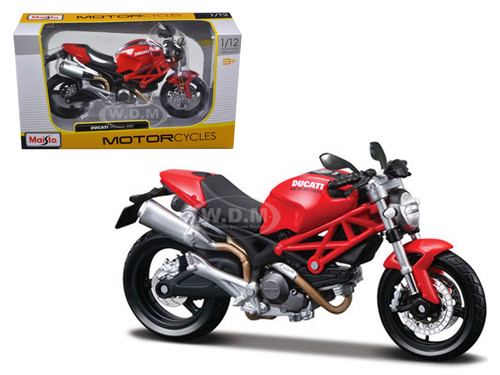
Ducati Monster Motorcycle Models
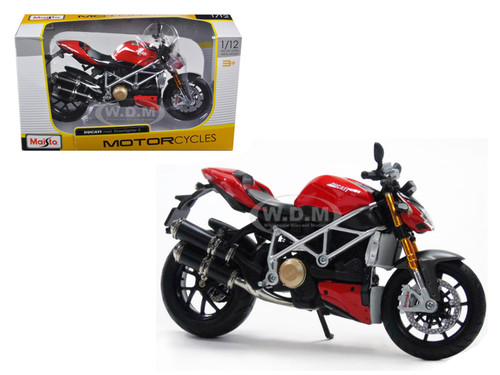
The Ducati Monster introduced a very different interpretation of the Ducati motorcycle. Presented in 1992, the Monster emphasized a minimalist naked-bike appearance, exposing the engine and frame rather than covering them with full sportbike bodywork.
The original Monster established a new category for Ducati and became one of the company's most enduring model families. Its basic concept—an exposed engine, compact proportions, muscular tank, and minimal bodywork—has been reinterpreted through multiple generations.
For collectors, Monster diecast models offer an alternative to fully faired Ducati superbikes. A display containing a classic Monster alongside a 916 or Panigale can show how differently Ducati approached sport-oriented motorcycle design.
The Monster has remained an important part of Ducati's lineup into the 2020s, with the fifth generation continuing the model's distinctive naked-sport concept.
Ducati Panigale and Modern Superbikes
The Panigale family represents the modern continuation of Ducati's superbike tradition. These motorcycles combine high-performance engines, advanced electronics, aerodynamic development, and styling derived from Ducati's racing experience.
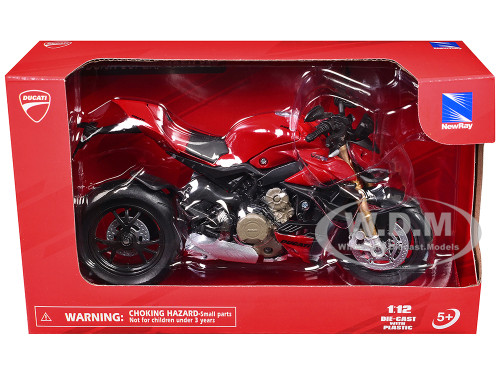
Modern Ducati models may include the Panigale V4, Panigale V4 R, Panigale V2, and special performance versions depending on the particular model year and diecast release.
The Panigale is an especially popular subject for motorcycle model collectors because its sharp fairings, aerodynamic surfaces, exposed mechanical components, and racing-derived appearance translate well into miniature form.
Collectors should pay attention to the exact version represented by a model. Differences between standard, S, R, SP, and other variants can include bodywork, wheels, exhaust systems, suspension components, graphics, and other details.
Other Ducati Motorcycle Models
Ducati's motorcycle history extends well beyond the 916 and Monster. Depending on availability, collectors may encounter models representing a broad selection of Ducati motorcycles, including:
- Cucciolo
- Ducati 60
- 125 Sport
- 175 T
- Gran Sport 125 Marianna
- 250 GP Desmo
- 750 GT
- 750 Super Sport
- 900 Super Sport
- 900 Superlight
- 750 F1
- 851 and 888
- 916, 996, and 998
- 999
- Monster
- Multistrada
- Desmosedici GP racing motorcycles
- Panigale
- Other modern Ducati sport and performance motorcycles
Ducati's own historical motorcycle archive demonstrates how extensive this progression has been, spanning lightweight postwar motorcycles, classic road bikes, superbikes, racing machines, Monster models, Multistrada motorcycles, and modern Panigale and MotoGP designs.
Ducati Motorcycle Scale Models
One of the advantages of collecting Ducati scale models is the variety of sizes available. The right scale depends on how much display space you have and whether you want a single centerpiece or a larger collection of motorcycles.
1/6 Scale Ducati Models
1/6 scale motorcycles are among the largest commonly encountered collectible motorcycle models. Their larger size allows manufacturers to reproduce bodywork, wheels, suspension, engine components, exhaust systems, and other details with greater visual presence.
These models are well suited to collectors who want a Ducati motorcycle to serve as a centerpiece.
1/10 Scale Ducati Models
1/10 scale provides a substantial display size while taking up less space than a 1/6 model. It can be a useful choice for collectors who want noticeable detail without moving to the largest motorcycle scales.
1/12 Scale Ducati Models
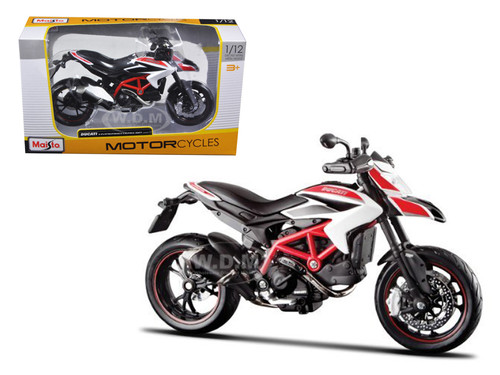
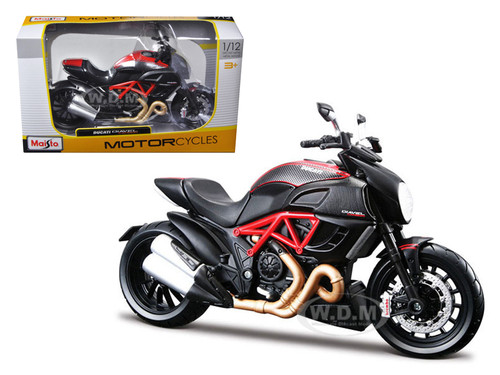
1/12 scale is one of the most familiar scales for motorcycle collectors. It offers a good balance between size, detail, and display space and works particularly well for building a collection of multiple Ducati motorcycles.
1/18 Scale Ducati Models
1/18 scale models are more compact and make it easier to display several motorcycles together. They are useful for collectors who want to compare different Ducati generations, racing liveries, or model families without requiring a large display cabinet.
1/43 Scale Ducati Models
1/43 scale provides a compact alternative for collectors with limited space or for those building a broad collection across many vehicle types. Individual models are smaller, but multiple motorcycles can be displayed together as part of a larger automotive or motorsport collection.
Not every Ducati motorcycle is produced in every scale, so always check the individual product listing for the exact scale, dimensions, materials, and features.
Maisto and New Ray Ducati Models
Collectors may encounter Ducati motorcycles from established diecast and scale-model manufacturers such as Maisto and New Ray. Manufacturer selection can be important because different releases may emphasize different combinations of diecast metal, plastic components, graphics, moving parts, and display features.
When comparing models, look at the exact product specifications rather than assuming that all models of the same motorcycle are identical. Scale, construction, finish, racing graphics, and included features can vary between releases.
Building a Ducati Motorcycle Collection
Ducati offers several ways to organize a diecast motorcycle collection. Some collectors focus on a particular model family, such as the Monster or Panigale. Others prefer a chronological approach that shows the progression from the Cucciolo and early single-cylinder motorcycles through the Desmo era, 916, Monster, MotoGP machines, and modern superbikes.
A racing-focused collection can also be organized around Ducati competition motorcycles and liveries, while an Italian motorcycle display can combine Ducati with other historic Italian manufacturers.
When selecting multiple models, consider keeping a consistent scale if you want a uniform display. Alternatively, different scales can be useful when the goal is to collect specific motorcycles that may not be available in one common size.
Ducati's century-long history provides plenty of material for either approach. From its origins as a radio-equipment company in 1926 to its transformation into a motorcycle manufacturer and its continuing development of performance motorcycles, Ducati offers a distinctive story that can be represented through miniature motorcycles.
Browse the available Ducati diecast motorcycle models at DiecastModelsWholesale.com to explore classic Ducati motorcycles, superbikes, racing models, Monster and Panigale motorcycles, and collectible models in available scales such as 1/6, 1/10, 1/12, 1/18, and 1/43.





 $14.99Was $19.99Save 25%