Ferrari is one of the most recognizable names in automotive history, combining high-performance road cars, racing success, Italian design, and engineering innovation. For collectors, Ferrari diecast model cars provide a way to display everything from classic front-engine sports cars and legendary racing machines to modern supercars and limited-production hypercars.
The Ferrari name is closely associated with Enzo Ferrari, who established Scuderia Ferrari in 1929 before creating his own automobile company. The first Ferrari-badged car, the 125 S, made its debut in 1947, beginning the road and racing history of the marque. Ferrari's first road car, the 166 Inter, followed in 1948.
This category features Ferrari diecast models in popular collector scales, including 1/12, 1/18, 1/24, and 1/43, depending on the individual product. Shoppers can find models representing different eras, body styles, racing programs, and Ferrari performance cars.
Ferrari Racing Heritage
Racing has been fundamental to Ferrari from the beginning. Enzo Ferrari established Scuderia Ferrari in Modena in 1929, initially operating as a racing organization for Alfa Romeo. Ferrari later began constructing its own competition cars, with the 125 S marking the beginning of the modern Ferrari automobile story in 1947.
Ferrari entered the Formula 1 World Championship in 1950 and has remained a continuous participant, making Scuderia Ferrari the longest-running team in the championship. Ferrari's competition history also extends far beyond Formula 1, including major victories at the 24 Hours of Le Mans, 24 Hours of Daytona, Mille Miglia, Nürburgring, and Sebring.
This racing heritage makes Ferrari particularly interesting to diecast collectors. A Ferrari collection can focus on road cars, Formula 1 cars, endurance racers, or combine all three to illustrate the relationship between Ferrari's competition and road-car development.
Ferrari 250 Series
The Ferrari 250 family represents one of the most important chapters in the company's classic-car history. Models such as the 250 GT, 250 GT Berlinetta, 250 GT California, 250 GT Lusso, 250 Testa Rossa, and 250 GTO are highly recognizable among collectors.
The 250 GTO is especially significant. Developed for competition in the early 1960s, it combined Ferrari's racing technology with an elegant grand touring design. Ferrari's own historical material identifies the 250 GTO as one of the marque's landmark cars and notes that 272 examples were produced.
A Ferrari 250 GTO diecast model can therefore be an important addition to a classic Ferrari collection, particularly when paired with other 250-series models.
Ferrari Dino and Mid-Engine Sports Cars
Ferrari's history also includes an important transition toward mid-engine sports cars. The Dino name became associated with Ferrari's V6-powered sports cars, beginning with the Dino 206 GT and continuing with models such as the 246 GT and 246 GTS.
Later Ferrari models expanded the company's mid-engine performance-car philosophy. The 308 GTB and GTS, introduced in the 1970s, became particularly influential and helped establish Ferrari's rear-mid-engine V8 sports-car formula. Ferrari's corporate history identifies the 308 GTB as one of the successful rear-mounted V8 models that helped drive the company's growth during the 1970s.
Collectors can use models from the Dino, 308, 328, 348, F355, 360 Modena, F430, and later families to create a chronological display of Ferrari's mid-engine V8 development.
Ferrari Testarossa
The Ferrari Testarossa became one of the defining Ferrari road cars of the 1980s. Its wide rear bodywork, distinctive side strakes, flat-12 engine, and dramatic styling made it instantly recognizable.
The Testarossa was followed by updated versions including the 512 TR and F512 M, giving collectors several related designs to explore.
A Testarossa diecast model can be particularly appealing to collectors interested in 1980s and 1990s supercars, while also providing a visual contrast with Ferrari's earlier and later designs.
Ferrari 288 GTO and F40
Ferrari's modern high-performance lineage includes the 288 GTO and F40, two cars that became milestones in the development of Ferrari road-going supercars.
The 288 GTO, introduced in 1984, revived Ferrari's Gran Turismo Omologato name and was developed around the requirements of high-performance driving and competition. Ferrari describes it as the first of its modern line of landmark supercars.
The Ferrari F40 followed in 1987 as a celebration of Ferrari's 40th anniversary. Its lightweight construction, turbocharged engine, and racing-inspired engineering made it one of the defining supercars of its era.
For diecast collectors, the 288 GTO and F40 are excellent choices for a display focused on Ferrari's evolution from classic grand touring cars into modern supercars.
Ferrari F50
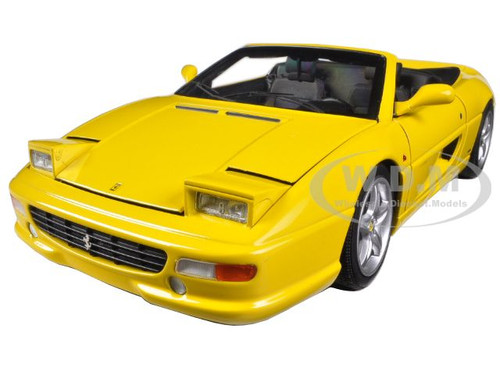
Introduced in 1995, the Ferrari F50 continued the company's series of limited-production flagship supercars. Ferrari developed the F50 with technology inspired by Formula 1, including an engine derived from the company's 1990 F1 power unit.
Its open-top and coupe-inspired design philosophy, high-revving V12 engine, and strong connection to Ferrari's racing technology make the F50 a distinctive subject for collectors.
A Ferrari F50 model can be displayed alongside the F40, Enzo, and LaFerrari to create a chronological collection of Ferrari's flagship road cars.
Ferrari Enzo
The Ferrari Enzo, introduced in 2002, was named after the company's founder and represented another step in transferring Formula 1 technology into a road-going Ferrari.
The car featured a carbon-fiber-intensive construction and a V12 engine, while its cockpit and controls reflected Ferrari's emphasis on the driver-machine relationship. Ferrari later identified the Enzo as the predecessor to LaFerrari in its series of flagship supercars.
For collectors, the Enzo is particularly interesting when displayed with the F40 and F50 because the three cars form a clear progression in Ferrari's flagship performance-car design.
LaFerrari
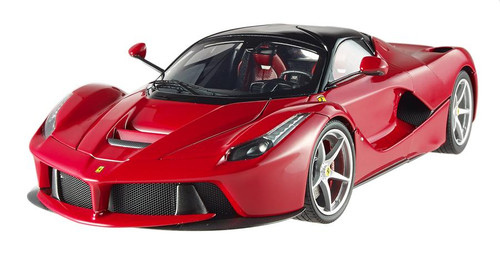
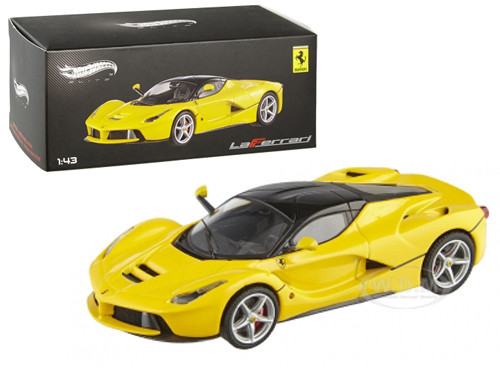
The LaFerrari continued Ferrari's flagship hypercar tradition into the hybrid era. Introduced in 2013, it used the HY-KERS hybrid system, incorporating technology influenced by Ferrari's Formula 1 development.
The LaFerrari was followed by the open-top LaFerrari Aperta, providing collectors with another distinctive version of Ferrari's hybrid hypercar concept.
A LaFerrari model can represent an important transition in Ferrari history, showing how hybrid technology became integrated into the company's highest-performance road cars.
Ferrari Modern Sports Cars
Ferrari's diecast model range can also represent numerous modern production cars beyond its flagship hypercars. Depending on availability, collectors may encounter models from families such as:
- 458 Italia and 458 Spider
- 488 GTB and 488 Spider
- F8 Tributo and F8 Spider
- 296 GTB and 296 GTS
- 812 Superfast and related V12 models
- SF90 Stradale and SF90 Spider
- Roma and Roma Spider
- Portofino
- California
- Purosangue
- Other contemporary Ferrari road cars
These models allow collectors to focus on particular engine layouts, generations, body styles, or design periods rather than limiting a collection to historic Ferraris.
Ferrari Formula 1 Diecast Models
Ferrari Formula 1 models offer another major collecting category. Scuderia Ferrari's continuous participation in the Formula 1 World Championship has produced decades of distinctive race cars, liveries, drivers, and championship seasons.
F1 collectors can organize Ferrari models by:
- Racing season
- Driver
- Chassis
- Championship year
- Team livery
- Sponsor markings
- Engine era
- Scale
A Formula 1 Ferrari can also complement road-going models from the same period, creating a display that shows the connection between Ferrari's racing program and its production cars.
Ferrari Endurance and Racing Models
Ferrari's competition history extends well beyond Formula 1. The marque has achieved major results in endurance racing, including the 24 Hours of Le Mans. The Ferrari 166 MM, for example, gave the company its first overall victory at Le Mans in 1949. Ferrari's competition history also includes the 275 P, which won at Sebring, the Nürburgring, and Le Mans in 1964.
For collectors, Ferrari endurance-racing models can provide a different perspective from Formula 1. GT racers, sports prototypes, and Le Mans cars often have distinctive aerodynamic designs and racing liveries that make them visually different from Ferrari road cars.
Collecting Ferrari Diecast Model Cars
A Ferrari collection can be organized in many ways. Some collectors concentrate on a single era, while others prefer to follow the development of the marque from its earliest road cars through modern hybrid performance vehicles.
Popular collecting themes include:
- Classic Ferrari road cars
- Ferrari 250 models
- Ferrari V8 sports cars
- Ferrari V12 models
- Ferrari supercars and hypercars
- Formula 1 Ferrari models
- Le Mans and endurance racers
- Open-top Ferrari models
- Ferrari models by decade
- Specific Ferrari generations
- Red Ferrari diecast models and other factory-inspired colors
When comparing two models of the same Ferrari, details such as body style, model year, wheel design, racing livery, interior, opening components, and manufacturer can make a meaningful difference to collectors.
Choosing the Right Ferrari Scale
Ferrari models are available in several scales, and the right choice depends on the type of collection and available display space.
1/18 scale is one of the most popular choices for collectors who want a strong combination of size and detail. It provides enough room for exterior styling, wheels, interiors, and other features to be represented clearly.
1/24 scale offers a smaller alternative that works well for collections containing multiple vehicles or limited display space.
1/43 scale is particularly useful for collectors building larger chronological collections because many cars can be displayed together in a relatively compact area.
1/12 scale provides a much larger presentation and is well suited to collectors who want a single Ferrari model to serve as a prominent display piece.
The exact features vary by product. Always check the individual listing for the scale, dimensions, construction, opening parts, display accessories, and other specifications.
Building a Ferrari Collection
One of the advantages of collecting Ferrari models is the enormous variety of designs available across different decades. A collection could begin with a classic 250 GTO, move through the 308 GTB, Testarossa, F40, F50, and Enzo, and continue into the modern LaFerrari, SF90, 296, 812, and other Ferrari models.
Another approach is to collect Ferrari's racing heritage alongside its road cars. A Formula 1 car, Le Mans racer, and road-going Ferrari from the same general era can create an interesting display showing how competition influenced the marque's engineering and design.
Whether you are a longtime Ferrari enthusiast or simply looking for a detailed model of a favorite Italian sports car, Ferrari offers an unusually broad range of subjects.
Browse the Ferrari diecast model cars available at DiecastModelsWholesale.com to explore classic sports cars, modern supercars, racing Ferraris, and iconic models in popular collector scales, and find the Ferrari that belongs in your collection.