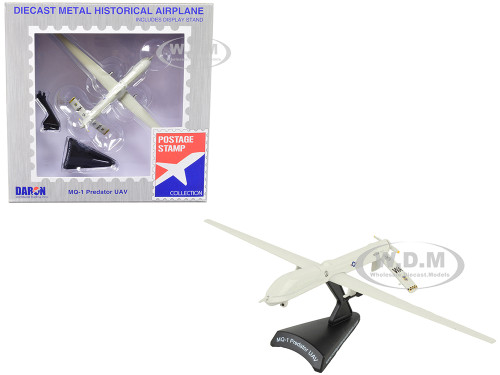
General Atomics diecast aircraft models represent some of the most recognizable unmanned aircraft in modern aviation. The name General Atomics is particularly associated with General Atomics Aeronautical Systems, Inc. (GA-ASI) and its family of remotely piloted aircraft, including the MQ-1 Predator, MQ-9 Reaper, MQ-1C Gray Eagle, MQ-9B SkyGuardian and SeaGuardian, and MQ-20 Avenger.
For aircraft collectors, General Atomics models offer a different subject from traditional fighter jets, bombers, and airliners. These aircraft played a major role in the development of modern remotely piloted aviation and are recognizable for their long wings, slender fuselages, sensor equipment, and distinctive configurations.
The General Atomics category at DiecastModelsWholesale.com is intended for collectors interested in military aircraft, unmanned aerial vehicles (UAVs), remotely piloted aircraft (RPAs), modern aviation, U.S. Air Force aircraft, and contemporary aerospace technology. Depending on the individual product, shoppers may find scale replicas representing different General Atomics aircraft, operators, configurations, markings, and scales.
General Atomics and the Development of Unmanned Aircraft
General Atomics Aeronautical Systems has its roots in the development of remotely piloted aircraft and advanced aerospace systems. GA-ASI was established as a business in 1992, and its first contract involved the GNAT-750 unmanned aircraft. In 1994, the company received a major program award for what would become the Predator program. The first Predator A aircraft flew in July 1994, beginning a family of aircraft that would eventually include several generations of remotely piloted systems.
The Predator program helped demonstrate that unmanned aircraft could provide persistent intelligence, surveillance, and reconnaissance capabilities while remaining under remote control. As the technology matured, General Atomics developed larger and more capable aircraft for a broader range of missions.
This evolution is one of the most interesting reasons to collect General Atomics aircraft models. A collection can illustrate the transition from the relatively small Predator A to the larger and more powerful MQ-9 Reaper, followed by newer systems designed for longer endurance, expanded payloads, and operations in a wider range of environments.
MQ-1 Predator Diecast Models
The MQ-1 Predator is one of the most historically significant General Atomics aircraft. Originally designated the RQ-1, the Predator made its first flight in 1994 and entered operational service in the mid-1990s. The U.S. Air Force later changed the designation to MQ-1 as the aircraft's capabilities expanded.
The Predator became widely recognized for its long endurance, distinctive configuration, and ability to provide real-time imagery and intelligence from remotely operated aircraft.
Early Predator operations focused heavily on intelligence, surveillance, and reconnaissance. Later configurations added weapons capability, creating the MQ-1 designation and making the aircraft a significant part of U.S. remotely piloted aviation operations.
The U.S. Air Force retired the MQ-1 Predator in 2018 as it transitioned toward an MQ-9 Reaper-centered remotely piloted aircraft fleet.
For collectors, an MQ-1 Predator diecast model represents an important transitional period in aviation history and can serve as the foundation for a General Atomics collection.
MQ-9 Reaper Diecast Models
The MQ-9 Reaper is the best-known successor to the Predator and one of the most recognizable unmanned military aircraft in the world.
General Atomics developed the aircraft from experience gained with the Predator program. The aircraft first flew as the Predator B in 2001, and the U.S. military subsequently designated it the MQ-9 Reaper. The aircraft is substantially larger and more powerful than the MQ-1, with increased payload capacity, speed, endurance, and mission capability.
The MQ-9 was designed as a multi-mission remotely piloted aircraft, combining intelligence, surveillance, and reconnaissance capabilities with the ability to carry external mission equipment and weapons.
Its long, slender wings and distinctive rear-mounted engine make the Reaper immediately recognizable. A diecast MQ-9 model can therefore make an unusual centerpiece for a modern military aviation collection.
MQ-9A Configurations
The MQ-9A has developed through multiple configurations, including Block 1 and Block 5 aircraft. General Atomics describes the MQ-9A as a turboprop-powered, multi-mission RPA designed for persistent surveillance and other missions.
When collecting an MQ-9 model, markings and configuration can be important. Models may represent particular operators, periods, or equipment configurations rather than simply being generic representations of the aircraft.
MQ-1C Gray Eagle
The MQ-1C Gray Eagle is another important member of the General Atomics Predator family. Developed for the U.S. Army, it is a larger and more capable development of the Predator design.
Gray Eagle aircraft are designed for long-endurance operations and can perform intelligence, surveillance, reconnaissance, communications, and other missions.
For collectors, the Gray Eagle provides an opportunity to distinguish between the closely related Predator family members. An MQ-1C model can be particularly useful in a collection focused on the evolution of U.S. military unmanned aircraft.
MQ-9B SkyGuardian and SeaGuardian
General Atomics has continued developing the Predator family with the MQ-9B SkyGuardian and MQ-9B SeaGuardian.
The MQ-9B family was developed with an emphasis on long endurance, extended range, international operations, and the ability to meet airworthiness requirements for operating in increasingly integrated airspace. The SeaGuardian is configured for maritime applications.
The aircraft are part of General Atomics' newer generation of remotely piloted aircraft and have attracted interest from international operators.
The U.K. Royal Air Force, for example, operates the MQ-9B-based Protector RG Mk 1, while other international customers and partners have selected or ordered MQ-9B aircraft.
For collectors, SkyGuardian and SeaGuardian models can represent the modern evolution of General Atomics aircraft beyond their original U.S. Predator and Reaper roles.
MQ-20 Avenger
The MQ-20 Avenger, also known as Predator C, represents another direction in General Atomics' unmanned aircraft development.
Unlike the turboprop-powered Predator and Reaper, the Avenger uses a jet engine and has a distinctly different configuration. Its swept wings and streamlined fuselage give it an appearance closer to a conventional high-performance aircraft.
The Avenger was developed through General Atomics' internal funding and was designed to provide increased speed and survivability for higher-threat environments.
For aircraft collectors, the MQ-20 is particularly interesting because it shows how General Atomics moved beyond the original Predator configuration into jet-powered unmanned aircraft.
General Atomics Aircraft and Modern Military Aviation
General Atomics aircraft have become closely associated with the development of remotely piloted aviation. The company's Predator family demonstrated the potential for long-endurance aircraft to remain airborne for extended periods while transmitting information to operators on the ground.
The aircraft are operated through a combination of air vehicles, ground control stations, communications equipment, sensors, and mission systems. This means that a General Atomics aircraft model represents only one visible component of a much larger aviation system.
For collectors, this can make General Atomics models particularly interesting when displayed alongside other modern aircraft such as reconnaissance aircraft, fighter aircraft, command-and-control aircraft, and other unmanned systems.
Collecting General Atomics Diecast Aircraft
General Atomics models can be collected around aircraft type, operator, historical period, or technology.
Collect by Aircraft Family
A collection focused on the Predator lineage could include:
- Predator A / RQ-1 / MQ-1 Predator
- MQ-1C Gray Eagle
- MQ-9A Reaper
- MQ-9B SkyGuardian
- MQ-9B SeaGuardian
- MQ-20 Avenger
This approach makes it possible to see how General Atomics' remotely piloted aircraft evolved over several generations.
Collect by Operator
Operator markings can add another dimension to collecting. General Atomics aircraft have been operated by the United States and international customers and partners.
Depending on the model, collectors may encounter:
- U.S. Air Force markings
- U.S. Army markings
- Royal Air Force markings
- Other international operator liveries
- Demonstration and test aircraft
- Specific aircraft registrations or serial numbers
When historical accuracy is important, check the aircraft's markings and configuration rather than relying only on the model name.
General Atomics Diecast Aircraft Scales
Scale is particularly important with General Atomics models because these aircraft have very long wings relative to their fuselage length.
Common aircraft scales may include 1/72, 1/100, 1/144, and 1/200, depending on the aircraft and manufacturer.
1/72 Scale
1/72 scale provides enough size for manufacturers to reproduce important details such as the aircraft's sensors, landing gear, propeller, engine area, and distinctive wing structure. Because General Atomics aircraft have relatively long wings, a 1/72 model can have a substantial display presence.
1/100 and 1/144 Scale
Smaller scales such as 1/100 and 1/144 can be useful for collectors who want to display several unmanned aircraft or combine General Atomics models with other modern military aircraft while conserving display space.
1/200 Scale
1/200 scale offers an even smaller footprint and can work particularly well for larger collections or displays featuring numerous aircraft types.
Exact availability varies by product, so collectors should check the individual listing for the scale, dimensions, materials, markings, and included accessories.
What to Look for in a General Atomics Model
When choosing a General Atomics diecast aircraft, consider the exact aircraft designation and configuration. Predator, Reaper, Gray Eagle, SkyGuardian, SeaGuardian, and Avenger aircraft can look related while representing significantly different designs and capabilities.
Important details to compare include:
- Aircraft type and designation
- Operator
- Historical period
- Aircraft markings
- Serial number or registration
- Sensor configuration
- Propeller or engine configuration
- Landing gear
- External equipment
- Scale
- Display stand
- Diecast metal and plastic construction
Some models emphasize overall aircraft shape and markings, while others include finer details intended for display collectors.
Why Collect General Atomics Diecast Models?
General Atomics offers a distinctive collecting subject because its aircraft represent the rapid development of remotely piloted and unmanned aviation.
The MQ-1 Predator represents the early operational era of modern long-endurance RPAs. The MQ-9 Reaper demonstrates the expansion of the concept into a larger multi-mission aircraft. Gray Eagle, SkyGuardian, SeaGuardian, and Avenger models show how the technology continued to evolve into different configurations and applications.
For collectors interested in UAVs, drones, military aircraft, modern aviation, U.S. Air Force aircraft, RAAF and international operators, Cold War-to-modern military technology, and contemporary aerospace history, General Atomics models offer an unusual and historically significant category.
Whether you are looking for an MQ-1 Predator, MQ-9 Reaper, Gray Eagle, SkyGuardian, SeaGuardian, Avenger, or another General Atomics aircraft, browse the available General Atomics diecast aircraft models at DiecastModelsWholesale.com and find a modern aviation subject to add to your collection.