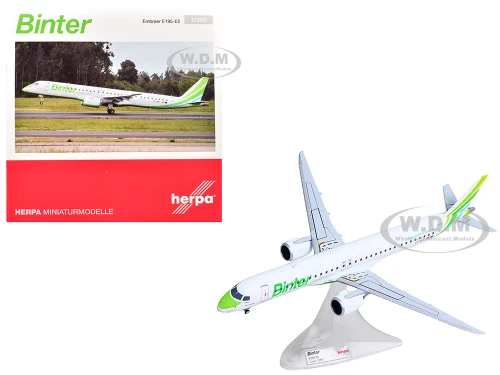
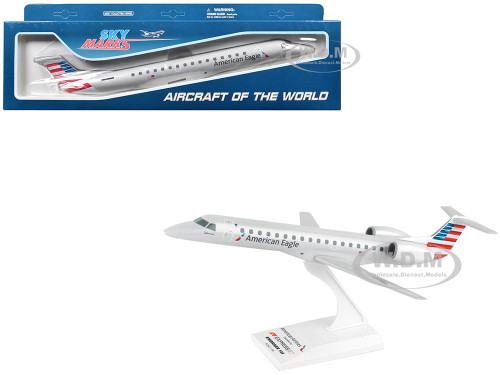
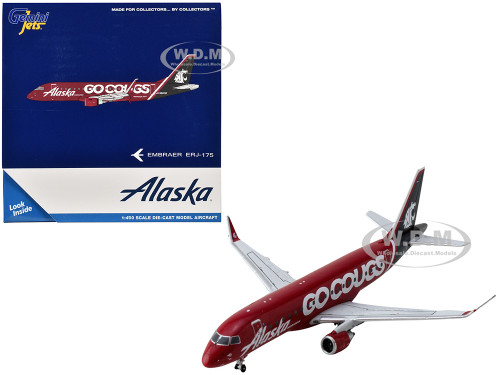
Embraer diecast aircraft models give aviation collectors the opportunity to add aircraft from one of Brazil's most important aerospace manufacturers to their displays. Founded in 1969, Embraer has developed a broad range of commercial, executive, military, and specialized aircraft. Its aircraft have become especially recognizable for their role in regional and short- to medium-haul passenger aviation, while the company's military and business-jet programs provide additional subjects for collectors.
For diecast and scale-aircraft collectors, Embraer offers an unusually broad range of subjects. Depending on the available models, this category may include commercial airliners such as the ERJ-145 and E-Jets, executive aircraft such as the Legacy and Phenom families, military aircraft such as the EMB 314/A-29 Super Tucano, and other historically significant Embraer designs.
Embraer models can also be particularly appealing to airline collectors because the company's aircraft have been operated by airlines around the world. An Embraer aircraft model can therefore represent not only the aircraft itself but also a specific airline, registration, route network, or period of service.
The History of Embraer
Embraer, short for Empresa Brasileira de Aeronáutica, was established in Brazil in 1969 with the goal of developing the country's aerospace industry. The company initially concentrated on aircraft suited to Brazil's transportation and aviation requirements before expanding into international markets.
One of Embraer's most historically important early aircraft was the EMB 110 Bandeirante, a twin-engine turboprop developed for passenger, cargo, and utility operations. The Bandeirante helped establish Embraer as an aircraft manufacturer and became an important part of regional aviation.
The company subsequently developed aircraft for agricultural aviation, military training, transport, surveillance, and other specialized roles. Its historical aircraft portfolio includes the EMB 111 Bandeirante Patrulha, EMB 120 Brasília, EMB 121 Xingu, EMB 312 Tucano, and other designs.
Embraer's expansion into regional jet aviation became a defining part of its history. The ERJ family, beginning with the ERJ-145, was developed to meet growing demand for smaller jet-powered regional aircraft. The ERJ program helped establish Embraer as a major participant in the regional airline market, particularly in North America.
Embraer ERJ Regional Jets
Embraer ERJ-135, ERJ-140 and ERJ-145
The ERJ family is one of the most recognizable groups of Embraer commercial aircraft. The ERJ-145 entered service in the 1990s and was joined by the smaller ERJ-135 and ERJ-140.
These aircraft became familiar at regional airports and were frequently operated on behalf of larger airlines under regional airline brands. Their compact size and efficient operation made them suitable for routes where a larger mainline jet would have provided more capacity than necessary.
For collectors, ERJ models can be particularly interesting when represented in the colors of regional carriers. Airline-specific details such as tail markings, titles, registration numbers, and regional-airline branding can make otherwise similar aircraft significantly different collectibles.
Embraer E-Jets
The introduction of the E-Jets family represented another major stage in Embraer's commercial aviation history. The original family consists of the E170, E175, E190, and E195. The E170 received certification in 2004, followed by the E175 and E190, with the E195 certified in 2006.
The E-Jets were designed for the space between smaller regional aircraft and larger single-aisle airliners. Their combination of passenger capacity, range, and operating flexibility made them suitable for both regional and mainline-style routes.
Embraer E170 and E175
The E170 and E175 occupy the smaller end of the original E-Jets family. The E175, in particular, became a familiar aircraft in North American regional airline service.
Models of E170 and E175 aircraft can be especially useful for collectors who focus on airline fleets. The same basic aircraft can look very different when represented by different operators, making airline livery collecting an important part of the appeal.
Embraer E190 and E195
The larger E190 and E195 expanded the E-Jets concept into higher-capacity markets. Embraer describes the E190 as combining regional-aircraft economics with capabilities suited to mainline operations, while the E195 became the largest member of the original E-Jets family.
The E190 and E195 are now common subjects for scale-aircraft collectors because they have been operated by airlines across numerous markets.
Embraer E-Jets E2
Embraer's second-generation E-Jets E2 family represents the company's continuing development of its commercial aircraft range. The E2 family includes the E190-E2, E195-E2, and E175-E2.
The E190-E2 and E195-E2 entered commercial service in 2018 and 2019, respectively. The aircraft incorporate newer engines, aerodynamic improvements, updated systems, and fly-by-wire technology.
The E195-E2 is the largest aircraft in the E2 family and has become an important modern Embraer subject. Embraer highlights its high-aspect-ratio wings, fourth-generation full fly-by-wire controls, and improvements in operating efficiency.
For collectors, E2 models can provide a modern counterpart to earlier ERJ and E-Jet aircraft and make it possible to show the evolution of Embraer's commercial aircraft designs.
Embraer Executive Jets
Embraer is not limited to commercial airliners. The company has also developed a substantial business-jet portfolio.
The Legacy family evolved from Embraer's commercial-aircraft expertise and includes aircraft designed for corporate and executive transportation. The company later introduced the Phenom 100 and Phenom 300, followed by larger aircraft such as the Praetor family.
The Phenom series is particularly recognizable among modern business aircraft. A scale model of a Phenom or Legacy can therefore complement an airline collection with a different side of Embraer's aviation history.
Embraer Military Aircraft
Embraer has also played an important role in military aviation.
A-29 Super Tucano
The A-29 Super Tucano, based on the EMB 314 designation, is one of Embraer's best-known military aircraft. It is a turboprop aircraft developed for missions including training and light attack.
Its compact size, distinctive configuration, and international service make the Super Tucano an appealing subject for military-aircraft collectors.
KC-390 Millennium
The KC-390 Millennium represents Embraer's move into a much larger class of military aircraft. It is a multi-mission military transport designed for roles including airlift and aerial refueling.
The KC-390 is particularly interesting for collectors who want to represent modern Brazilian aerospace development or compare contemporary Embraer military aircraft with the company's commercial and executive designs. Embraer continues to list the KC-390 among its Defense & Security programs.
Airline Livery Collecting
One of the strongest reasons to collect Embraer diecast aircraft is the variety of airline liveries available.
A single aircraft type can appear in numerous paint schemes, making it possible to build a collection around an aircraft family rather than simply around the manufacturer. Collectors may choose to focus on:
- A favorite airline
- Regional airline fleets
- National carriers
- Historical airline liveries
- Specific aircraft registrations
- One aircraft type in multiple liveries
- The evolution of an airline's paint scheme
- Regional aviation in a particular country or region
For example, an E175 model in one airline's livery can look completely different from another E175 with a different operator, even though the underlying aircraft is the same.
Registration numbers are also worth checking when collecting airline models. Two models representing the same aircraft type may depict different individual aircraft, and registration-specific details can make a difference to collectors who build historically accurate fleet displays.
Choosing an Embraer Diecast Aircraft Model
Scale is one of the most important considerations when buying an Embraer aircraft model.
1/72 scale models are relatively large and are well suited to collectors who want a highly visible aircraft display.
1/100 scale offers a useful middle ground for many commercial aircraft and can work well for collectors who want recognizable aircraft without the footprint of a larger model.
1/144 scale is one of the most practical choices for airline collections. It provides enough size for recognizable details while allowing multiple aircraft to be displayed together.
1/200 scale is especially popular among airline model collectors who want a balance between detail and display space.
1/400 scale allows collectors to build large airline fleets or represent numerous aircraft types while using relatively little display space.
The best scale depends on the collector's existing display and the type of aviation collection being built. Matching scale across an airline fleet can be particularly useful when displaying several Embraer models together.
What to Check Before Buying
When selecting an Embraer diecast aircraft model, compare the product specifications carefully. Important details include:
- Aircraft type and variant
- Airline or operator
- Aircraft registration
- Scale
- Manufacturer of the model
- Material and construction
- Landing gear configuration
- Stand or display base
- Livery and markings
- Packaging
- Whether the aircraft represents a current or historical configuration
These details are especially important for airline collectors because a model's registration and livery can identify a specific aircraft and period.
Building an Embraer Aircraft Collection
An Embraer collection can be organized chronologically, by aircraft family, or by operator. A chronological display could begin with the EMB 110 Bandeirante and continue through the ERJ family, E-Jets, E2 aircraft, and modern executive and military programs.
Another approach is to focus exclusively on commercial aircraft. A collection containing ERJ-145, E170, E175, E190, E195, and E2 models can illustrate how Embraer's regional-aircraft designs developed over several decades.
Collectors interested in military aviation can instead focus on aircraft such as the A-29 Super Tucano and KC-390. Business-aircraft enthusiasts can build a separate display around Legacy, Phenom, and Praetor aircraft.
This flexibility is one of the strengths of collecting Embraer models: the manufacturer connects commercial aviation, executive aviation, military aircraft, and Brazilian aerospace history.
Embraer Diecast Aircraft Models for Collectors
From the Bandeirante and ERJ regional jets to the E-Jets E2, executive aircraft, A-29 Super Tucano, and KC-390 Millennium, Embraer provides a broad range of aircraft subjects for aviation enthusiasts.
Whether you are building an airline fleet, collecting aircraft by scale, documenting Brazilian aviation history, or looking for a particular Embraer aircraft and airline livery, scale models offer a way to represent these aircraft in a compact display.
Browse the Embraer diecast aircraft models at DiecastModelsWholesale.com to explore the available aircraft, scales, airlines, and liveries and find the next Embraer model for your collection.